More than a century has passed since the brutal midnight execution of Russia’s final imperial family in the cramped basement of the Ipatyev House in Yekaterinburg. On the night of July 16–17, 1918, the Bolshevik secret police ended three centuries of Romanov autocracy, cutting down Czar Nicholas II, Czarina Alexandra, and their five children—Olga, Tatiana, Maria, Anastasia, and Alexei.
Yet, the mystique and enduring cultural fascination surrounding the Romanov dynasty have only intensified. Much of this staying power stems not merely from the geopolitical upheaval of the Russian Revolution or the gruesome nature of their demise, but from an unprecedented visual archive. Armed with box-shaped Kodak Brownie cameras, the Romanov children documented their everyday lives with a zealous enthusiasm unseen in any other contemporary European royal house.
Preserved across international state archives, university libraries—including Yale University’s Beinecke Rare Book & Manuscript Library—and private collections, thousands of intimate photographs offer a haunting, humanizing portal into a doomed world. These snapshots counter historic critiques of a cold, insular dynasty, revealing instead a surprisingly relatable family whose private reality starkly contrasted with their rigid public image.
Detailed Chronology: From Absolute Power to Captivity
1. The Burden of the Crown (1894–1904)
When 26-year-old Nicholas II ascended the Russian throne in 1894 following the death of his father, Alexander III, he inherited an empire spanning one-sixth of the globe. From the outset, Nicholas admitted his profound inadequacy for the role, telling a cousin that he was "not prepared to be a czar" and knew "nothing of the business of ruling."
Nicholas married Alix of Hesse—who took the name Alexandra upon converting to Russian Orthodoxy—a favorite granddaughter of Britain’s Queen Victoria. The early years of their marriage were consumed by the pressure to produce a male heir. Instead, Alexandra gave birth to four daughters in rapid succession: Olga (1895), Tatiana (1897), Maria (1899), and Anastasia (1901). The repeated lack of a male heir caused acute anxiety at court and public disappointment.
The birth of Tsarevich Alexei in 1904 initially seemed like a dynastic triumph, but it planted the seeds of the family’s ultimate destruction. Alexei inherited hemophilia, a genetic blood-clotting disorder passed down through Queen Victoria’s lineage. The constant, life-threatening nature of the boy’s condition drove a deeply protective Alexandra into the spiritual orbit of Grigori Rasputin, a Siberian mystic whose perceived ability to soothe Alexei’s suffering granted him catastrophic political influence.
2. The Domestic Cocoon and the Rise of Photography (1905–1914)
As political unrest mounted—sparked by the 1905 Revolution and widespread dissatisfaction with autocratic governance—the Romanovs increasingly retreated from the public eye. Shielding Alexei’s fragile health led the family to enclose themselves within the Alexander Palace at Tsarskoye Selo.
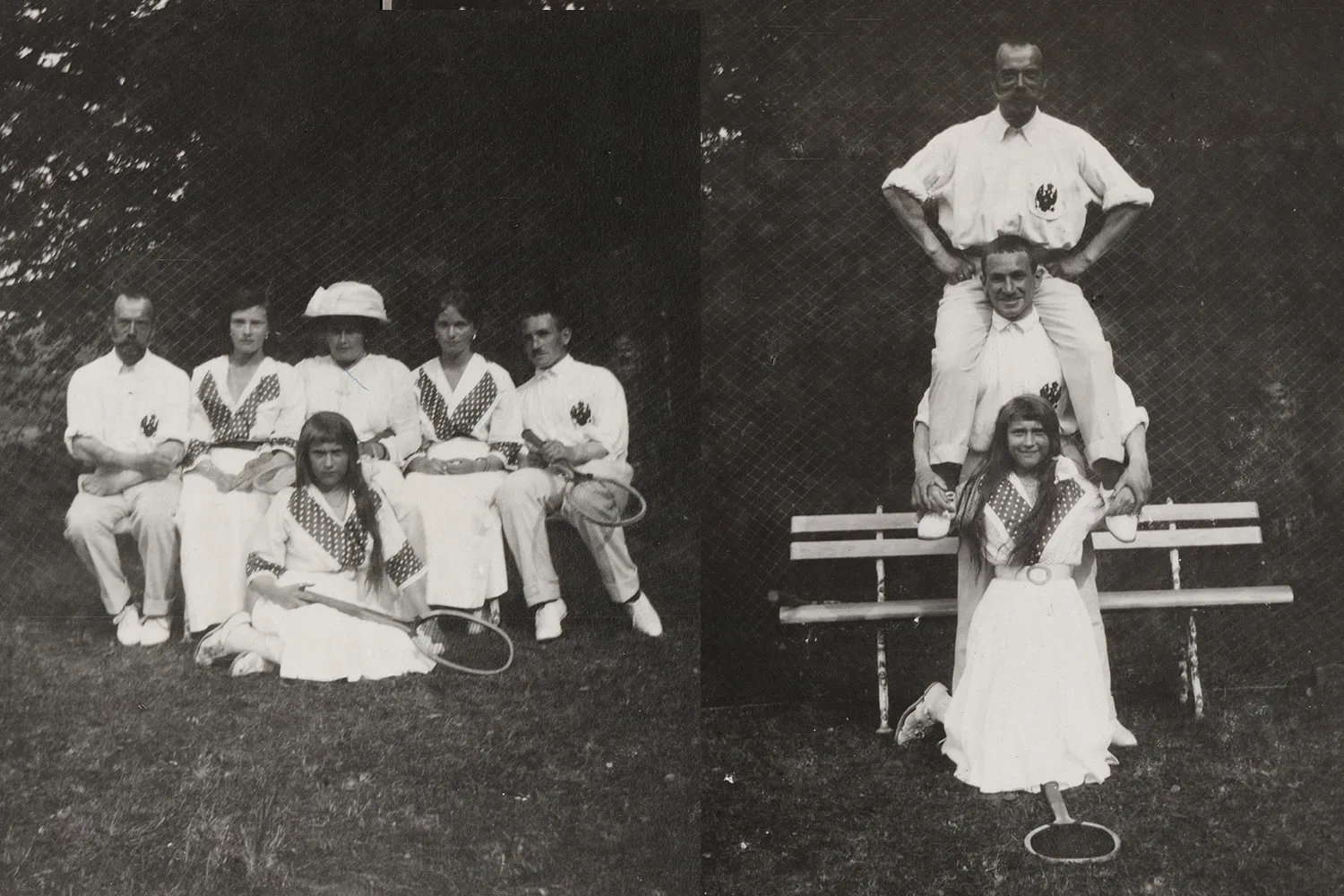
During this quiet era, photography became an obsessive domestic pastime. The children carried Kodak Brownies everywhere, capturing candid moments of boating, bicycling, playing tennis, and goofing around. Anastasia, known for her sharp wit and penchant for practical jokes, famously took early mirror selfies, posed with false teeth while her sister Olga slept, and even grinned as she sneaked puffs from her father’s cigarettes.
While official portraits presented the four girls—collectively known by their acronym, OTMA (Olga, Tatiana, Maria, Anastasia)—as serene, indistinguishable figures in matching white dresses, their private albums revealed vibrant, individual personalities. Olga was dreamy and introspective; Tatiana acted as her mother’s devoted helper; Maria was maternal and conventionally striking; and Anastasia was mercurial and irreverent.
3. War, Revolution, and Abdication (1914–1917)
The outbreak of World War I in 1914 accelerated the collapse of the empire. As Russian military casualties mounted and food shortages plagued the cities, public anger focused on the German-born Alexandra and her reliance on Rasputin. Though a group of Russian elites assassinated Rasputin in late 1916, it was too late to save the regime.
In February 1917, the February Revolution paralyzed Petrograd (formerly St. Petersburg). Stripped of military support and urged by his generals to step down to save the war effort, Nicholas abdicated on March 15, 1917, relinquishing the throne for both himself and his ailing son.
4. Imprisonment and the Final Months (1917–1918)
Following his abdication, the former imperial family was placed under house arrest at Tsarskoye Selo. Shortly after, a severe outbreak of measles swept through the household, causing the grand duchesses to lose their hair. In a poignant, haunting series of June 1917 photographs taken by their tutor Pierre Gilliard, the children posed with shaved heads. Alexandra reportedly wept, remarking that they looked like prisoners heading to execution—a chillingly prophetic statement.
In August 1917, the Provisional Government transferred the family to Tobolsk in remote Siberia for safety. Following the Bolshevik seizure of power in the October Revolution, the prisoners were moved once more in spring 1918 to the Ipatyev House in Yekaterinburg. Cut off from the outside world, their cameras confiscated, and their guards increasingly hostile, the Romanovs spent their final weeks awaiting a fate that arrived in the dark hours of July 16–17, 1918.
Supporting Context & Metrics
The Scope of the Archive: Thousands of surviving photographs and glass-plate negatives are distributed across major repositories, including Yale University’s Beinecke Rare Book & Manuscript Library, the State Archive of the Russian Federation, and private collections.
The Economic Scale: Nicholas II was one of the wealthiest monarchs in human history, exercising absolute sovereignty over a population exceeding 125 million subjects across 8.6 million square miles.
The Fatal Flaw: Hemophilia afflicted roughly one in three male descendants in Queen Victoria’s extended royal network, but Alexei’s severe manifestations became the primary catalyst for the family’s reliance on Rasputin—a dynamic that critically eroded public trust in the Romanov dynasty during wartime.
The Execution Metrics: The midnight execution in Yekaterinburg involved 11 executioners firing simultaneously in a cramped 13-by-16-foot basement. Due to jewel-sewn corsets that deflected initial bullets and bayonet thrusts, the execution lasted an agonizing 20 minutes before all 11 occupants (the imperial family plus four loyal attendants) were successfully killed.
Official Statements and Historical Perspectives
Historian and Romanov biographer Helen Rappaport emphasizes the psychological gravity of the photographic record:
"There’s something so very haunting about [seeing] those four lovely girls whose lives were cut short and that handsome and engaging little boy… The Romanovs really used photography to publicize and promote an image of the family as this beautiful domestic unit. But the private albums humanize a family that fiercely protected their privacy at the cost of intense criticism over their perceived insularity."
Natalia Sidlina, curator of major London museum exhibitions exploring the twilight of the tsars, noted during archival analyses:
"What amazed me was how alike those albums were to any other family albums we have. The Romanovs looked just like any middle-class family, engaging in leisure activities, pasting prints into albums, and hand-coloring their favorite memories."
Prominent biographer Robert K. Massie, in his seminal work Nicholas and Alexandra, summarized the tragic trajectory of the final reign:
"It is one of the supreme ironies of history that the blessed birth of an only son should have proved the mortal blow to the Romanov dynasty… Imperial Russia was toppled by a tiny defect in the body of a little boy, moving too swiftly into an era where events and ideas were changing too radically for an entrenched autocracy to survive."
Future Outlook and Archival Preservation
Today, more than a century after their tragic deaths, the Romanov family continues to command intense global interest. Modern historical research focuses heavily on preserving, digitizing, and contextualizing the fragile primary sources left behind.
Institutions like Yale University and international digital heritage projects are making high-resolution scans of the original Kodak Brownie snapshots and hand-pasted family albums accessible to the public. These efforts ensure that the victims of Yekaterinburg are remembered not merely as flat, tragic martyrs of the 20th-century Russian Revolution, but as real, breathing human beings whose domestic joys, quirks, and vulnerabilities were permanently captured through their own lenses before history swept them away.

/https://tf-cmsv2-smithsonianmag-media.s3.amazonaws.com/filer_public/8d/ad/8dad55dd-6089-4211-a179-dc51f45ad2b5/anastasia-tennis.png)
/https://tf-cmsv2-smithsonianmag-media.s3.amazonaws.com/accounts/headshot/meilan_headshot2.png)
:focal(750x500:751x501)/https://tf-cmsv2-smithsonianmag-media.s3.amazonaws.com/filer_public/8d/ad/8dad55dd-6089-4211-a179-dc51f45ad2b5/anastasia-tennis.png)
/https://tf-cmsv2-smithsonianmag-media.s3.amazonaws.com/filer_public/7f/d1/7fd1ff35-08f9-4b88-a2a5-8093673a2cdf/anastasia_nikolaevna_of_russia_fooling_around_original.jpg)
/https://tf-cmsv2-smithsonianmag-media.s3.amazonaws.com/filer_public/23/18/23186e2a-54a3-495b-a7f5-2aa50bdb453c/inside_anastasia_smoking.jpg)
/https://tf-cmsv2-smithsonianmag-media.s3.amazonaws.com/filer_public/30/bf/30bf0f74-b6f2-4950-839e-c4ba627ad751/romanov_cycling_on_bikes_5_of_10.jpg)
/https://tf-cmsv2-smithsonianmag-media.s3.amazonaws.com/filer_public/80/10/8010618b-b792-4a82-accc-a18190e7632b/anastasia_nikolaevna_romanova_in_a_selfie_1915.png)
/https://tf-cmsv2-smithsonianmag-media.s3.amazonaws.com/filer_public/91/8d/918daa7d-bb79-4982-8eae-1a2f78580529/mirror-selfie.png)
/https://tf-cmsv2-smithsonianmag-media.s3.amazonaws.com/filer_public/07/dc/07dcdb3f-e14f-406f-bd57-6a9ffee17e1c/3840px-family_nicholas_ii_of_russia_ca_1914.jpg)
/https://tf-cmsv2-smithsonianmag-media.s3.amazonaws.com/filer_public/35/0c/350c569a-b87e-4b0e-8f74-cdf74eabac7d/royal_family_group.jpg)
/https://tf-cmsv2-smithsonianmag-media.s3.amazonaws.com/filer_public/bb/c5/bbc55b38-df69-4bb9-af94-2e148612ebab/screenshot_2026-07-15_at_123625pm.png)
/https://tf-cmsv2-smithsonianmag-media.s3.amazonaws.com/filer_public/e9/8c/e98c51fb-f4e3-428d-9519-15783945c5a1/nicholas_ii_and_alexei_in_reval_1908.jpg)
/https://tf-cmsv2-smithsonianmag-media.s3.amazonaws.com/filer_public/f5/64/f564102b-b1d9-4459-866a-b190d4101739/empress_alexandra_fyodorovna_of_russia_and_her_children.jpg)
/https://tf-cmsv2-smithsonianmag-media.s3.amazonaws.com/filer_public/21/aa/21aae4ab-fe2a-4c73-a227-df826e8af206/olgatatianamariaanastasia1916.jpg)
/https://tf-cmsv2-smithsonianmag-media.s3.amazonaws.com/filer_public/7c/f0/7cf0dee6-b8eb-4a92-9dd0-76634fe1fdfb/olgabeachreading.jpg)
/https://tf-cmsv2-smithsonianmag-media.s3.amazonaws.com/filer_public/86/2d/862d7775-4ec5-459c-86b3-5929cb8b48d0/tatianaalexandra.jpg)
/https://tf-cmsv2-smithsonianmag-media.s3.amazonaws.com/filer_public/56/7a/567a553a-3708-4793-867c-5c2cbaf64c0e/maria_nikolaevna_aboard_the_imperial_yacht_polar_star.jpg)
/https://tf-cmsv2-smithsonianmag-media.s3.amazonaws.com/filer_public/9b/79/9b795fe5-de6a-4f55-a583-b51045cd32eb/mariaanastasiamugging.jpg)
/https://tf-cmsv2-smithsonianmag-media.s3.amazonaws.com/filer_public/bb/38/bb387afe-ee95-4efe-acb8-2602345b1dc5/anastasia_romanova_-_gym_at_the_alexander_palace_1913.jpg)
/https://tf-cmsv2-smithsonianmag-media.s3.amazonaws.com/filer_public/98/24/98240e07-a031-4e26-9098-d558295d68ed/screenshot_2026-07-15_at_123910pm.png)




Comments
Facebook App ID not configured. Please add it in the Customizer.