
Executive Overview
The 2026 FIFA World Cup, jointly hosted across North America, was billed as a triumphant convergence of sport and cutting-edge technology. Yet, beneath the veneer of high-definition spectacle and AI-driven innovations lies a more unsettling reality. Among the marquee technological integrations introduced at the tournament—touted by FIFA President Gianni Infantino and Lenovo CEO Yuanqing Yang at CES 2026—was "Referee View," an AI-stabilized, body-worn camera system designed to broadcast the game directly from the official’s point of view (POV).
While ostensibly marketed as a tool for transparency, fan engagement, and referee accountability, Referee View serves a starkly different purpose. Far from democratizing the viewing experience, these body-worn lenses represent the aesthetic and logistical merging of athletic adjudication with modern state surveillance. By examining the structural symmetry between referee body cameras and law enforcement body-worn tech, this investigation reveals how FIFA’s high-tech rollout mirrors a broader cultural shift toward constant observation, sanitized institutional transparency, and the tight corporate management of reality.
Detailed Chronology: A Tournament in the Panopticon
The Group Stage and the Cyborgian Bipod
On June 24, during the final matches of the World Cup’s group stage—a synchronized scheduling format preserved since 1982 to eliminate match-fixing—fans were treated to the ultimate multi-screen panopticon. Watching from a living room equipped with FOX One’s Multiview, viewers bounced from Scotland-Brazil to Morocco-Haiti.
Read Also
The illusion of immersive access was shattered in the 78th minute of the Brazil match. After Vinicius Jr. netted his second goal, a thousand-plus miles away in Dallas, a three-person Video Assistant Referee (VAR) team spotted a minor infraction in the buildup. Referee César Ramos, stationed in Miami, was recommended an on-pitch review.
As Ramos jogged to the sideline, the broadcast transitioned to Referee View. Viewers were subjected to the frantic, AI-stabilized jostle of the referee’s head-mounted rig. The perspective was visceral, yet entirely alien to the traditional grammar of football broadcasting. Ramos’s subsequent decision to wave off the goal showcased the new technological apparatus in action: the referee as a living tripod, a cyborgian vehicle moving lenses across the turf to serve a machine-driven verdict.
The Meadowlands Experience vs. The Broadcast Reality
Days later, attending the Norway-Senegal match at MetLife Stadium in New Jersey offered a contrasting perspective. Outside the venue, the atmospheric weight of the modern security state was palpable. Drones hovered over the purple storm clouds near the American Dream mega mall, while a gauntlet of NYPD, Transit Police, National Guard, NJ State Troopers, and militarized private forces monitored every turnstiles-bound supporter.
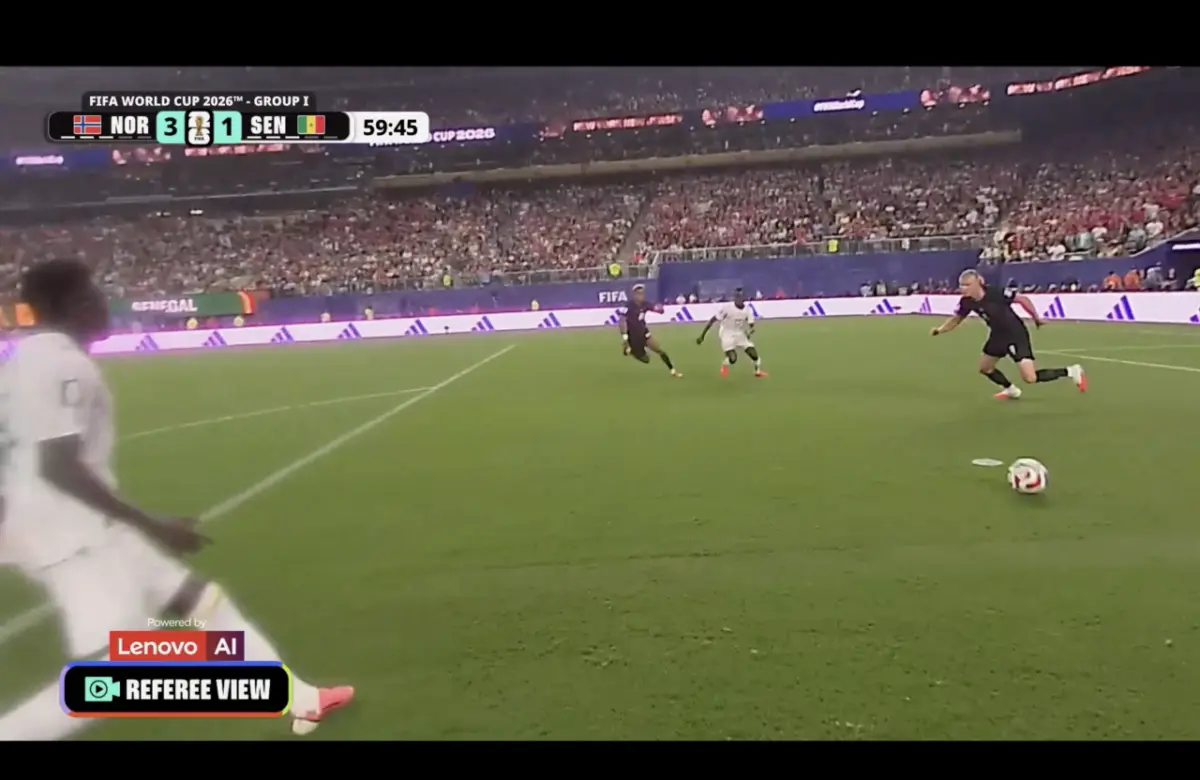
Inside the stadium, the match unfolded with the raw, uninterrupted beauty of live sport. Yet, a subsequent review of the television broadcast revealed how heavily mediated the event was for home audiences. The ref cam, making intermittent appearances—such as capturing a shaky, fish-eye view of a missed shot by Nicolas Jackson or a disjointed angle of Erling Haaland’s buildup play—offered negligible analytical value. Instead of shedding light on disputed plays, the footage was strictly curated. As a matter of explicit FIFA policy, controversial decisions were routinely scrubbed from the Referee View catalog, leaving viewers with a sanitized, motion-sickening loop of administrative compliance.
Supporting Context & Metrics: The Tech Stack and the Surveillance Apparatus
The technical architecture underpinning the 2026 World Cup was unveiled six months prior at CES 2026 in Las Vegas. There, FIFA and Lenovo rolled out a comprehensive suite of digital tools:
- Advanced Team Analytics Platforms: Real-time tactical data systems designed to map spatial dynamics.
- Avatar-Enabled Play Reviews: 3D reconstructions powered by pre-tournament player body scans.
- AI-Stabilized Body Cams: Head-mounted, gyroscopically smoothed recording devices worn by match officials to eliminate the debilitating motion sickness of earlier trials.
The Parallel Economies of State and Sport
The timing of the CES rollout coincided with the fifth anniversary of the January 6 Capitol insurrection—an event heavily documented by police body cameras that continues to sit at the center of contested political narratives. More ominously, the deployment of Referee View occurred against a backdrop of aggressive domestic policing in American cities, where agencies like ICE and federal task forces operate with impunity, frequently backed by selectively edited or withheld body-cam footage.
The corporate symbiosis between Lenovo and law enforcement provides crucial context. While Lenovo does not manufacture the physical cameras—a domain dominated by subsidiaries like Motorola Solutions, another prominent World Cup sponsor—the tech giant dominates the higher echelons of the data supply chain. Lenovo’s enterprise solutions specialize in the cloud-based storage, automated processing, and AI-driven sorting of continuous surveillance data.
| Metric / Feature | Referee Body Cameras | Law Enforcement Body Cameras |
|---|---|---|
| Primary Placement | Head-mounted (ear/temple rigs) | Chest-mounted harness |
| Stated Purpose | Fan engagement, empathy, transparency | Public accountability, evidence gathering |
| Actual Function | Aesthetic novelty, curated institutional control | Expansion of the surveillance state, narrative protection |
| Data Handling | Curated by broadcast producers; controversial feeds suppressed | Managed via cloud infrastructures (e.g., Lenovo backend systems); selectively disclosed |
Official Statements and Institutional Rationale
FIFA’s leadership has vigorously defended the integration of Referee View, framing it as an essential empathetic bridge between the officiating crew and an increasingly hostile public.
"We want the fans to put themselves in the referees’ shoes, to understand how difficult a referee’s job could be."
— Pierluigi Collina, Chairman of FIFA’s Referees Committee
Pierluigi Collina’s sentiment is echoed by corporate partners who position AI integration as a neutral arbiter of truth. Yet, this rhetoric ignores the inherent subjectivities of football officiating. Despite semi-automated offside technology and multi-angle VAR reviews, crucial determinations—such as excessive force, simulation, and tactical fouling—remain deeply interpretive.
When errors occur, such as the blown goal-kick call during the Argentina-Austria match that prompted open frustration from commentators Darren Fletcher and Owen Hargreaves, the ref cam offers no retroactive clarity. FIFA’s strict operational guidelines ensure that the raw, unfiltered confusion of the referee’s immediate perspective is kept away from the public eye whenever a major blunder takes place. Transparency is thus rendered conditional: it is deployed only when it reinforces the authority of the institution, and suppressed when it threatens to expose its fallibility.
Future Outlook: The Normalization of the Panopticon
The 2026 World Cup marks a watershed moment in the technologization of global sport. By embedding body-worn cameras into the official uniform of match referees, FIFA has successfully normalized first-person surveillance aesthetics within the world’s most popular pastime.
As sports broadcasting increasingly mimics the visual grammar of first-person shooter video games and police operational feeds, the boundary between entertainment and surveillance dissolves. The "ref cam" is not an isolated gadget; it is a symptom of a digital culture that demands total capture, where every square inch of public and athletic space must be monitored, cataloged, and monetized.
Looking forward, the implications extend far beyond the pitch. As cloud infrastructure providers like Lenovo continue to merge the evidentiary needs of municipal police forces with the entertainment demands of global sports conglomerates, the mechanisms of control become increasingly seamless. Fans tuning in for the "beautiful game" are subtly inducted into a wider architecture of observation—one where the camera is always rolling, the institutional narrative is pre-scripted, and the viewer is permanently cast as both spectator and subject.





Comments
Facebook App ID not configured. Please add it in the Customizer.