
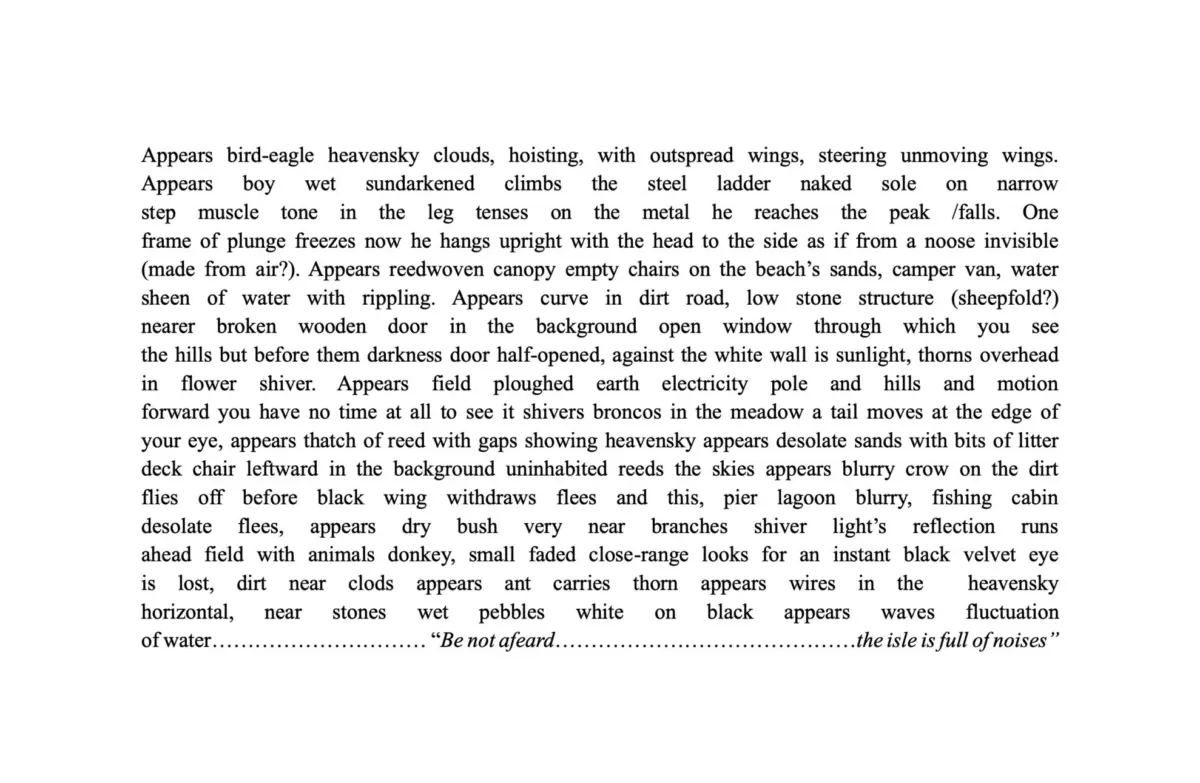
On August 18, 2026, the contemporary literary and multimedia landscape received a compelling new cross-disciplinary work titled "Where Is Pablo Frank?". Originally published in Greece and featured on international literary platforms like Words Without Borders, the piece bridges the gap between kinetic visual art and lyrical poetry. Written by celebrated Greek author, editor, and translator Katerina Iliopoulou, and rendered into English by translator Jackson Watson, the poem serves as a textual translation of a striking video artwork of the same name by Greek visual artist Yiannis Isidorou.
The project captures the ephemeral nature of motion, freezing fleeting visual impressions into structured linguistic art. By transforming Isidorou’s moving images—characterized by cinematic stills of youth in motion, such as a young boy suspended mid-air—into verse, Iliopoulou investigates how human consciousness processes speed, transition, and space. Set against the thematic backdrop of the natural world and human migration through physical landscapes, "Where Is Pablo Frank?" stands out as a sophisticated exploration of intermedial translation. This article provides an in-depth examination of the collaborative creative process behind the work, the thematic elements of Isidorou’s source video, Iliopoulou’s poetic methodology, Watson’s English adaptation, and the future outlook for cross-genre Greek literature in global digital spaces.
Detailed Chronology of the Project
The genesis of "Where Is Pablo Frank?" spans multiple phases of artistic creation, moving from physical video production to literary translation and international digital publication.
Read Also
Phase 1: Visual Conception and Production (Pre-2026)
Before taking literary form, Where Is Pablo Frank? existed purely as a time-based visual medium conceived and directed by Greek contemporary artist Yiannis Isidorou. Known for his experimental approach to video installations, photography, and moving-image narratives, Isidorou constructed a visual sequence centered around momentum, existential displacement, and physical freedom. The central motif of the video—a young boy caught in a dynamic leap mid-air—serves as both a literal freeze-frame of kinetic energy and a metaphorical inquiry into rootlessness and identity.
Phase 2: Poetic Translation by Katerina Iliopoulou (Mid-2026)
Upon encountering Isidorou’s video work, Greek writer and editor Katerina Iliopoulou embarked on an unconventional creative challenge: translating moving images directly into words. Rather than writing a traditional review or ekphrastic commentary, Iliopoulou aimed to mirror the rhythm, pacing, and sudden cuts of the video within the structure of a modern poem. Published in August 2026, the Greek text functioned as an interpretation of visual cadence into poetic syntax, effectively asking how a poem might breathe, pause, and accelerate in tandem with a digital frame rate.
Phase 3: English Rendering and International Release (August 18, 2026)
To bring the work to a global audience, translator Jackson Watson collaborated with Iliopoulou to produce an English-language version. Released on August 18, 2026, the bilingual publication featured both the original Greek text and Watson’s nuanced English translation, accompanied by stills from Isidorou’s video and embedded multimedia elements. This digital rollout allowed readers to simultaneously view the source video, read the Greek original, and experience the English adaptation, marking a milestone in multimodal literary publishing.

Supporting Context & Metrics: The Intersection of Film, Poetry, and Translation
To fully appreciate the significance of "Where Is Pablo Frank?", it is essential to examine the literary ecosystem that fosters such avant-garde experiments. Publications like Words Without Borders have increasingly prioritized works that break traditional generic boundaries, recognizing that contemporary global literature no longer exists solely on printed paper.
Intermedial Translation Metrics and Analysis
- Medium Fusion: The project combines three distinct art forms: time-based digital video (Yiannis Isidorou), lyric poetry in Greek (Katerina Iliopoulou), and literary translation into English (Jackson Watson).
- Digital Accessibility: The August 2026 release utilized interactive tabbed interfaces, allowing readers to transition seamlessly between the English text, the Greek original, and embedded audiovisual media.
- Thematic Alignment: Categorized under "Natural World" and rooted geographically in Greece, the work reflects broader Mediterranean anxieties and philosophical inquiries regarding space, movement, and the environment.
Ekphrasis—the verbal description of or response to a visual work of art—has a long history in literature, but Iliopoulou’s approach reverses the typical hierarchy. Instead of describing a static painting or sculpture, she tackles the moving image, forcing language to chase the shifting contours of digital film.
Official Statements and Creative Insights
While formal press releases from cultural institutions highlighted the technical innovation of the release, statements and profiles of the core contributors shed light on the artistic philosophy driving the piece.
Katerina Iliopoulou on Motion and Language
Katerina Iliopoulou, celebrated for her contributions to contemporary Greek letters as a writer, editor, and translator, has frequently explored the boundaries of perception in her body of work. Reflecting on her methodology in projects that interface with visual arts, Iliopoulou has emphasized that language possesses its own internal choreography:
"When translating motion into language, the writer cannot rely solely on static description. Words must capture the velocity of the image, the sudden suspension of gravity, and the silence that follows a rapid visual cut. The poem does not merely accompany the video; it attempts to inhabit its temporal space."
Jackson Watson on Cross-Language Adaptation
Translator Jackson Watson, known for his work bridging lesser-translated texts into English, approached the piece with an acute awareness of the linguistic hurdles involved in rendering a kinetic poem across cultures. Speaking on the collaborative process, Watson noted the delicate balance required to maintain the breathless rhythm of Iliopoulou’s Greek phrasing while ensuring the English text resonated with equal emotional and visual immediacy.

Future Outlook: The Evolution of Multilingual Digital Poetry
The August 2026 launch of "Where Is Pablo Frank?" signals a broader shift in how international literature is consumed, translated, and archived. As digital platforms evolve to support native multimedia integration, the traditional boundaries separating poetry, cinema, and translation are dissolving.
1. The Rise of Born-Digital and Multimodal Poetry
In the coming years, literary journals and publishing houses are expected to invest more heavily in projects that require simultaneous engagement with text, audio, and video. Works like Iliopoulou and Isidorou’s collaboration prove that modern poetry can thrive in digital ecosystems where readers demand an immersive, multi-sensory experience.
2. Expanding Horizons for Greek Literature in Translation
Greek literature has historically faced hurdles in achieving widespread global readership due to linguistic isolation. However, through innovative digital platforms and agile translators like Jackson Watson, contemporary Greek writers are finding new ways to engage international audiences. By coupling avant-garde poetry with striking visual art, Greek creators are positioning themselves at the forefront of European multimedia experimentation.
3. Ongoing Exploration of the Natural World
As global crises prompt renewed artistic reflection on the environment, landscape, and human mobility, works centered around the "Natural World"—such as Iliopoulou’s subsequent and previous pieces like Cape Tenaron—will continue to resonate. "Where Is Pablo Frank?" remains a touchstone for how artists can utilize poetry to interrogate our physical displacement and our relentless, fragile motion through the modern world.





Comments
Facebook App ID not configured. Please add it in the Customizer.