
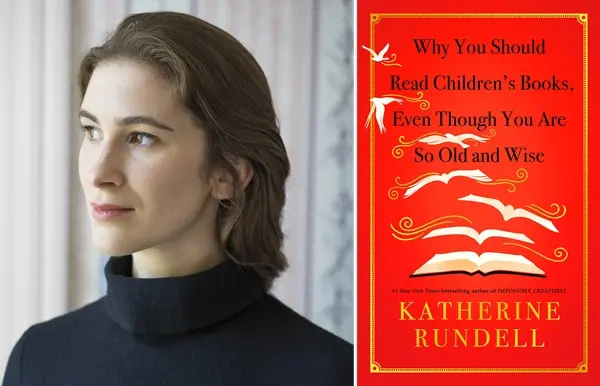
In an era dominated by algorithmic distraction, fast-paced digital media, and the constant demand for adult productivity, acclaimed British author Katherine Rundell issues a passionate, intellectual, and deeply moving manifesto in defense of an overlooked literary ecosystem. Her new essay-length volume, Why You Should Read Children’s Books, Even Though You Are So Old and Wise (published by Knopf on September 1), argues that children’s literature is not merely a training ground for young readers, but a vital, sophisticated art form capable of offering profound meaning, emotional resonance, and intellectual clarity to adults.
Rundell, an esteemed fellow of All Souls College, Oxford, and a celebrated author of both children’s fiction and adult nonfiction, draws upon a decade of immersion in the literary arts to challenge long-standing cultural prejudices. She contends that society routinely underestimates children’s books, viewing them through a condescending lens of simplicity while ignoring the rigorous craftsmanship, emotional distillation, and philosophical depth required to write them successfully.
Simultaneously, Rundell’s creative footprint is expanding across multiple cultural landscapes. Alongside the publication of her new essay, she is adapting Impossible Creatures (Knopf)—the inaugural title in her sweeping middle-grade fantasy series—into a major feature screenplay for Disney. Furthermore, the third installment in the series, The Neverfear, arrives on U.S. shelves on September 1, cementing her status as one of the most prolific and imaginative voices in contemporary literature.
Read Also
In an exclusive, wide-ranging conversation, Rundell opened up to Publishers Weekly about the personal origins of her work, the blurred boundaries between writing for children and adults, her childhood memories of literary starvation in Zimbabwe, and why she famously describes great children’s literature as "literary vodka."
Detailed Chronology: From Academic Halls to Disney Studios
To understand the trajectory of Katherine Rundell’s career is to witness a rare bridging of two worlds: the rarefied, intellectual gravity of Oxford academia and the boundless, incandescent wonder of children’s storytelling.
The Dual Life of an Oxford Fellow
For close to ten years, Rundell has balanced her dual identity as a creator of imaginative fiction for young minds and a serious academic researcher at All Souls College, Oxford. This unique vantage point exposed her to a persistent cultural bias. She observed firsthand how societal perceptions of her intellect shifted dramatically depending on which of her professional hats she wore.
While her academic output and meticulously researched adult biographies—such as Super-Infinite: The Transformations of John Donne—commanded immediate, heavyweight respect, her children’s fiction was occasionally met with patronizing dismissal, as if writing for young people were an entertaining hobby rather than a high-stakes artistic endeavor. This dichotomy served as the intellectual tinder for Why You Should Read Children’s Books, Even Though You Are So Old and Wise.
The Genesis of a Manifesto
Frustrated by the undervaluing of a century’s worth of extraordinary children’s literature, Rundell distilled her frustrations into a sharp, elegant volume. Released on September 1 by Knopf, the book serves as a historical overview and a passionate defense of the genre. It argues that the societal landscapes reflected in classic and contemporary children’s books do not expire when a reader crosses the threshold into adulthood. Instead, they offer enduring ethical frameworks and emotional sanctuaries that mature readers desperately need.
Expanding Empires: Screenplays and Series
As her manifesto makes its way into the hands of readers, Rundell’s creative empire is scaling new heights. Impossible Creatures, the critically acclaimed first book in her middle-grade fantasy series, is currently being adapted into a feature-length screenplay for Disney. This cinematic translation speaks to the universal, visually arresting appeal of her world-building.
Concurrently, the relentless momentum of her publishing schedule continues unabated. September 1 also marks the U.S. release of The Neverfear, the highly anticipated third installment in the Impossible Creatures universe. For Rundell, there is no cognitive dissonance between penning intricate histories of seventeenth-century poets, crafting magical fantasies, and writing cultural critiques; all of her work is bound by a singular, unyielding obsession: the pursuit of truth.
Supporting Context & Metrics: The Anatomy of Literary Cravings
The Zimbabwean Childhood and Literary Starvation
To fully appreciate Rundell’s fierce protection of children’s access to books, one must look back at her formative years. Raised in Zimbabwe—where her father worked for the Department for International Development—Rundell experienced firsthand what it means to be physically and culturally isolated from the literary sustenance she craved.
In her youth, British publishing houses would release new titles by her favorite authors, but months would pass before those volumes crossed oceans and materialized on shelves in Zimbabwe. This delay bred an acute sense of longing. Rundell recalls pleading with her family in England to mail books across continents, equating that yearning directly to the physical desire for sweets.
This metaphor of nutritional craving underpins her philosophy on childhood reading. Just as young people consume food rapidly because they desire an immediate, pleasurable rush of energy, Rundell learned to read with ferocious speed to flood her mind with the physical and emotional sensations of a well-told story. Consequently, she argues that modern educational systems must flood children with a vast, diverse array of reading material. Because children possess unique palates, forcing a uniform curriculum upon them is as futile as attempting to feed every child the exact same meal.
Defining "Literary Vodka"
One of the most striking concepts introduced in Rundell’s new book is her characterization of children’s literature as "literary vodka." In casual discourse, brevity and simplicity are often equated with a lack of depth. Rundell dismantles this fallacy completely.
Rather than viewing children’s books as hollow or missing elements due to their concise, fast-paced nature, she argues that they are masterclasses in distillation. They take the widest, most complex, and most terrifying human emotions—power, loneliness, dread, love, sacrifice, and mortality—and concentrate them until they burn with absolute clarity.
Whether examining E.B. White’s exploration of mortality and friendship in Charlotte’s Web or navigating the existential dread of winter in Tove Jansson’s Moominland Midwinter, children’s books do not shy away from human vulnerability. They ask the ultimate existential questions: Can we change our fate? Can we survive our profoundest isolation? By distilling these overwhelming concepts into accessible, powerful narratives, these books offer an intoxicating form of truth that adults often spend a lifetime trying to relearn.
Official Statements & Insights: In Conversation with Katherine Rundell
In her interview with Publishers Weekly, Rundell elaborated on the philosophical underpinnings of her work, offering deep insights into the creative process, the unity of her writing life, and the enduring power of literature across a lifetime.
On the Undervaluing of Children’s Literature
Discussing the motivation behind her essay, Rundell explained:
"I had probably been publishing children’s fiction for close to a decade by the time I started writing this book, and I had come to believe very passionately that children’s literature as an art is underrated, undersung, and often seen without the full nuance and clarity that it deserves. I knew this in part from experience, both as a children’s writer and as a fellow of All Souls College, Oxford. The ways that people treated me were very different according to which job I told them I did."
She emphasized that the volume is designed as a direct challenge to cultural snobbery:
"The book itself is a small, sharp, distilled argument about how there has been so much absolutely extraordinary work that has been produced in the children’s ecosystem, particularly over the last 100 years, that deserves our cultural attention and critique, and from which we can gain joy and beauty and rich meaning from, even—or especially—in adulthood."
On Blurring the Lines Between Academic Nonfiction and Children’s Fantasy
Addressing whether her creative approach shifts when moving between rigorous biographies like Super-Infinite: The Transformations of John Donne and magical middle-grade fiction, Rundell rejected the idea of a mental gear-shift:
"There isn’t some switch in my head that’s being flicked. They feel like they’re coming from the same place. There are, of course, some differences in approach. I wrote a book called Super-Infinite, which required an enormous amount of fidelity to the truth and to absolute accuracy… But the fundamental properties of writing fiction for children and nonfiction for adults feel very similar to me because, ultimately what you’re asking readers is, ‘Does this matter? Is this true?’ With Super-Infinite, I mean that literally, and with something like a dragon, I mean that emotionally."
On the Inevitability of Human Solitude
Expounding upon her deep affection for Tove Jansson’s Moominland Midwinter, Rundell articulated how children’s literature prepares us for the unvarnished realities of adult life:
"Moominland Midwinter is essentially about the idea that there will be moments where we will have to stride out into the world alone, and our aloneness will be so intense that it will almost overwhelm us. Despair always tracks your heels, and that is part of what it is to be a person. It will be cold and it will be dark and you will be lost—that is inevitable, that is the human heart—and yet in that lostness there will be truth, and there will be things that you can uncover. Maybe you will find an enchanted horse that will come to life. Maybe you will find a friend you didn’t expect to see. Maybe the sun will rise, and as it does, the snow will be flooded red and pink and gold."
Summarizing the timeless elasticity of these texts, she noted:
"You can read a children’s book when you’re six and you can also read it when you’re my age, 38, and you’ll get something different from it."
Future Outlook
As Katherine Rundell looks toward the horizon, her multi-front cultural campaign is poised to leave an indelible mark on both contemporary publishing and cinematic entertainment.
The publication of Why You Should Read Children’s Books, Even Though You Are So Old and Wise arrives at a critical cultural juncture. As adult readers increasingly seek solace, emotional clarity, and imaginative escape from an increasingly fragmented media landscape, Rundell’s manifesto provides a timely roadmap back to the foundational texts of our youth. It invites a re-evaluation of school curricula, literary criticism, and adult reading habits, urging society to embrace the radical joy of children’s literature without shame or irony.
Simultaneously, the development of the Impossible Creatures screenplay for Disney signals a major expansion of her imaginative universes into the visual mainstream. With millions of readers eagerly diving into The Neverfear upon its September 1 release, Rundell’s fictional worlds are cementing themselves as modern classics.
Ultimately, Rundell’s body of work—spanning archival biography, high-fantasy adventure, and cultural critique—stands as a testament to the belief that stories are not mere child’s play. They are vital instruments of survival. Whether through the meticulous historical truth of a 17th-century poet or the emotional truth of a magical dragon, Katherine Rundell continues to remind readers of all ages that the human heart, in all its lostness and wonder, requires profound and beautiful stories to endure.




Comments
Facebook App ID not configured. Please add it in the Customizer.