
Executive Overview
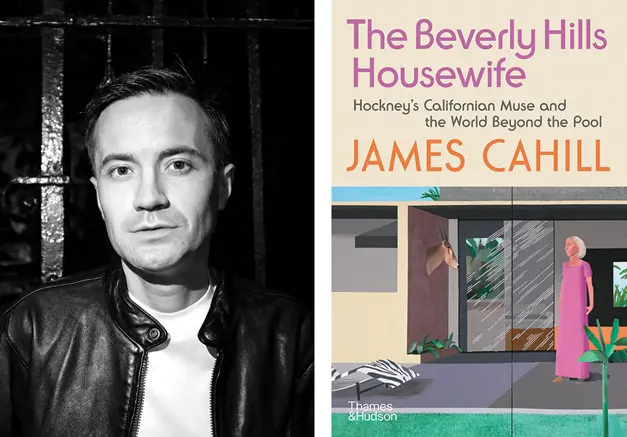
In the canon of modern art, few images capture the psychological and geographical vertigo of mid-century Southern California quite like David Hockney’s 1966 masterpiece, The Beverly Hills Housewife. The canvas features art collector and patron Betty Freeman standing poised, semi-formal, and radiating an enigmatic stillness against a backdrop of hyper-saturated, crystalline light and modernist architecture.
In a new critical assessment featured in his latest book, writer and art critic James Cahill trains an analytical lens on this defining painting. Exploring the intersection of queer aesthetics, geographical displacement, biographical vulnerability, and the mythos of Los Angeles, Cahill unpacks the layers of meaning embedded within Hockney’s brushstrokes.
This enriched feature delves deep into Cahill’s insights, examining how an expatriate British painter and an aspiring Boston-born patron intersected during a formative era in Los Angeles history. Through a rigorously structured journalistic lens, we explore the historical context of the painting, the intimate dynamics of Hockney and Freeman’s friendship, the unique socio-cultural ecosystem of 1960s California, and the enduring legacy of a portrait that launched one of the most iconic bodies of work in contemporary art history.
Read Also
Detailed Chronology: From the English Coast to the Sun-Drenched Pacific
To understand the genesis of The Beverly Hills Housewife, one must first trace the biographical and geographic trajectories of both the artist and his subject. The convergence of David Hockney and Betty Freeman in mid-1960s Los Angeles was not merely a meeting of two creative minds; it was a collision of distinct cultural epochs.
1961–1964: The Expatriation and the Lure of the West
David Hockney first arrived in Los Angeles in 1964, drawn westward by the promise of personal and artistic liberation. Having recently graduated from the Royal College of Art in London, Hockney was seduced by the imagery of American cinema, muscle cars, swimming pools, and an uninhibited queer culture that contrasted sharply with the more restrictive social codes of postwar Britain.
When Hockney looked at Los Angeles, he saw a landscape devoid of the heavy historical baggage that defined European capitals. As Cahill notes, the city was "radically new, different, and uncharted." In Hockney’s eyes, there were no real artistic precedents for representing L.A.—no historical "ghosts" haunting the drafting table. This absence of tradition did not intimidate the young painter; rather, it fueled an immense, almost staggering ambition. Hockney famously remarked that he could be the city’s Piranesi—the eighteenth-century Italian artist renowned for his monumental, atmospheric etchings of architectural spaces. It was an audacious claim for a young British expat, yet one he would systematically fulfill.
1966: The Creation of The Beverly Hills Housewife
By 1966, Hockney had firmly established his foothold in the Southern California art scene. It was during this period that he crossed paths with Betty Freeman, a woman who would become one of the twentieth century’s most influential patrons of contemporary art and new music.
Freeman, who had grown up amidst the rigid social structures of Boston, had relocated to Los Angeles, seeking a reinvention of her own. However, in 1966 and 1967, her life was standing at a precarious crossroads. Despite her innate glamour and sophisticated tastes, Freeman was still trying to find her footing. Her marriage was quietly unravelling, and the grand ambitions she held for her life had yet to materialize.
When Hockney chose her as the subject for what would become The Beverly Hills Housewife, he captured this exact moment of suspension. In the painting, Freeman stands upright, her body slightly angled, poised between her past and an uncertain future. This psychological liminality resonated deeply with Hockney, who was simultaneously navigating his own process of "becoming"—transitioning from a promising young outsider into the master painter who would define the visual lexicon of modern California.
Supporting Context & Metrics: The Sociocultural Ecosystem of 1960s L.A.
The creation of The Beverly Hills Housewife cannot be isolated from the unique socioeconomic and cultural conditions of Los Angeles during the turbulent decade of the 1960s. To grasp the full weight of Cahill’s critique, one must examine the metrics of the era’s art world, the architecture of the West Coast, and the dynamics of queer patronage.
The Horizontal City and the Micro-Art Scene
Unlike the densely packed, vertically oriented metropolises of the American East Coast or Europe—where social hierarchies were physically and metaphorically mapped onto skyscrapers and centuries-old institutions—Los Angeles offered a radically horizontal landscape.
- The Scale of the Scene: In the mid-1960s, the contemporary art circle in Los Angeles was remarkably small and intimate. Gallery openings, gatherings in Malibu beach houses, and soirées in Beverly Hills brought together a tight-knit community of painters, sculptors, composers, and patrons.
- Fluidity of Interaction: Because the contemporary art infrastructure was still relatively unformed, individuals moved between disciplines and social strata with relative ease. There were fewer rigid institutional gatekeepers compared to Boston or New York.
- Architectural Openness: The modernist glass-and-steel homes that proliferated across the hillsides fostered an aesthetic of transparency and exposure. As one of Cahill’s interviewees observed, "everything in L.A. tends towards the horizontal." This spatial openness directly influenced Hockney’s compositional style, encouraging wide frames, crisp horizontal sightlines, and flat planes of saturated color.
The Psychology of Queer Patronage
Cahill places Hockney’s work within a historical lineage of queer artists—from the nineteenth century to the mid-twentieth century—who maintained a profound fascination with glamorous, assured women. However, he points out a crucial nuance in Hockney’s approach.
While historical precedents often involved famous divas, society figures, or muses kept at an aesthetic distance, Hockney’s relationship with Betty Freeman was intensely personal. Freeman was not yet a household name in the global art world; she was a friend navigating personal turbulence.
This dynamic highlights a fascinating psychological pattern: the tendency of younger gay men to seek out older, poised, and impeccably styled women as mirrors for their own identities. In the case of Hockney and Freeman, this dynamic was symbiotic. Freeman found in Hockney an artist who validated her nascent identity as a cultural patron, while Hockney found in Freeman a kindred spirit whose quiet, inscrutable glamour mirrored his own artistic aspirations as a charmed outsider.
Official Statements & Critical Perspectives
In discussions surrounding his critical framework for The Beverly Hills Housewife, James Cahill expands upon the broader implications of viewing Los Angeles through an expatriate’s eyes, as well as the enduring nature of portraiture.
On the Illusion of L.A. Realism and the "Charmed Outsider"
Cahill cautions contemporary writers and historians against falling into the trap of over-romanticizing 1960s Los Angeles. Yet, he maintains that the city’s early mythology was uniquely potent for artists who arrived without preconceived notions.
"The force of those early L.A. pictures has to do with Hockney being a charmed outsider," Cahill explains. "The city was radically new, different, and uncharted. In Hockney’s view, there were no real precedents for representations of L.A. in art and, as he put it, no ghosts."
This lack of historical ghosts allowed Hockney to invent a visual language that felt simultaneously hyper-real and theatrical. The blinding Californian sun did not wash out his subjects; rather, it rendered them with an iconic, almost sculptural clarity.
On the Genesis of a Portraiture Series
Cahily emphasizes that Beverly Hills Housewife was not merely an isolated commission; it served as the conceptual and historical catalyst for an entire, highly influential series of large-scale double and single portraits that would cement Hockney’s international reputation.
"There are also parallels between his work and the longer English tradition of portraiture, which he was very conscious of even at his most Californian," Cahill notes. "Beverly Hills Housewife originated his series of portraits."
By anchoring his hyper-modern Californian subjects within the compositional rigor of traditional European portraiture—drawing subconscious cues from centuries of British and continental masters—Hockney created a tension between local vernacular and universal art history.
Future Outlook: The Enduring Legacy of Hockney’s Vision
As we look toward the future of art criticism and curation, the reassessment of mid-century works like The Beverly Hills Housewife offers vital lessons on how we interpret geography, identity, and patronage.
Re-Evaluating Modernism Through a Biographical Lens
For decades, mainstream art history tended to view Hockney’s L.A. paintings as sun-bleached pop-art snapshots—effervescent celebrations of leisure, swimming pools, and palm trees. Critics like James Cahill are instrumental in shifting this narrative toward a deeper psychological and sociological reading. By examining the anxieties, personal transitions, and underlying vulnerabilities of subjects like Betty Freeman, modern criticism rescues these canvases from the realm of superficial decoration and restores them to their rightful place as profound psychological documents.
The Persistence of the L.A. Mythos
Los Angeles remains a global capital of imagination, reinvention, and media production, yet the physical and cultural landscape that enchanted Hockney in 1964 has undergone seismic transformations. Real estate booms, urban density, and shifting economic realities have altered the horizontal openness that once allowed intimate, cross-disciplinary friendships to flourish within a small artistic circle.
Nevertheless, the enduring appeal of The Beverly Hills Housewife suggests that the idea of Los Angeles as a place of radical self-invention continues to resonate. It stands as a monument to a fleeting historical moment when an English painter and an American collector could look out across the sun-drenched canyons of Beverly Hills and collectively decide to rewrite the rules of modern art.
As publishers, critics, and scholars continue to unpack the multifaceted layers of twentieth-century visual culture, works like Cahill’s analysis ensure that the brilliant, crystalline light of Hockney’s California will continue to illuminate new generations of art lovers, collectors, and seekers.
A version of this article originally appeared in the August 31, 2026 issue of Publishers Weekly.




Comments
Facebook App ID not configured. Please add it in the Customizer.