
The intersection of modern international sports, geopolitics, and deep-seated cultural mythology rarely manifests with as much raw, unvarnished intensity as it does within the ecosystem of the FIFA World Cup. At the center of this year’s global tournament stood the Argentine national football team—a squad burdened not merely by the standard weight of athletic expectations, but by a sprawling tapestry of historical grievances, nationalist zeal, and the towering specter of soccer sainthood.
From the arcane locker-room chants invoking the 1994 expulsion of Diego Maradona to the lingering phantom of the 1982 Falklands (Malvinas) War, Argentina’s campaign was less a traditional athletic tournament and more a theatrical crusade. Yet, this phenomenon is far from isolated to Buenos Aires. Across the globe, the modern sports fan has evolved from a passive observer into an active co-creator of national narratives, converting athletic stadiums into arenas of quasi-religious devotion and ideological proxy wars.
This deep dive explores the mechanics of international fandom, examining how historical trauma, geopolitical conflicts, refereeing controversies, and the sheer psychological weight of the quadrennial tournament converge. By analyzing the structural trajectory of the tournament—from group-stage euphoria to the bitter, combative final against Spain—we dissect the fragile boundary where healthy sporting passion bleeds into systemic societal polarization.
Read Also
Detailed Chronology: The Anatomy of a Grievance-Driven Tournament
The Group Stages: The Blooming of Infinite Possibilities
The tournament opened with a familiar global spectacle. Stadia teemed with painted faces, whimsical national costumes, and high-definition television broadcasts engineered to capture the emotional highs and lows of the human condition. From purposing-lipped Cabo Verdean supporters to weeping children bearing the colors of early-exit minnows, the early fixtures established a charismatic economy where emotional investment was traded as a form of currency.
For the minnows and heavyweights alike, the group stages represented a brief window of absolute openness. Historic blowouts—such as Germany’s staggering 7–1 rout—coexisted with shock draws, allowing millions of mathematical and emotional possibilities to bloom simultaneously. Fans worked tirelessly to nudge their teams forward through sheer ritualistic willpower, operating under the comforting illusion that collective caring could bend physical reality on the pitch.
The Knockouts and Semifinals: History as a Weapon
As the tournament narrowed through the elimination rounds, the psychological profile of the fans and players shifted from hopeful optimism to punitive historicism.
In the high-stakes semifinals, tactical approaches frequently dissolved into ideological warfare. France’s "great-man" theory of individual brilliance crashed against Spain’s rigorous positional collective. Meanwhile, the other bracket featured Argentina locked in a brawling, survivalist clash against an English side whose tactical posture relied less on fluid attacking play and more on a stubborn, rear-guard performance reminiscent of historical national sieges.
For Argentina, the path to the final was soundtracked by their viral locker-room anthem:
"Thirty-two years later, Scaloni will avenge / The Cup stolen from number ten! . . . For Las Malvinas! / For El Diego! / For the last one with Leo!"
Investigating these lyrics reveals a complex web of historical revisionism. The reference to "thirty-two years later" points to 1994 and Diego Maradona’s infamous expulsion from the North American World Cup after testing positive for ephedrine. While the song frames this as a malicious theft, it glosses over the reality that Maradona’s peak had already passed following a 1991 cocaine ban. Nevertheless, historical accuracy is secondary to the functional logic of the fan: any grievance will do if it fuels the righteous machinery of pursuit.
The Final: Spain vs. Argentina and the Collapse of Excess
The ultimate collision arrived in the final match between Spain and Argentina. Spain deployed an immaculate, geometric possession game, anchored by Rodri’s staggering 101 completed passes. Argentina, conversely, fielded an XI heavily overmotivated by the ghosts of Maradona, Messi, and the Malvinas.
Reflecting Lionel Messi’s pre-match plea to his teammates—"Estemos tranquilos, muchachos… Olvidémonos de todos, solo juguemos" ("Let’s stay calm, boys… Let’s forget everything, just play")—the squad found it impossible to actually shed the apocalyptic import heaped upon their shoulders. Unable to match Spain technically, Argentina leaned into a combative, antagonistic state of play. By the 90th minute, Argentina had accumulated more attempts to have Spanish players red-carded on technicalities (one) than actual shots on target (zero).
Ultimately, Spain secured a 1–0 victory in extra time, cementing one of the most one-sided scorelines in a major final. As the final whistle blew, the pent-up tensions erupted into minor physical altercations on the pitch, perfectly encapsulating the devastating cost of a tournament designed to compress four years of national yearning into ninety minutes of fragility.
Supporting Context & Metrics: The Geopolitics of Fandom
To understand the fervor of the Argentine supporters—and the deep-seated animosities held by neutral observers—one must examine the structural inequalities of global football and the historical backdrop of the Falklands/Malvinas conflict.
The Historical Echo of March–June 1982
The geopolitical ghost haunting modern matches between the United Kingdom and Argentina traces back to the Falklands War of 1982. Triggered by a scrap-hauling crew raising the Argentine flag on South Georgia Island and subsequently escalated by an unpopular right-wing military junta seeking to manufacture nationalist unity, the conflict claimed the lives of at least 907 people.
| Conflict Metric | Data / Detail |
|---|---|
| Duration | March – June 1982 (74 days) |
| Trigger Event | Scrap-hauling crew raises Argentine flag on South Georgia Island; subsequent junta invasion. |
| Key Naval Casualties | Argentine cruiser General Belgrano (sunk by UK submarine); British destroyer Sheffield (sunk by Argentine missile). |
| Total Fatalities | At least 907 lives lost (predominantly Argentine military personnel). |
| Geopolitical Aftermath | Resurgence of British nationalism under Margaret Thatcher ("Put the Great back into Britain"); collapse of the Argentine military junta leading to democratic elections in 1983. |
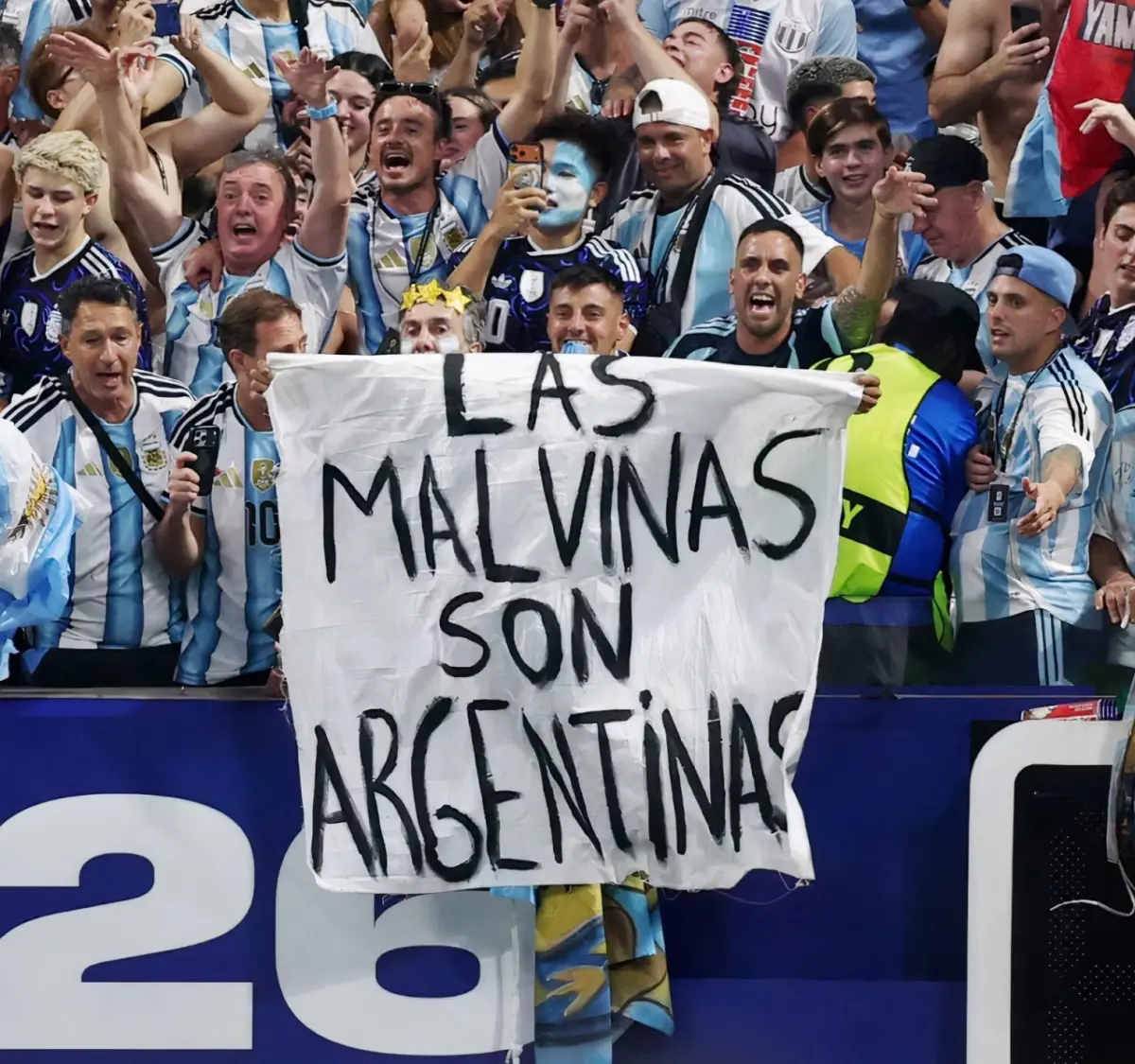
For the Argentine junta, the war was an exercise in narrative-building—an attempt to claim territory held by the UK since 1833 to distract from domestic economic failures and human rights abuses. Decades later, this militaristic posturing has been safely metabolized into athletic folklore, transforming geopolitical tragedy into terrace chants and banner displays like Las Malvinas son Argentinas.
The Etymology and Evolution of the "Fan"
The word fan derives from the Latin fanaticus, originating from fanum (shrine or temple). Eighteenth-century lexicographer Samuel Johnson defined a fanatick as "an enthusiast; a man mad with wild notions of religion."
When the term was first applied to baseball spectators in 1850s America, it carried this direct theological weight. Today, modern fan-studies scholars emphasize that fandom is not merely a passive psychological preference, but an active, co-creative artisanal practice. As demonstrated during the World Cup—where towns like Lawrence, Kansas, enthusiastically adopted the Algerian national team staying at their local hotel—fans construct entire parallel economies of ritual, costume, and shared suffering.
Official Statements & Public Reactions
The cultural collision of the tournament drew sharp commentary from players, analysts, and cultural observers alike, highlighting the tension between sporting integrity and tribalist excess.
-
Lionel Messi, Argentina Captain (Pre-Final Address):
"Estemos tranquilos, muchachos. Olvidémonos de todos, solo juguemos."
(Let’s stay calm, boys. Let’s forget everything, just play.)
Context: An acknowledgment of the crushing, apocalyptic weight of national expectation placed upon the squad prior to the ultimate fixture against Spain. -
Barbara Paredes, Sister of Argentine Midfielder Leandro Paredes:
"Getting this far and beating England meant everything to us. We might not have the fourth star, but we have the Falklands for ourselves."
Context: Speaking to reporters following the tense semifinal victory, illustrating the seamless blending of athletic achievement and geopolitical symbolism unique to the Argentine sporting identity. -
Margaret Thatcher, British Prime Minister (June 1982, post-Falklands conflict):
"Today has put the Great back into Britain."
Context: A reflection of how political leaders historically leverage military and athletic nationalism to consolidate domestic power.
Future Outlook: The Containment of Modern Tribalism
As the dust settles on another quadrennial cycle of international football, the long-term implications of hyper-fandom merit serious sociological inquiry.
The tournament functioned as a high-pressure quarantine container—a "rubber room" where societal antipathies, historical resentments, and tribal loathing could be safely bled out through chants, internet memes, and symbolic match-day aggressions. For the vast majority of spectators, the stadium serves this exact purpose: a harmless outlet for irrational, high-intensity passions that would otherwise prove destructive in civil society.
However, the primary modern hazard lies in the failure of the container. In an era marked by deep political and cultural polarization, the behavioral modes of sports fandom—characterized by retroactive prophecy, moralistic punitiveness, tribal insularity, and the absolute rejection of nuance—are no longer safely siphoned off into athletic arenas. Instead, they are increasingly hemorrhaging into art, gender discourse, and mainstream political life.
If the World Cup teaches us anything, it is that human beings possess an insatiable appetite for meaning-making under constraints. Whether through the tragicomic poetry of an aging Lionel Messi leading a cynical, overmotivated squad, or the desperate flag-waving of a neutral observer hoping to see their personal enemies suffer symbolically, fandom remains an ineradicable facet of modern existence. The challenge for the future is ensuring that our collective need for narrative, belonging, and tribal victory remains safely contained within the white lines of the pitch, rather than consuming the world beyond it.





Comments
Facebook App ID not configured. Please add it in the Customizer.