
Executive Overview
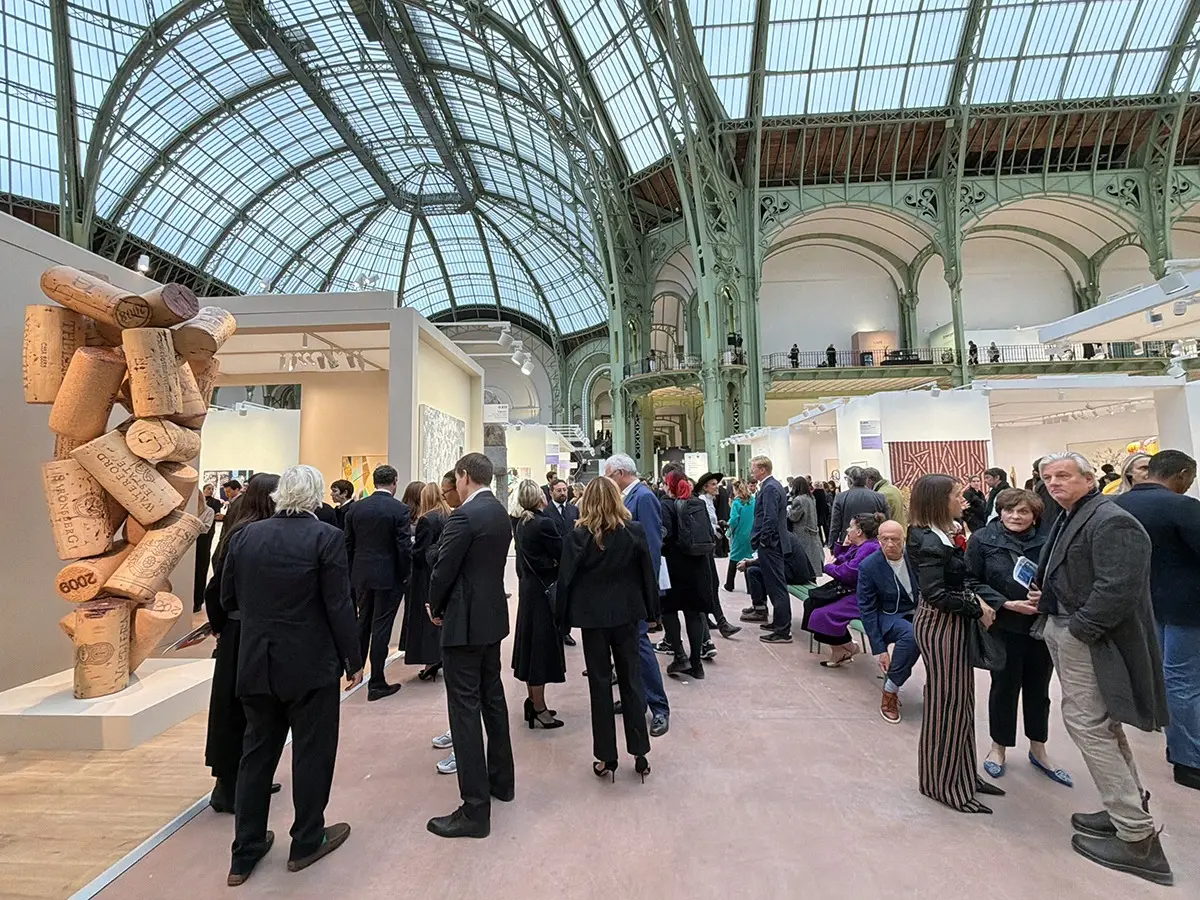
Despite the physical remnants of weekend protests casting a shadow across several of Paris’s historic arrondissements, the international art world marched forward with unyielding momentum as Art Basel Paris 2026 commenced. Kicking off with the highly anticipated Avant Première ultra-VIP preview inside the architectural marvel of the Grand Palais, this year’s iteration of the fair proved that the global market’s appetite for premier blue-chip and museum-grade art remains thoroughly insatiable.
While initial observations noted a slightly more measured cadence—marked by a shorter opening queue compared to the explosive debut of the Avant Première initiative the previous year—this restraint quickly translated into a streamlined, highly focused buying environment. Aisles were comfortably navigable rather than gridlocked, allowing elite international collectors, museum directors, and institutional curators to engage deeply with galleries. Concerns that ongoing domestic disruptions might deter high-net-worth travelers ultimately proved unfounded. A formidable contingent of American collectors, major European buyers, and prominent institutional leaders descended upon the French capital in full force.
The overarching narrative of the fair’s opening hours was one of deliberate refinement. Galleries successfully curated tighter, more rigorous presentations, catering to a sophisticated clientele that demands transparency, deep historical context, and flawless provenance. As major international dealers reported brisk, high-value transactions—ranging from eight-figure masterworks to strategic mid-market placements—Art Basel Paris reaffirmed its status as a cornerstone of the global art market calendar, even as it contended with the unique distractions and vibrant competing attractions of the City of Light.
Read Also
Detailed Chronology of the Avant Première Preview
Tuesday Afternoon: The Doors Open at the Grand Palais
At precisely 3:00 p.m. on Tuesday, the Grand Palais opened its grand doors for the exclusive Avant Première preview, marking the official opening salvo of Art Basel Paris 2026. Unlike the chaotic, elbow-to-elbow rushes that historically characterized mega-fair debuts, the entry sequence was notably civilized. A modest queue formed roughly ten minutes prior to opening—a visual indicator that fair organizers and participating galleries had meticulously pruned their ultra-VIP guest lists.
Inside, the spatial choreography paid immediate dividends. The booths were brimming with serious, capital-ready collectors who wasted little time in initiating serious dialogues. Dealers remarked almost universally on the "good energy" permeating the historic nave of the Grand Palais, noting that the shortened timeline of the Avant Première forced a high-octane pace of decision-making that contrasted sharply with the more leisurely strolls typical of traditional public fair days.

Rapid-Fire Transactions and Major Early Sales
Because the Avant Première operates on an accelerated timeline, participating galleries adapted by closing transactions with remarkable velocity.
- Templon Gallery: Just over an hour into the event, Paris-based dealer Mathieu Templon reported a strong start, highlighting heavy demand for artist Bilal Hamdad. The gallery secured the sale of Hamdad’s L’envers du soir (2026) for €65,000, setting a confident tone ahead of the artist’s hotly anticipated solo exhibition slated for March.
- Thaddaeus Ropac: Ropac hit the ground running with an impressive ledger of 15 sales during the preview hours. Notable movements included four Picasso works dating from 1906 to 1938 (sold for undisclosed sums), a 1953 mixed-media Lucio Fontana for €1.8 million, and a 2019 Georg Baselitz painting fetching €800,000.
- Hauser & Wirth: In what quickly became one of the most talked-about sequences of the afternoon, Hauser & Wirth executed a staggering string of high-value placements. Among them was an unexpected, late-addition masterpiece: Gerhard Richter’s 1965 Rokokotisch (Rococo Table), which commanded a price in the vicinity of $10 million. The gallery also parted with Georg Baselitz’s 1965 canvas Der Hirte (The Shepherd) for approximately $10 million, George Condo’s Woman with Designer Shirt (2026) for $2.9 million, a 1961 Lucio Fontana Concetto spaziale for €1.7 million ($1.9 million), Philip Guston’s Untitled (1969) for $1.5 million, and Alexander Calder’s Four Dots and Brass Tail (c. 1953) just shy of the $1 million mark.
- Pace Di Donna Schrader: Marking what is widely believed to be the highest-priced single work at the fair, the gallery unveiled Amedeo Modigliani’s striking 1917 reclining nude, Nu étendu (Lolotte), valued in excess of $100 million. Emmanuel Di Donna noted that while a canvas of this historical magnitude requires a protracted negotiation period, the surrounding booth activity resembled "drinking from a fire hose."
- Gagosian & White Cube: Gagosian confirmed the eight-figure sale of a 1987 Willem de Kooning alongside a notable Peter Doig painting. Meanwhile, White Cube logged an impressive 16 sales, anchored by two Julie Mehretu paintings—dating from 2001 and 2018 respectively—each commanding $7.85 million. White Cube also moved historical works on paper, including a Picasso (€150,000) and a Léger (€65,000).
- Gladstone & David Kordansky: Gladstone reported strong figures, including a Victor Man painting for $1.3 million and two Wangechi Mutu collage works at $325,000 each. David Kordansky Gallery saw pre-fair holds convert into firm sales, highlighted by a rare Sam Gilliam hard-edge abstraction, Mycenaean Ode (1965), which changed hands for $300,000.
Supporting Context & Metrics: The Market Climate and Attendance
Robust Institutional and Collector Turnout
Despite widespread media reports detailing transit disruptions and weekend protests across the French capital, institutional heavyweights and premier private collectors arrived in droves. Navigating the floor of the Grand Palais revealed a dense concentration of international cultural leadership.
Among the Top 200 Collectors spotted surveying the booths were:
- Allison Berg
- Glenn Fuhrman
- Pamela Joyner
- Nancy A. Nasher
- Bob Clark
- Jason and Michelle Rubell
- Anne-Cecilie Speyer
- Jessica Seinfeld
- Adam Lindemann
The institutional presence was equally formidable, featuring museum directors and chief curators such as Michael Govan (LACMA), Massimiliano Gioni (New Museum), Ruba Katrib (MoMA PS1), Giampaolo Bianconi (Art Institute of Chicago), and Max Hollein alongside David Breslin of the Metropolitan Museum of Art—the latter of whom spearheaded a massive trustee delegation in Paris for the week. Hollywood figures Katie Holmes and Natalie Portman were also observed taking in the offerings.
The London-Versus-Paris Dynamic
Coming on the heels of Frieze’s traditional October run in London, Art Basel Paris 2026 fueled ongoing industry debates regarding the geopolitical and commercial supremacy of Europe’s rival art capitals. Collector Will Paley offered a pragmatic perspective on the ecosystem, describing the two events as "complementary."

"Frieze is primarily for young galleries, young artists, and young collectors with a more adventurous tone," Paley observed, "while Art Basel Paris has a higher price point."
Official Statements and Industry Insights
The complexities of staging a high-stakes commercial fair within a sprawling, culturally rich metropolis were a primary talking point among elite gallerists. While the influx of top-tier talent provides an unmatched client base, Paris presents distinct logistical and psychological distractions.
- Marc Payot (President, Hauser & Wirth): Highlighting the tension between fair commerce and urban allure, Payot remarked, "The strength of this fair is the top-tier attendance. However, the problematic side is that you get distracted by the city. People come here to see a thousand things." He further contextualized the changing temperament of contemporary buyers, noting that while transaction speeds at fairs still outpace traditional gallery models, the overall velocity of the market has cooled compared to the hyper-inflated climate of five years ago. "It’s definitely a slower pace… but great things do find great homes."
- Thaddaeus Ropac: Echoing Payot’s sentiments, Ropac observed that collectors exhibit a unique decisiveness in Paris precisely because the fair must compete with a multitude of museum exhibitions, gallery openings, and high-end retail opportunities. "Collectors make decisions fast in Paris," Ropac noted, adding that while some clients prefer to bypass the crush of official VIP hours in favor of citywide cultural programming, the demand for blue-chip inventory remains robust enough to justify bringing historically significant, high-value material normally reserved for Art Basel’s flagship Swiss outing.
- Xavier Hufkens: Brussels-based dealer Xavier Hufkens reported ten successful transactions, led by a Charline von Heyl painting at $475,000. Reflecting on the juxtaposition of urban unrest and cultural celebration, Hufkens remarked via email: "Despite a rather turbulent weekend, we’ve felt a genuine enthusiasm for art from the very start of the fair. There’s something about Paris: its contradictions, its restless energy, its ability to surprise you at every turn. Fluctuat nec mergitur, as the city’s motto goes. It feels particularly fitting this week."
- Nicolas Nahab (Cofounder, NG Partners): Offering an analytical macro-perspective, art adviser Nicolas Nahab addressed the underlying behavioral shifts among collectors navigating an ongoing "period of adjustment" in the broader art market. According to Nahab, widespread market corrections and pricing skepticism have forced a fundamental shift in buyer psychology. "Collectors today don’t trust prices like they used to, and don’t take them at face value," Nahab explained. "This lack of trust makes them doubt and interrogate information given to them. They need reassurance, research, and a global understanding of an artist’s practice and market before making a decision, which is why the decision-making is so slow. If trust is there, then the decision is easy for collectors."
Future Outlook: Collaboration, Adaptation, and Market Evolution
As the art market continues to recalibrate in response to economic caution and heightened buyer scrutiny, Art Basel Paris 2026 has illuminated clear structural trends that will likely define the trajectory of international art fairs for the foreseeable future.
The Rise of the Shared Booth Model
One of the most notable logistical evolutions at this year’s fair was the proliferation of shared booths—reaching a record 12 collaborative presentations representing 24 distinct international galleries. A prime example unfolded on the fair’s second floor, where Vienna-based Layr joined forces with Berlin and Munich-based Kraupa-Tuskany Zeidler.
The collaborative booth successfully integrated historic and contemporary works, pairing Franz West’s provocative 1983/1984 Passstück (prosthetic sculptures designed to alter human movement) with Anna Uddenberg’s contemporary 2026 installation White Noise (Soft Skills), which features a faceless mannequin contorted by futuristic office furniture.

Amadeo Kraupa-Tuskany emphasized the strategic advantage of these joint ventures, noting that they successfully placed pivotal works into prominent European collections. Emanuel Layr underscored that the cooperative model successfully bridged European and American collector bases.
"Something that really matters to us is staying excited ourselves, but also exciting other people, and asking new questions," Layr stated. "Now you have to be super open about how you operate—how you present yourself, and how you join forces."
Conclusion: A Transformed Marketplace
Art Basel Paris 2026 has proven that despite macroeconomic headwinds, civil disruptions, and shifting collector psyches, the structural appetite for masterworks and rigorous contemporary curation remains resilient. By embracing leaner presentation formats, fostering creative gallery collaborations, and leaning into the unparalleled cultural gravity of the French capital, the fair has successfully adapted to a more mature, discerning market era. As the week unfolds beyond the Avant Première, the prevailing sentiment among dealers and collectors alike is one of cautious optimism—a testament to the enduring truth of Paris’s historic motto: Fluctuat nec mergitur (Tossed by the waves, but not sunk).

Comments
Facebook App ID not configured. Please add it in the Customizer.