
Executive Overview
The debate surrounding the monumental reshaping of the nation’s capital reached a critical juncture on September 29, when the American Institute of Architects (AIA) dispatched a scathing formal letter to Jaime Loichinger, Director of the Advisory Council on Historic Preservation (ACHP). The correspondence serves as a blistering indictment of the federal agency’s decision to effectively abdicate its statutory oversight role regarding President Donald Trump’s controversial 250-foot-tall triumphal arch project.
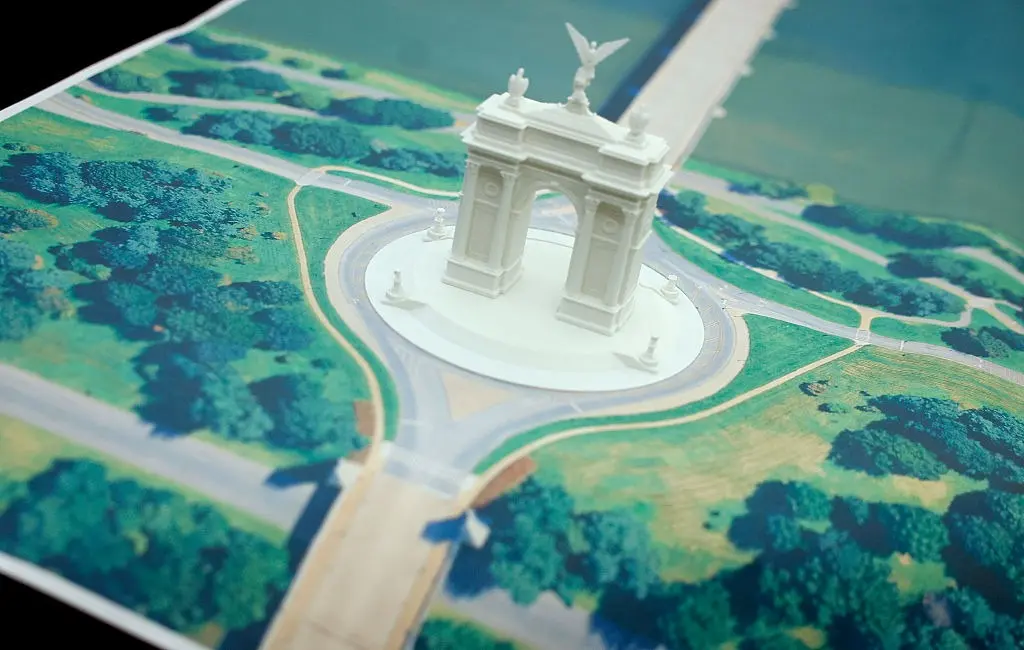
The proposed monolithic structure, slated for Memorial Circle directly adjacent to the hallowed grounds of Arlington National Cemetery, has triggered an unprecedented clash between executive ambitions, historic preservation mandates, and the design community. At the heart of the AIA’s grievance is the ACHP’s abrupt September 24 choice to bypass Section 106 of the National Historic Preservation Act (NHPA)—a foundational statutory mechanism designed to protect the nation’s irreplaceable historic fabric from unchecked federal undertakings. By sidestepping this rigorous review process, the ACHP has chosen instead to engage in closed-door communications with U.S. Secretary of the Interior Doug Burgum, a prominent administration ally.
The AIA’s intervention elevates the dispute from a local zoning and design disagreement to a national constitutional and procedural crisis. As architectural organizations, military veterans, and historic preservationists join forces to halt a project they argue will permanently disfigure the monumental core of Washington, D.C., the foundational laws protecting America’s historic landscape are being severely tested. This comprehensive report explores the timeline of the controversy, the mechanics of the bypassed Section 106 process, the spatial and aesthetic arguments raised by the architectural community, and the broader implications for the future of federal infrastructure and monumental design.
Read Also
Detailed Chronology of a Controversial Monument
The path from a casual holiday remark to a full-scale legal and architectural battle has been swift, contentious, and marked by institutional maneuvering.
December: The Genesis of the Arch
The concept of a grand triumphal arch first entered the public consciousness during a White House holiday party in December. President Trump articulated his vision for a massive, classical monument intended to crown the capital’s landscape. Initially met by many observers as rhetorical hyperbole, the proposal quickly transitioned from conceptual aspiration to an aggressive administrative priority. By early spring, federal agencies were instructed to fast-track feasibility studies, site selections, and design approvals, compressing a process that typically spans years into a matter of months.
May: Commission of Fine Arts Approval
Despite mounting warnings from urban planners, architects, and preservation groups, the Commission of Fine Arts (CFA) voted to approve the plan in May. The approval process was characterized by critics as rushed and impervious to public input. The CFA’s green light cleared the path for the National Park Service (NPS) to move forward with preparations, establishing Memorial Circle—a critical traffic and visual nexus connecting the Lincoln Memorial, Arlington Memorial Bridge, and Arlington National Cemetery—as the definitive site.
Late August to Mid-September: Resistance and Legal Action
As details of the 250-foot-tall structure emerged, public outcry intensified. Military veterans, appalled by the prospect of an imposing, triumphalist structure altering the solemn dignity of the gateway to Arlington National Cemetery, organized formal opposition.
By mid-September, the conflict spilled over into the federal court system. A coalition of Vietnam veterans and historic preservation organizations filed a lawsuit seeking an emergency temporary restraining order to block construction, which was slated to break ground mid-month. The legal action successfully froze initial site work, creating a temporary reprieve for opponents while exposing deep fractures within the federal agencies tasked with overseeing the project.
September 24: The ACHP Bypasses Section 106
In what many legal scholars and preservationists view as a procedural evasion, the Advisory Council on Historic Preservation announced on September 24 that it would bypass the statutory Section 106 review process. Rather than exercising its mandate to thoroughly evaluate the project’s adverse effects and seek mitigation strategies in consultation with the public and expert stakeholders, the ACHP opted to terminate its formal involvement. Instead, the agency elected to communicate directly with Secretary of the Interior Doug Burgum, bypassing transparent, public-facing administrative channels.
September 29: The AIA’s Formal Denunciation
Responding directly to the ACHP’s withdrawal, the American Institute of Architects issued its definitive, sharply worded letter on September 29. Signed by leadership within the organization, the letter condemns the ACHP’s retreat, demands a reversal of the agency’s procedural shortcut, and calls for an immediate reassessment of the monument’s location, scope, and design.
The Mechanics of Section 106 and Institutional Evasion
To fully understand the gravity of the AIA’s September 29 letter, one must examine the legal framework governing historic preservation in the United States.
Enacted in 1966, the National Historic Preservation Act (NHPA) established a comprehensive program to preserve the historical and cultural foundations of the nation. Section 106 of the NHPA is widely regarded as the cornerstone of federal historic preservation law. It requires all federal agencies to take into account the effects of their undertakings on historic properties and to afford the Advisory Council on Historic Preservation a reasonable opportunity to comment on such projects.
The Section 106 process is designed to be transparent, consultative, and rigorous. It mandates:
- Identification and Evaluation: Cataloging historic properties within the area of potential effect.
- Assessment of Adverse Effects: Determining whether a federal project will diminish the integrity of historic sites.
- Consultation: Engaging state historic preservation officers, tribal nations, local governments, the public, and consulting parties—such as the AIA—to seek ways to avoid, minimize, or mitigate adverse effects.
By choosing to bypass this statutory mechanism, the ACHP has effectively shielded the triumphal arch project from public scrutiny and expert consultation. The decision to route discussions exclusively through Secretary of the Interior Doug Burgum replaces an open, rule-bound administrative process with bilateral executive negotiation. For the architectural community, this circumvention sets a dangerous precedent, suggesting that federal oversight laws can be selectively disabled whenever an administration seeks to fast-track politically favored construction projects within the nation’s capital.
Architectural and Spatial Critique: Disruption of the Capital’s Sacred Core
The AIA’s opposition is rooted not merely in procedural fouls, but in a profound spatial and aesthetic critique of the monument itself. Washington, D.C., is a meticulously planned city, governed by the L’Enfant Plan and subsequent McMillan Plan, which established a harmonious framework of axial vistas, monumental placement, and civic scale.
The Myth of the "Isolated Object"
The core argument articulated in the AIA’s letter challenges the foundational assumption that monuments in the capital can be treated as standalone entities.
"Washington’s monuments are not a collection of isolated objects," the letter states. "A 250-foot permanent arch at the central hinge of this landscape cannot coexist with the rest of the area’s historic sequence, reciprocal views, civic meaning, and solemn function."
At 250 feet tall—equivalent to a 25-story building—the proposed arch would tower over its immediate surroundings, disrupting the delicate visual equilibrium established over a century of urban design. Memorial Circle serves as the pivotal hinge connecting the District of Columbia to the final resting place of the nation’s service members. Introducing a colossal triumphal arch—a architectural typology historically associated with military conquest and autocratic rule—into this landscape fundamentally alters its symbolic character.
The Fallacy of Alternative Location Dismissals
The National Park Service previously argued that considering alternative locations or reduced scales would "alter the project’s fundamental nature and prevent achievement of its goals." The AIA’s letter dismantles this rationale, labeling it premature and intellectually dishonest.
The institute urges the ACHP to compel a genuine, good-faith analysis of alternative options. Such an analysis could explore:
- Reduced Scale: Designing a structure that respects the height limits and human scale of surrounding memorials.
- Alternative Siting: Moving the monument away from the sensitive threshold of Arlington National Cemetery to a location where it does not visually dominate or dwarf existing memorials.
- Contextual Harmony: Ensuring that any new construction reinforces, rather than subverts, the solemn, democratic, and republican values embedded in the capital’s existing architectural lexicon.
Official Statements and Institutional Positions
The conflict over the triumphal arch has mobilized a diverse coalition of institutional stakeholders, each articulating distinct concerns regarding the project’s trajectory.
The American Institute of Architects (AIA)
The AIA has positioned itself as the guardian of professional design standards and civic integrity. Through its leadership, the institute has emphasized that architecture in the nation’s capital must reflect democratic consensus and deep respect for historical context rather than arbitrary executive decree. By demanding that the ACHP advise Secretary Burgum that the project "must not proceed" in its current form, the AIA is asserting the profession’s right and duty to intervene when landmark planning is compromised.
Military Veterans and Preservationists
The coalition of military veterans and historic preservation groups—represented in ongoing federal litigation—has focused heavily on the cultural dissonance of placing a triumphal arch at the gates of Arlington National Cemetery. Veterans’ advocates argue that a monument celebrating traditional European triumphalism is antithetical to the quiet, egalitarian sacrifice commemorated at Arlington. Their successful push for a temporary restraining order demonstrates that public opposition extends far beyond professional design circles.
The Federal Administration and Supporters
Proponents of the arch, championed by President Trump and facilitated by officials like Secretary Doug Burgum and the Commission of Fine Arts majority, argue that the capital’s monumental core should continue to evolve by adding grand architectural statements. Supporters frame the arch as a bold, patriotic addition that honors American achievement and revives the classical monumental traditions of Western civilization. From this perspective, bureaucratic hurdles like Section 106 are seen as obstructive red tape designed to stifle bold civic vision.
Future Outlook: A Defining Test for Federal Preservation Law
As the legal and administrative battle lines harden, the controversy over the Washington triumphal arch has evolved into a watershed moment for American urban planning and historic preservation.
- The Legal Horizon: The immediate future of the project rests heavily on the federal courts. If the temporary restraining order secured by veterans and preservationists is converted into a preliminary or permanent injunction, the construction timeline will be indefinitely frozen, forcing the administration to either comply with statutory review processes or abandon the site altogether.
- The Procedural Precedent: The ACHP’s willingness to bypass Section 106 will likely face intense congressional scrutiny and potential legal challenges from preservation groups. If federal agencies can routinely bypass statutory oversight by routing decisions through politically aligned cabinet secretaries, the National Historic Preservation Act faces a serious erosion of its regulatory power.
- The Professional Stand: The AIA’s forceful intervention signals that the architectural profession is prepared to actively contest executive overreach when it threatens the integrity of the built environment. Whether this collective pushback will force a redesign, relocation, or cancellation of the arch remains to be seen.
What is certain, however, is that the debate over the 250-foot arch has transcended stone and steel. It has become a profound national conversation about who controls the monumental landscape of Washington, D.C., how historical memory is inscribed upon the public realm, and whether the laws enacted to protect our shared heritage still hold binding authority in an era of rapid political and architectural disruption.





Comments
Facebook App ID not configured. Please add it in the Customizer.