
Executive Overview
As the international fashion calendar drew to a close with the hushed opulence of Louis Vuitton’s grand finale in Paris, the cultural elite pivoted sharply across the English Channel to London for one of the most anticipated and star-studded nights of the season. The occasion was the grand opening of “The 90s: Art and Fashion” at Tate Britain, an ambitious exhibition designed to map the volatile, high-energy intersection where contemporary art and haute couture collided during the final decade of the twentieth century.
The guest list read like an index of modern style royalty: Donatella Versace, Givenchy’s Sarah Burton, Burberry’s Daniel Lee, legendary photographer Ellen von Unwerth, and British Museum Director Nicholas Cullinan turned out in force. Their presence underscored the profound curatorial influence behind the project—most notably Edward Enninful, the visionary former editor-in-chief of British Vogue, who served as a co-curator. Enninful, renowned for injecting unbridled glamour and progressive representation into the Condé Nast flagship during his tenure from 2017 to 2024, collaborated alongside a formidable team of Tate Britain curators: Jessica Vaughan, Helen Little, Dominique Heyse-Moore, Alex Farquharson, and Celeste McEvoy.
Yet, despite the dizzying wattage of the opening night’s red carpet, the exhibition has touched off a fierce, deeply polarized debate within the British cultural establishment. While some mainstream broadsheet critics hailed the show as a five-star masterpiece that captures the electric pulse of a defining creative era, others dismissed it as an over-commercialized, superficial “magazine spread” unworthy of a national gallery.
Read Also
Beneath the superficial friction of critical reviews, however, lies a much more substantial curatorial project. Far from being a mere exercise in nostalgia or a commercial vehicle for archival Kate Moss posters, “The 90s: Art and Fashion” attempts a systemic revision of British art history. By deliberately shifting the spotlight away from the overwhelmingly white, male hegemony of the Young British Artists (YBAs)—such as Damien Hirst and Tracey Emin—and toward marginalized voices, queer narratives, and the lived experiences of women and people of color, the exhibition offers a timely, albeit contentious, reflection on how the past continues to haunt and inform contemporary socio-political anxieties.
Detailed Chronology: From Paris Runways to Millennial London
The genesis of “The 90s: Art and Fashion” can be traced through the converging timelines of British subcultural evolution, the rise of the style press, and the institutional self-reflection of major art museums in the mid-2020s.
The Runway-to-Gallery Pipeline
The 1990s in the United Kingdom was characterized by an unprecedented cross-pollination between the worlds of high fashion, independent magazines, music, and visual art. Designers looked to contemporary artists for inspiration, while photographers like Juergen Teller and Corinne Day obliterated the boundary between editorial fashion spreads and gritty, realist documentary photography.
When Tate Britain conceived the exhibition years prior to its opening, the goal was not merely to display vintage garments alongside paintings, but to demonstrate how youth culture, economic shifts, and creative ambitions mirrored one another across disciplines. The timeline culminated on a Tuesday night in October, when the museum rolled out the red carpet, transforming the hallowed halls of Tate Britain into an extension of fashion week. The proximity of the exhibition’s opening to the close of Paris Fashion Week created a seamless media narrative, cementing the show as a major global fashion event before the general public had even set foot inside the galleries.
The Critical Backlash and Media Blitz
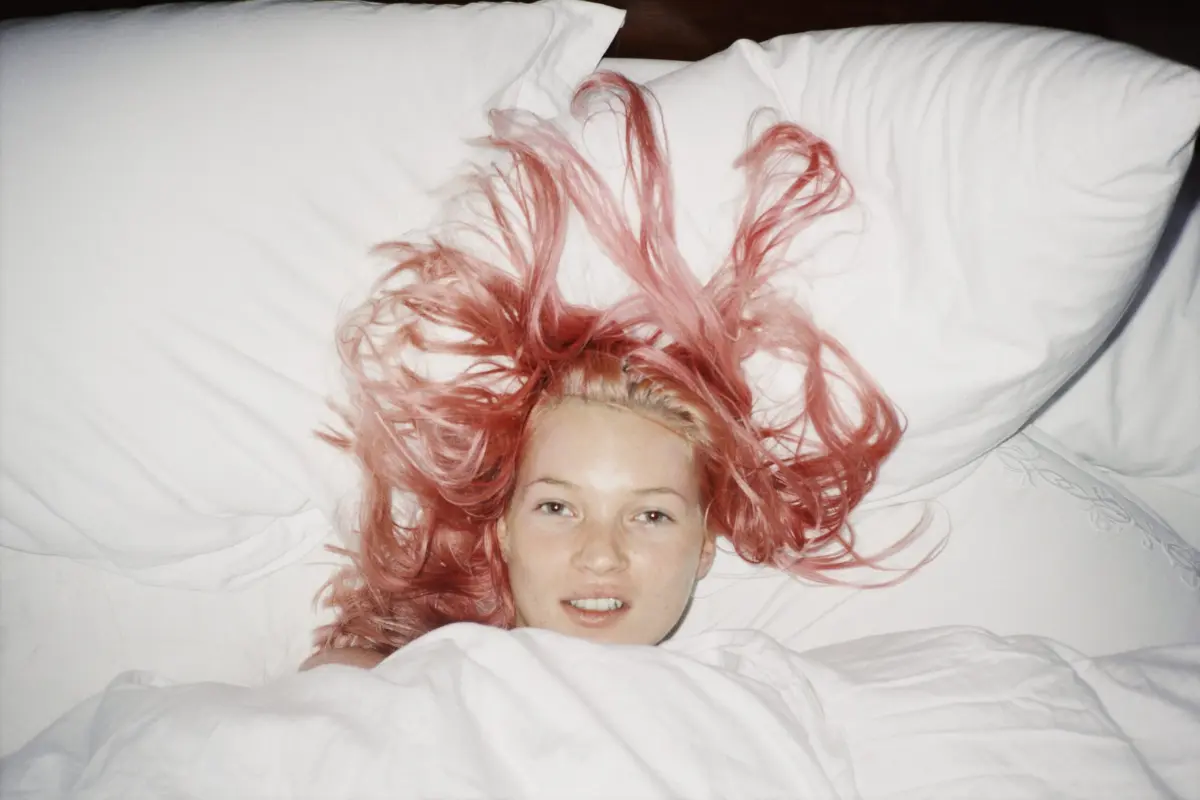
Immediately following the star-studded vernissage, the exhibition was thrust into the center of a media storm. The run-up to the opening had relied heavily on high-profile marketing campaigns—most notably the omnipresence of Kate Moss’s image captured through the lens of Juergen Teller, plastered across billboards and transit stations throughout London.
This heavy-handed commercial framing drew immediate ire from traditionalist art critics. Waldemar Januszczak, chief art critic for The Times of London, famously lamented, “I expected a celebration of the Nineties—instead it was a fashion disaster.” Jonathan Jones of The Guardian was even more scathing, awarding the exhibition a dismal one-star rating and writing, “This isn’t an exhibition, it’s a magazine spread.” Jones continued his critique with a damning assessment of the visitor experience: “I hoped what I’d seen was a prologue to more art, bigger art, with enough space to appreciate it. But no. That’s it. You leave as dissatisfied as you might after flicking through a 30-year-old copy of The Face in a dentist’s waiting room.”

Conversely, other corners of the press found profound resonance within the galleries. Alastair Sooke, chief art critic for the Daily Telegraph, awarded the show five stars, noting that it left him “buzzing.” Stephen Armstrong of The Independent echoed this sentiment, observing that “the hope on the walls of this five-star exhibition is heartbreaking.”
This dichotomy highlights a fundamental tension in contemporary museum curation: the uneasy alliance between institutional art history and commercial style culture, and how the aggressive marketing of a show can inadvertently prejudice the critical reception of the artworks within.
Supporting Context & Metrics: Redefining the 1990s Canon
To understand the friction surrounding “The 90s: Art and Fashion,” one must examine the socio-economic and art-historical metrics of the decade it seeks to reinterpret, as well as the current cultural landscape of modern Britain.
The Decentering of the YBAs
For decades, the standard art-historical narrative of 1990s Britain has been dominated by the Young British Artists (YBAs). Fueled by Charles Saatchi’s patronage, media sensationalism, and a rebellious ethos centered on shock value, figures like Damien Hirst, Tracey Emin, Sarah Lucas, and Marcus Harvey became international superstars.
However, this canon was predominantly white, male, and heteronormative. Jessica Vaughan, one of the co-curators of the Tate exhibition, noted in an interview that the primary objective was to expand this narrow historical lens.
“The story of the YBAs is really well-known and some of the criticism we’ve got so far is that we haven’t included those big names enough,” Vaughan explained. “There are works by Tracey Emin and Damien Hirst there. We just wanted to spotlight other artists who we didn’t think got their dues and Edward always did that in fashion.”
By placing canonical YBA figures in conversation with under-recognized contemporaries—such as Hamad Butt, Eileen Perrier, Yinka Shonibare, and Barbara Walker—the curators have constructed a far more complex and inclusive map of 1990s British creativity.
Queer Narratives and the Shadow of the AIDS Crisis
One of the exhibition’s most poignant achievements is its unflinching engagement with queer themes, which were largely marginalized or sanitized in mainstream accounts of 1990s British culture. During a decade scarred by the ongoing devastation of the HIV/AIDS epidemic and pervasive institutional homophobia, queer artists channeled their grief, defiance, and desire into works of staggering power.
A prime example within the exhibition is Familiars (1992), a haunting three-part sculptural installation by Hamad Butt, a queer South Asian artist. The piece features vacuum-sealed glass bulbs containing lethal toxic chemicals. Viewers are invited into a precarious physical engagement with the sculpture, operating under the implicit, terrifying risk that a single misstep could crack a bulb and release the poison.

The work serves as a brilliant, terrifying metaphor for homophobia, contagion, and the existential dread of the AIDS crisis. The piece carries its own heavy mythology; when Familiars was last exhibited at the Tate during the 1990s, one of the glass vials actually fractured, forcing an emergency evacuation of the entire gallery.
“It’s the idea that the thing that we’re most attracted to might be the thing that’s the most threatening to us and the work has a mythology around it,” Vaughan noted.
Similarly, Steve McQueen’s 1993 seminal film Bear presents two Black men wrestling in a delicate choreography that swings effortlessly between tenderness and combat, dripping with raw homoerotic tension. While McQueen has since achieved global acclaim as a Turner Prize-winning artist and Academy Award-winning filmmaker, works like Bear are rarely contextualized alongside the laddish, hyper-heterosexual spectacle that often characterized the peak years of the YBA movement.
The Female Gaze and Corporeal Realities
The exhibition also undertakes a vital re-examination of female bodily autonomy and representation. Juxtaposed against the omnipresent, ethereal, and often exploitative images of Kate Moss shot by Corinne Day and Juergen Teller are works that confront the visceral reality of inhabiting a female body in the 1990s.
On display is Sam Taylor-Johnson’s 1993 photographic work Fuck, Suck, Spank, Wank, which features the artist wearing a T-shirt emblazoned with those four provocative words, her white denim jeans slumped deliberately around her ankles. (In a nod to the commercial crossover of art and fashion, the museum has even recreated the T-shirt for sale in its gift shop.)
Nearby hangs Sarah Lucas’s iconic 1997 photograph Chicken Knickers, which depicts a raw, whole chicken fastened to the front of a woman’s underwear.
“We wanted to capture what it was to be a young woman at that time and to counter the images of Kate Moss by Corinne Day and others,” Vaughan explained regarding this curatorial juxtaposition.
Official Statements & Curatorial Vision
The intellectual backbone of “The 90s: Art and Fashion” rests on the premise that art and style do not evolve in vacuum-sealed academic silos. Instead, they are deeply interconnected symptoms of cultural transformation.
Reflecting on the overarching thesis of the exhibition, Jessica Vaughan elaborated on the creative explosion that defined the era:

“There was this huge moment of growth and creativity, a time which really defined the parameters of what we now consider contemporary art. There was also this real boom in fashion and [the show] is about how they were feeding off one another and how the thematics were parallels in the things that these young creatives were interested in.”
This synergy is visually and conceptually mapped across multiple galleries, demonstrating how fashion designers and visual artists grappled with identical questions of identity, consumerism, national pride ("Cool Britannia"), and alienation.
Future Outlook: Relevance to Modern Britain
While some critics chose to view the exhibition as an exercise in shallow, toothless nostalgia, a closer examination reveals that “The 90s: Art and Fashion” offers striking, almost prescient commentary on the current socio-political climate of the United Kingdom in the mid-2020s.
Echoes of Thatcherism and Political Polarization
The UK is currently navigating a sharp, turbulent upswing in right-wing populism and political polarization. In September alone, British cryptocurrency billionaire Ben Delo made headlines by donating £36 million to the far-right political party Reform UK—the largest single political donation in modern British history.
Against this backdrop, the galleries within the Tate exhibition that examine the post-Margaret Thatcher sociopolitical landscape feel remarkably urgent. The disused urban spaces, economic precarity, and gritty survivalism captured in the photography of Corinne Day and Juergen Teller reflect an era of economic restructuring whose long-term consequences continue to reverberate today.
The Crisis of Nightlife and Cultural Spaces
Furthermore, the exhibition’s deep dive into 1990s British nightlife—spanning queer underground parties, drum and bass raves, and the dying embers of acid house—carries a heavy, melancholic weight. According to recent cultural data, more than a quarter of London’s independent late-night music venues, clubs, and creative spaces went dark between 2020 and 2025, choked out by gentrification, soaring rents, and post-pandemic economic pressures.
In this light, the gallery dedicated to the nocturnal countercultures of the 1990s is not merely a nostalgic trip down memory lane; it is a stark reminder of what happens when municipal authorities fail to protect the incubators of youth culture and grassroots creativity.
Conclusion: A Legacy Worth Debating
“The 90s: Art and Fashion” may have ruffled the feathers of traditionalist art critics who prefer their white cubes sterile and divorced from the glamorous, moneyed machinery of the fashion industry. Yet, by forcing an uncomfortable marriage between high art, commercial style, marginalized narratives, and political anxiety, the exhibition achieves something far more valuable than polite consensus. It sparks a necessary debate about who gets remembered in our cultural histories, how creative movements are co-opted or preserved, and what past decades can teach a fractured present about the defiant, messy art of survival.


Comments
Facebook App ID not configured. Please add it in the Customizer.