
Executive Overview
New York’s blockbuster fall auction marathon drew to a muted close on Thursday evening at Christie’s Rockefeller Center salesroom, yielding a total of $145.9 million across a 56-lot sale dedicated to 21st-century art. While the evening featured notable institutional-grade material, high-profile estate consignments, and philanthropic offerings, the auction played out against an unmistakable backdrop of market fatigue.
The proceedings were immediately impacted by last-minute withdrawals, most notably high-value works by Jeff Koons and Ed Ruscha that had collectively been expected to fetch up to $11 million. Even after these deletions left the pre-sale expectations pegged between $126 million and $192 million, the final hammer total of $117.7 million (rising to $145.9 million with buyer’s fees included) fell considerably shy of aggregate expectations.
Although the house maintained a healthy sell-through rate of 91 percent—finding buyers for 51 of the 54 offered lots—the atmosphere inside the salesroom was distinctly enervated. Notable market figures, blue-chip dealers, and prominent advisors filled select rows, but plenty of empty seats signaled that collectors and institutions alike were nursing auction-week exhaustion. High-profile passes for blue-chip names such as John Currin, William Eggleston, Wade Guyton, Gerhard Richter, and Yayoi Kusama further underscored a growing disconnect between consignor valuations and buyer appetite.
Read Also
As prominent dealer Jeanne Greenberg Rohatyn bluntly observed on her way out of the auditorium: "The estimates were too high for this market. We need to readjust, and the houses need to be at the forefront of managing expectations."
Detailed Chronology: A Slow-Burning Evening at Rockefeller Center
The Sonnabend Trove Struggles to Find Momentum
The evening commenced inauspiciously with the first 19 lots—all sourced from the legendary collection of Antonio Homem, long-time director of the Sonnabend Gallery and adopted son of its visionary founder, Ileana Sonnabend—failing to hammer above their pre-sale estimates. The collection, sold to benefit their foundation, ultimately totaled $41.9 million against an adjusted pre-sale estimate of $35.25 million to $53.15 million (excluding the withdrawn Koons sculpture Wild Boy and Puppy). Fully half of the 20 Sonnabend lots hammered below their low estimates.
Relief arrived only with the final lot of that opening trove: Jean Prouvé’s striking architectural furniture piece, Table “Centrale” (“Trapèze”), petit modèle. After a spirited, five-minute bidding war between several specialists and a determined bidder in the room, Sara Friedlander, Christie’s chairman of postwar and contemporary art in the Americas, secured the piece for a client with a winning hammer bid of $1.3 million. Inclusive of fees, the table realized $1.7 million, comfortably besting its $700,000–$1,000,000 estimate.

Other blue-chip anchors from the Sonnabend collection experienced mixed receptions:
- Andy Warhol’s iconic 1962 Pop art canvas, Campbell’s Soup Can (Turkey Noodle)—estimated at $6 million to $8 million—was hammered down by Adrien Meyer to a room bidder at $7.3 million, totaling $9 million with fees.
- Roy Lichtenstein’s towering 1963 canvas Large Spool, which had remained off the market since the Sonnabends purchased it from the Leo Castelli Gallery four decades prior, was chased by absentee bids before Friedlander stepped in at $7 million. Totaling $8.6 million with fees, it fell short of its ambitious $10 million to $15 million estimate amid its concurrent spotlight at the Whitney Museum of American Art’s major Lichtenstein retrospective.
- Jeff Koons’s colorful, six-foot-high polychrome sculpture Hulk (Friends) (2004–12) cleared a modest $3.3 million hammer ($4.15 million with fees) via Christie’s Michael Baptist, resting near the low end of its $3.5 million to $5.5 million estimate.
Basquiat Fails to Ignite Fireworks
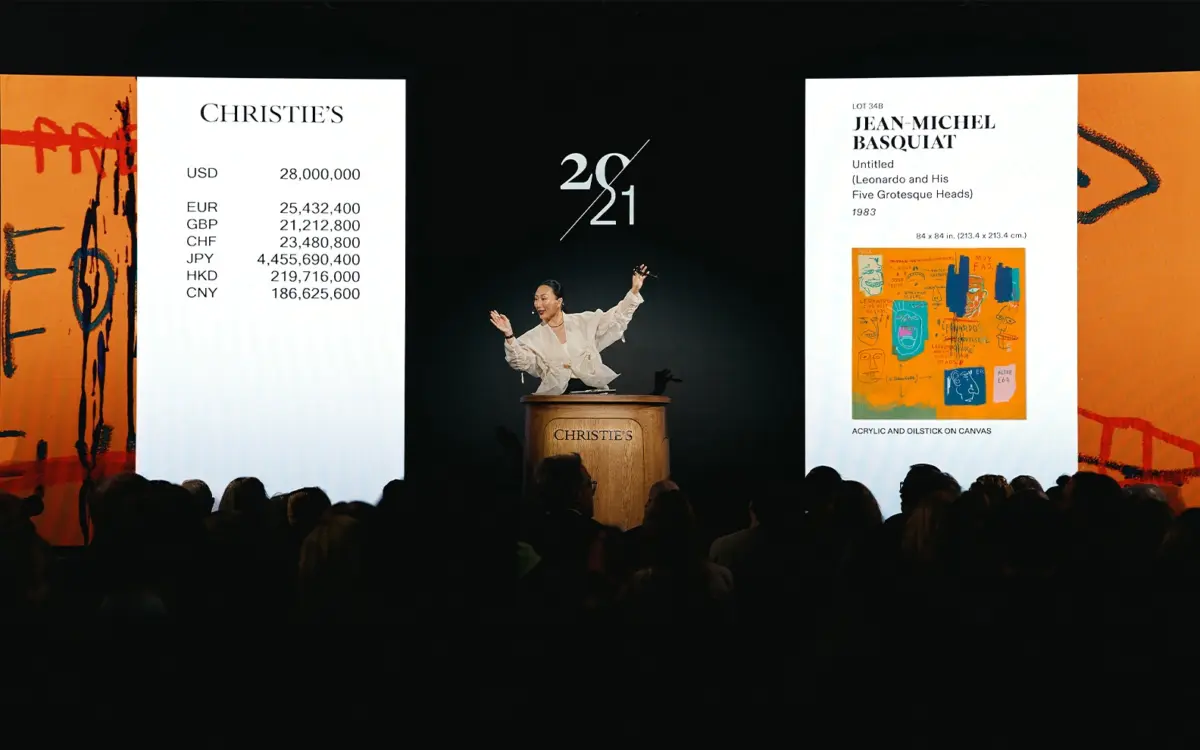
The undisputed headline attraction of the evening was Jean-Michel Basquiat’s monumental 1983 painting, Untitled (Leonardo and His Five Grotesque Heads). Measuring seven feet square and featuring the artist’s trademark scratchy scrawls and frantic caricatured faces over an intense orange ground, the work had been off the market for two decades.
Yet, the canvas failed to generate the electric bidding wars typical of the artist’s peak market years. Yu-Ge Wang opened the bidding at a staggering $23 million, eliciting an uncomfortable silence across the room before Ana Maria Celis, head of postwar and contemporary art, stepped in to rescue the lot. Celis battled Alex Rotter, Christie’s global president of 20th- and 21st-century art, before hammering the piece down at $28 million. With fees, the final price settled at $32.9 million—just shy of the $30 million low estimate.
Despite failing to spark a runaway bidding frenzy, the seller realized a tidy return on investment. The canvas previously traded at Sotheby’s London in 2000 for just over $400,000, before tripling to $1.3 million at the same house in 2005.
The Gund Estate and Selective Bright Spots
In contrast to the Sonnabend trove, the ten works offered from the estate of beloved philanthropist Agnes Gund fared notably better. Gund’s collection hammered for $20.4 million against a $16.95 million to $24.65 million pre-sale estimate, ultimately reaching $25.7 million with fees.
The highlight of the Gund grouping was Vija Celmins’s meditative 1990 painting Untitled (Ocean), acquired by Gund the year after its creation. The work sparked a rare, genuine four-minute bidding battle among private sales head Joanna Szymkowiak, Hong Kong specialist Arco Yu, and a resolute female bidder in the room. The room bidder ultimately prevailed at a hammer price of $5.75 million ($7.1 million with fees), landing just underneath its $6 million low estimate.

Elsewhere in the Richter market, mixed fortunes prevailed. A 1990 Abstraktes Bild from the estate of legendary dealer Marian Goodman failed to attract a single bid at its $6 million to $8 million estimate. However, just three lots later, a vibrant 1991 Abstraktes Bild dominated by deep reds, blues, and greens sparked a swift contest between Friedlander and Rotter. Rotter secured the canvas for $7.6 million ($9.4 million with fees), neatly within its $7 million to $10 million estimate.
Supporting Context & Metrics: The Broader Auction Week Panorama
Thursday’s $145.9 million tally served as the final chapter in a monumental, week-long New York auction cycle characterized by staggering extremes. While evening sales earlier in the week commanded headline-grabbing totals, they also established a context of selective fatigue by the time Christie’s rolled out its 21st-century inventory on Thursday night.
Week-Long Marketplace Performance Snapshot:
- Monday (Sotheby’s): Launched the week with a $378.7 million two-part auction featuring collections from media magnate Ted Baum and interior designer Ruth Baum, alongside "The Now" contemporary offerings.
- Tuesday (Christie’s): Staged a nearly three-hour 20th-century extravaganza totaling $626.6 million, spearheaded by a record-breaking $85.8 million Wassily Kandinsky abstraction and an $82.3 million Gustav Klimt landscape. Simultaneously, Jeff Koons flooded the block with seven works totaling $104 million.
- Tuesday (Phillips): Delivered a steady $104.4 million modern and contemporary sale anchored by a $44.6 million Amedeo Modigliani sculpture.
- Wednesday (Sotheby’s): Captured the week’s highest single-session total with a staggering $777.8 million Impressionist and modern art sale, crowned by Vincent van Gogh’s record-shattering Châtaigniers en fleurs at $190.4 million.
Against this backdrop of multi-billion-dollar liquidity circulating in earlier sessions, Thursday’s 21st-century sale felt like a necessary cooldown. Lower-tier and charity-driven lots captured unexpected sparks of energy—such as the record-breaking sale of a swirling Julia Jo abstraction for $403,200 to benefit the Coalition for the Homeless—while major lots with aggressive estimates were summarily punished by the room.
Official Statements and Market Analysis
The prevailing sentiment as collectors and dealers filed out of Rockefeller Center was one of cautious recalibration. The consensus among market insiders is that consignors and auction houses must adjust to a shifting economic and psychological landscape where buyers are no longer willing to absorb inflated guarantees or unrealistic pre-sale estimates.
"The estimates were too high for this market," reiterated Jeanne Greenberg Rohatyn. "We need to readjust, and the houses need to be at the forefront of managing expectations."
Marianne Boesky echoed this diagnostic assessment, noting the palpable lack of energy in the room. "The lots that were estimated too high were punished, and those estimated low were rewarded."

Despite the macro-level sluggishness, micro-level records proved that capital remains accessible for correctly priced, high-quality works. New artist auction records were established during the evening for Jim Nutt ($1.1 million), Antonio Santín ($486,400), and Julia Jo ($409,600), proving that appetite for discovery and accessible blue-chip alternatives remains intact.
Future Outlook: Navigating the Post-Marathon Correction
As the dust settles on the fall 2026 New York auction circuit, market watchers are drawing clear lessons from Christie’s Thursday night finale. The record-shattering heights achieved earlier in the week by blue-chip Impressionist, Modern, and early 20th-century masterpieces—typified by historic benchmarks for Van Gogh and Kandinsky—highlight a flight to absolute quality and historical pedigree.
Conversely, the sluggish sell-through mechanics and conservative bidding seen in the 21st-century sector signal that the contemporary market has entered a mature phase of correction. High-growth speculative bubbles are deflating, and consignors can no longer rely on unbridled post-pandemic exuberance to clear aggressive financial hurdles.
Moving into the upcoming winter and spring seasons, major auction houses face clear strategic imperatives. To maintain healthy sell-through rates and invigorate exhausted salesrooms, houses must work proactively with estates and foundational trustees to calibrate estimates realistically. Until such adjustments become standardized, the art market will continue to reward prudent pricing while ruthlessly penalizing overconfidence.



Comments
Facebook App ID not configured. Please add it in the Customizer.