
Executive Overview
It was an evening of soaring superlatives, breathtaking valuations, and calculated financial high-wire acts at Sotheby’s New York headquarters. During a marquee night that underscored both the enduring allure and the shifting dynamics of the ultra-high-end art market, the auction house brought in a staggering total of $777.8 million across two consecutive sales of Impressionist, Modern, and contemporary works.
This titanic figure represents the highest single-night gross in Sotheby’s storied history, comfortably edging past the previous watermark of $706 million achieved the prior November at the Breuer building. Yet beneath the veneer of historic totals and blockbuster records—including a monumental new high for Vincent van Gogh—the evening laid bare the delicate tensions governing the upper echelons of the art trade. Aggressive pre-sale guarantees, an abundance of cautious bidding, and late-stage lot withdrawals revealed an ecosystem where ambition occasionally outpaces market heat.
While Asian buyers demonstrated robust, unwavering purchasing power and institutional treasures shattered records to benefit historically Black colleges, market analysts questioned whether sky-high guarantees are beginning to strain buyer enthusiasm. As the dust settled on a multi-million-dollar marathon, Sotheby’s leadership stood firm, celebrating record-shattering milestones while weathering critiques over pricing strategies that left some industry insiders whispering about overconfidence.
Read Also
Detailed Chronology: The Billion-Dollar Blueprint Unfolds
The evening was structured as a dramatic two-act play, beginning with the highly anticipated single-owner auction of the elite Blaquier-Arrieta collection, followed by a dynamic, multi-owner evening sale comprising 47 diverse lots.
Act I: The Blaquier-Arrieta Showcase and the Van Gogh Milestone
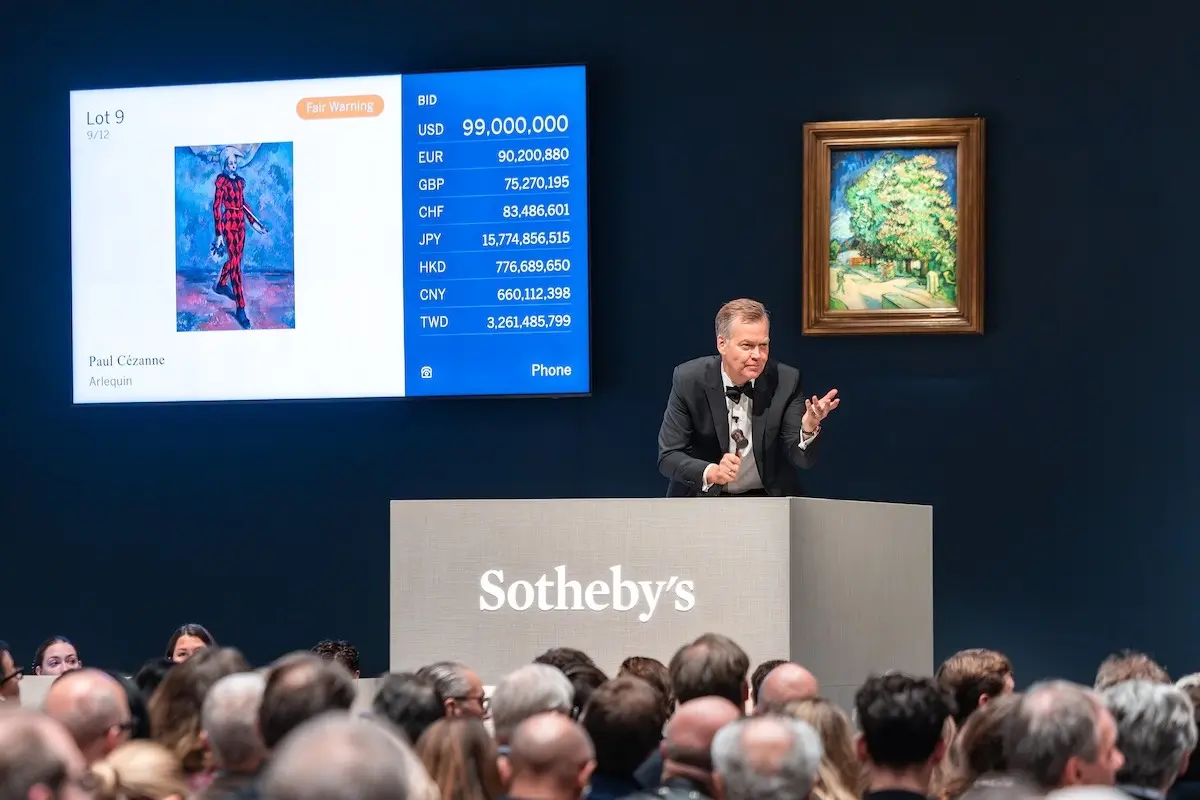
The first chapter of the evening centered on the 12 masterworks from the Blaquier-Arrieta collection. Anticipation had reached a fever pitch in the weeks leading up to the sale, driven heavily by two marquee lots: Vincent van Gogh’s vibrant 1890 canvas Châtaigniers en fleurs and Paul Cézanne’s complex 1888–90 figurative work Arlequin.
When the totals were tallied, the collection brought in $412 million. While this figure established a new record for a single-owner evening sale dedicated to Impressionist and modern art at Sotheby’s, it fell just shy of its presale low estimate of $414.5 million.
The two anchor paintings achieved eye-popping financial figures, but the physical room lacked the electric, frenetic energy typically associated with nine-figure transactions.

- Vincent van Gogh’s Châtaigniers en fleurs (1890): Hammered down to a final price of $190.4 million (inclusive of fees), this staggering sum marked a new personal auction record for the Dutch master. It also cemented its place as the highest price for any work of art ever sold at Sotheby’s and the fourth-highest price achieved by any artist in auction history. Despite these monumental figures, the bidding process was notably subdued, characterized by only a smattering of active participation.
- Paul Cézanne’s Arlequin (1888–90): Capturing the second-highest price for a Cézanne at auction, the piece commanded $111 million. However, the contest was anticlimactic, inching along through a conservative exchange of just four bids that ping-ponged between Sotheby’s specialists Lisa Dennison (Chairman of the Americas) and Helena Newman (Chairman of Sotheby’s Europe). The hammer ultimately fell to Newman.
When pressed by media outlets after the sale regarding whether recent publicity surrounding a restitution claim against the van Gogh had dampened buyer enthusiasm, Sotheby’s CEO Charles Stewart dismissed the notion. Pointing out the historic nature of the price, Stewart remarked, "I think you have to separate auction heat from auction results."
As the Blaquier-Arrieta sale progressed toward its conclusion, the atmosphere reignited during the final offerings. Henri de Toulouse-Lautrec’s Femme assise de profil vers la gauche (1890) sparked intense competition between phone bidders Edith Eustis and Simon Stark, alongside several room participants, before selling to a male collector in the second row for $3.8 million.
Shortly after, Camille Pissarro’s snow-drenched 1875 landscape Maison de Piette à Montfoucault, effet de neige, avec un homme portant un fagot triggered a fierce telephone duel between specialists Wendy Lin, Serena Hildebrandt, and Alina Davey. Davey ultimately secured the lot for $2 million on behalf of the same anonymous buyer who had acquired Edgar Degas’s Avant la course (c. 1893) for $18 million earlier in the session with the assistance of Ben Doller.
Act II: The 47-Lot Multi-Owner Surge
If the opening act was defined by institutional gravity and heavy guarantees, the subsequent 47-lot multi-owner sale was a masterclass in organic market momentum. Bolstered by no fewer than 33 Sotheby’s specialists fielding remote bids, the sale grossed $365.8 million, achieving a near-immaculate sell-through rate with only a single lot failing to find a buyer.
The evening’s competitive tone was established early, with top-tier lots generating immediate, ferocious bidding wars. The crown jewel of this segment was Edward Hopper’s atmospheric 1944 seascape The Martha McKeen of Wellfleet, consigned from the esteemed collection of Baroness Carmen Thyssen-Bornemisza.
Sparking a four-way telephone battle among Sotheby’s specialists, the painting was ultimately claimed by Scott Niichel, vice chairman and head of the middle market for modern and contemporary art. Inclusive of fees, the work fetched $47.8 million, securing Hopper’s second-highest auction result in history (trailing only his iconic Chop Suey, which brought $91.8 million at Christie’s in November 2018).
Hot on the heels of the Hopper was René Magritte’s surrealist masterwork L’Ami de l’ordre (1964), featuring his iconic bowler-hatted figure. Coming from the collection of Sydell Miller—who had acquired the canvas in 1998 for a modest $5.3 million—the painting soared to $45 million. Bidders inside the salesroom waged a protracted war against Sotheby’s specialists Jackie Wachter and Bame Fierro March before an anonymous room bidder secured the prize.

Supporting Context & Metrics: Record-Breaking Philanthropy and Global Demand
Amidst the established European masters and modern titans, several cultural milestones and geographic shifts dominated the evening’s narrative, proving that the appetite for historically overlooked narratives is reshaping the upper echelons of the market.
The Aaron Douglas Phenomenon
One of the most electric moments of the night arrived via American modernism. Aaron Douglas’s 1931 painting depicting abolitionist icon Harriet Tubman shattered expectations and institutional benchmarks alike. Estimated conservatively at $2.5 million to $3.5 million, the piece effortlessly dismantled the artist’s previous auction record of $600,000 (set at Swann Galleries in 2008).
The work vaulted past milestones to achieve an extraordinary $14.1 million. In a triumph of institutional philanthropy, the entirety of the proceeds will directly benefit Bennett College, a historically Black women’s institution in Greensboro, North Carolina.
The bidding for the Douglas canvas was a family affair at first, pitting specialist Jackie Wachter against her father, George Wachter, Sotheby’s Chairman of North and South America. As room participants chimed in, Stefany Morris, Sotheby’s head of American art, entered the fray, ultimately prevailing against the room to claim the historic work. David Galperin, Sotheby’s vice chairman and head of contemporary art, captured the mood of the room:
"We knew it was going to make a big price. That’s one of the most exciting auction moments—when you have something that is so categorically the very best by an artist whose work rarely comes to auction."
Mary Cassatt and Global Wealth Distribution
Continuing the streak of institutional records, Mary Cassatt’s impressionist masterpiece Summertime (1894–95), hailing from the Armand Hammer collection, sold for $13.3 million—nearly doubling the artist’s previous auction high of $7.5 million. The triumph highlighted the evening’s depth of competition, with specialists David Galperin, Caroline Seabolt, Wendy Lin, and Simon Stock all vying for the work before an online bidder swept in to win.
Furthermore, the evening reaffirmed the formidable footprint of Asian collectors in driving Western fine art prices. Senior executives Jen Hua and Wendy Lin (Sotheby’s Asia Chairman) maintained a punishing pace throughout the night. Asian buyers actively acquired or heavily contested museum-caliber works by Henri de Signac, Maurice de Vlaminck, Claude Monet, Pierre-Auguste Renoir, Chaïm Soutine, Egon Schiele, Pablo Picasso, and Edgar Degas. This sustained purchasing power underscores a structural realignment in the global art market, where Eastern capital acts as a primary stabilizing force during periods of Western economic recalibration.

Official Statements and Industry Friction: The Guarantee Debate
Despite the headline-grabbing figures and historic tallies, the auction was not without logistical friction and vocal industry critique.
In a departure from standard transparency protocols, three high-profile lots—by René Magritte, Paul Cézanne, and Henri Matisse—were withdrawn while the sale was actively in progress, without prior public announcement. Among the unceremoniously pulled works were Matisse’s La Jetée à Collioure (estimated at $5 million–$7 million) and Cézanne’s L’Oncle Dominique (estimated at $3 million–$5 million). Both were part of an 11-work consignment originating from the collection of George Weiss, the hedge fund founder currently navigating bankruptcy proceedings, as revealed by ARTnews earlier in the month. Additionally, a drawing by Remedios Varo failed to find a buyer.
More critically, the extensive use of financial guarantees—particularly within the Blaquier-Arrieta collection, where every single lot was guaranteed—sparked intense debate among market leaders.
Phillip Hoffman, founder and chairman of the Fine Art Group, voiced sharp skepticism regarding auction house risk management strategies immediately following the Blaquier sale.
"The guarantees were just too high," Hoffman told journalists. "I think these guarantees are just pushing the limit."
Hoffman argued that by setting financial guarantees at such elevated thresholds, Sotheby’s left prospective buyers with virtually no room to organically compete. He characterized the approach as "a little bit of overconfidence" on the house’s part, calculating that Sotheby’s and its financial backers may have absorbed significant paper losses—potentially reaching up to $50 million—on underperforming guaranteed lots that lacked competitive breathing room.
Confronted with these criticisms after the gavel fell, CEO Charles Stewart defended the house’s aggressive methodology with unapologetic pragmatism:

"Our estimates weren’t shy. You can read into that whatever you like. We were happy with the result of everything."
Future Outlook
Sotheby’s historic $777.8 million evening serves as a complex microcosm for the high-end art market as it navigates the mid-2020s. On one hand, the absolute liquidity of the market for blue-chip masterpieces remains remarkably robust. Institutional masterworks, rare historical artifacts like the Aaron Douglas Harriet Tubman, and the unyielding liquidity of Asian collectors demonstrate that capital is eager to flow toward undisputed quality.
On the other hand, the friction observed around heavily guaranteed lots and late-stage withdrawals signals that the era of unbridled, speculative exuberance may be giving way to a more sober, calculating climate. Auction houses are increasingly walking a tightrope: balancing the aggressive financial incentives required to secure prime consignments against the risk of over-inflating pre-sale estimates.
As the market looks toward upcoming seasonal cycles in New York and London, the takeaway from Sotheby’s blockbuster night is clear. The appetite for museum-quality trophies is undiminished, but the financial margins for error have narrowed considerably. In this new paradigm, auction houses, guarantors, and collectors alike must navigate a landscape where historic triumphs and high-stakes gambles walk hand in hand.



Comments
Facebook App ID not configured. Please add it in the Customizer.