
Executive Overview
Few figures in the annals of art history command the foundational gravity of Wassily Kandinsky. Widely heralded as the father of abstract art, the Russian-born modernist fundamentally decoupled painting from the representation of the physical world, forging a visual vocabulary rooted in color, line, and geometry that would forever alter the trajectory of Western aesthetics. Yet, while his cultural legacy is secure and universally celebrated, his financial trajectory in the secondary art market has historically charted a course of dignified, measured appreciation. Unlike certain contemporaries whose values skyrocketed via speculative frenzy and seismic leaps, Kandinsky’s auction records have traditionally been rewritten by razor-thin margins—incremental steps upward that spoke to a steady, highly sophisticated collector base rather than volatile market hype.
That patient market paradigm is now on the verge of a dramatic transformation. On November 17, Christie’s New York is scheduled to offer Betonte Ecken (1922–23) as the crown jewel of its fall marquee sales, bearing an ambitious pre-sale estimate of $60 million to $80 million. The consignor, who acquired the masterpiece at Sotheby’s New York nearly four decades ago in 1986, is positioned to reap the rewards of a lifetime of stewardship. More importantly, auction house representatives have confirmed to ARTnews that the work carries a financial guarantee, ensuring that when the hammer falls, a new auction benchmark will be established.
This upcoming sale is not merely another high-priced transaction in an increasingly frothy global art market; it represents a watershed moment for abstract modernism. To understand the magnitude of Betonte Ecken, one must trace the deliberate, methodical climb of Kandinsky’s auction history—a narrative defined by rare masterpieces, fierce institutional competition, and a market that has slowly, deliberately prepared itself to cross the unprecedented $60 million threshold.
Read Also

Detailed Chronology: The Evolution of Kandinsky’s Auction Records
To appreciate the significance of a potential $80 million price tag for Betonte Ecken, it is vital to examine how Kandinsky’s market has evolved over the past several decades. Unlike pop art or contemporary works that experience exponential leaps overnight, the modernist master’s financial milestones have historically been characterized by disciplined, tactical increments.
The Foundation of the Modernist Market (Late 20th Century)
For much of the late 20th century, major works by Wassily Kandinsky appeared on the open market relatively infrequently, with the vast majority of his seminal Bauhaus-era and pre-WWI abstractions held securely within institutional collections or passed down through private European estates. When works did surface, buyers were primarily elite European and American collectors who understood the pivotal role Kandinsky played in the Blue Rider (Der Blaue Reiter) movement. During this era, prices remained modest by today’s standards, typically hovering in the low-to-mid millions, serving as foundational benchmarks for the burgeoning twentieth-century avant-garde market.
The Turn of the Century and the Approach to $20 Million
As the global art market expanded exponentially at the turn of the twenty-first century, blue-chip modern art experienced a structural revaluation. Collectors increasingly recognized that foundational modernist works were finite assets. During the 2000s and early 2010s, Kandinsky’s record steadily climbed through the teens of millions. Works from his vibrant, transitional periods—where figurative landscapes dissolved into swirling orchestrations of line and color—began to capture the intense imagination of ultra-high-net-worth individuals seeking historical pedigree and intellectual rigor in their acquisitions.

The Dramatic 2017 Sotheby’s London Milestone
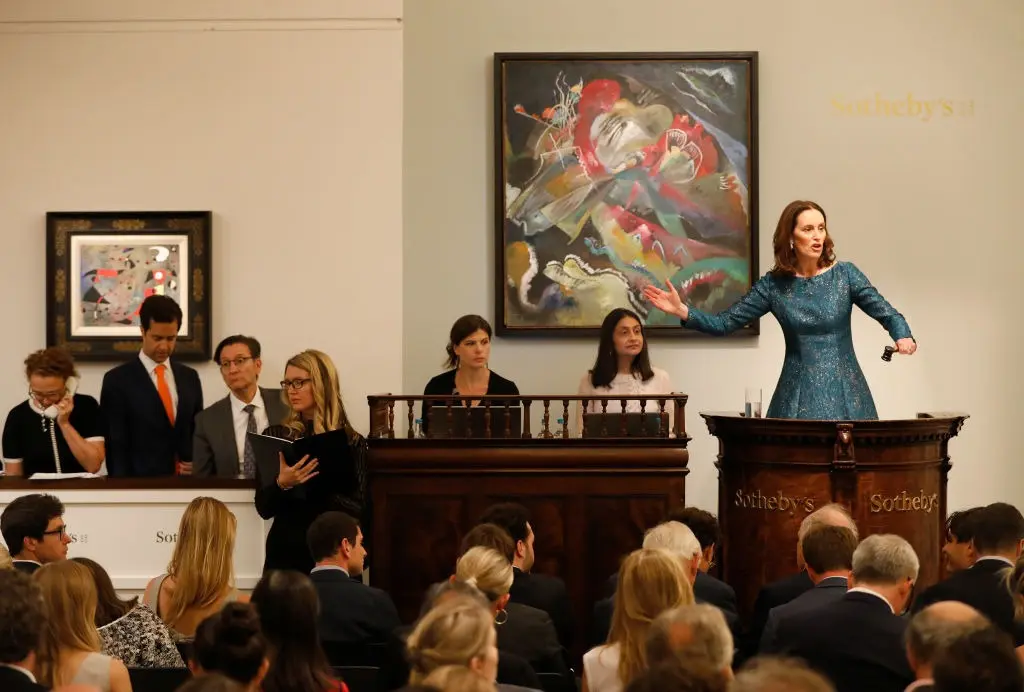
A critical inflection point in the modern history of Kandinsky’s market occurred on June 21, 2017, during the Impressionist and Modern Art Evening Sale at Sotheby’s London. Under the steady gavel of Helena Newman, Sotheby’s European Chairman, the auction played host to a rare convergence of market demand that broke the artist’s auction record twice in under a single hour.
First, Murnau mit Kirche II (Murnau with Church II) (1910)—a brilliantly hued landscape from Kandinsky’s pivotal time in the Bavarian alpine village of Murnau, which bridges his early figurative style and his breakthrough into pure abstraction—came to the block. Bidding was fierce, reflecting the intense competition for works with museum-quality provenance (having notably survived a turbulent history of Nazi confiscation and subsequent restitution). When the hammer fell, Murnau mit Kirche II achieved £20.9 million ($26.4 million), shattering the artist’s previous global record.
Yet, the evening had not finished making history. Later in the same auction, Kandinsky’s 1917 masterpiece Painting with White Lines came forward. Benefiting from the heightened energy in the salesroom and the palpable scarcity of top-tier canvases, the work surpassed the newly minted record, commanding £33 million ($41.6 million) with fees. This double-breaking feat within sixty minutes illustrated a crucial market truth: when premier Kandinsky canvases emerge with pristine provenance and visual dynamism, institutional and private buyers are willing to push past historical ceilings, albeit still within a structured, measured continuum.

The Post-Pandemic Resurgence and Approaching the Apex
In the years following the 2017 milestone, the market for blue-chip modernism faced the disruptions of a global pandemic followed by a swift, highly competitive post-lockdown resurgence. Capital seeking safe-haven assets increasingly gravitated toward proven historical masterworks. In March 2023, Murnau mit Kirche II returned to the auction block at Sotheby’s London, consigned by the Van Abbemuseum in Eindhoven following a successful restitution claim to the heirs of the original Jewish owners, Siegbert and Johanna Margarethe Stern. The painting soared to £37.2 million ($44.9 million), setting a new baseline for the artist and proving that Kandinsky’s market resilience remained entirely intact despite macroeconomic uncertainties.
Supporting Context & Metrics: Analyzing the $60M–$80M Benchmark
The jump from a previous high-water mark of roughly $45 million to a conservative estimate of $60 million—with a ceiling of $80 million—represents a quantum leap for Wassily Kandinsky’s market valuation. To contextualize this ambitious pricing strategy, industry analysts and market historians must examine several intersecting financial, historical, and art-historical variables.
The Significance of Betonte Ecken (1922–23)
At the heart of this upcoming market test is Betonte Ecken (Accented Corners), painted between 1922 and 1923. This chronological placement is critically important. By 1922, Kandinsky had accepted an invitation from Walter Gropius to teach at the Bauhaus in Weimar, Germany. This period marked one of the most intellectually rigorous and visually arresting phases of his career.

Having moved away from the more expressionistic, painterly explosions of his pre-WWI Munich years, Kandinsky’s Bauhaus period embraced a structured, geometrically precise visual lexicon. In works like Betonte Ecken, circles, triangles, intersecting lines, and planes of cool and warm color interact with architectural precision. This geometric shift reflected his deep theoretical writings, particularly his seminal 1926 Bauhaus publication Point and Line to Plane. For contemporary collectors, these Bauhaus-era masterworks represent the philosophical peak of twentieth-century constructivist and abstract thought—a potent blend of science, spirituality, and visual poetry.
Provenance and Market Scarcity
Provenance is the invisible currency of the high-end art market, and Betonte Ecken boasts an exemplary pedigree. The anonymous seller’s acquisition of the painting at Sotheby’s New York in 1986 means the work has been held out of circulation for nearly forty years. In the contemporary ecosystem, long-held institutional or private masterworks that re-emerge after decades generate an extraordinary aura of freshness. Collectors are starved for top-tier material; when a canvas of this historical caliber transitions from a private collection back into the public sphere, it commands a severe scarcity premium.
Financial Guarantees and Auction House Strategy
Christie’s decision to attach a pre-sale estimate of $60 million to $80 million—backed by a financial guarantee—is a calculated masterstroke of modern auction house strategy. In a high-stakes environment where consignors hold immense leverage, auction houses must frequently offer third-party or house guarantees to secure marquee consignments. By guaranteeing the lot, Christie’s not only secures the premier lot of the autumn season but signals absolute confidence to the global collector base that Kandinsky’s market is robust enough to sustain a nearly 100% valuation jump over his previous records.

Official Statements and Industry Perspectives
The announcement of Betonte Ecken heading to the New York auction block has sent ripples of anticipation throughout the global art community. While representatives for Christie’s have maintained strict confidentiality regarding the identity of the consignor and the specifics of the financial guarantee structure, key insights from market insiders illuminate the prevailing sentiment.
Speaking on background, several prominent art advisors and private dealers have noted that the $60 million to $80 million estimate, while aggressive, accurately reflects the structural undervaluation of Kandinsky relative to his peers in the modernist pantheon. While artists such as Pablo Picasso, Claude Monet, and Mark Rothko routinely command nine-figure sums in the $100 million-plus bracket, Kandinsky—despite being equally revolutionary in his complete invention of non-objective art—has historically lagged behind in sheer monetary valuation.
"For decades, Kandinsky has been one of the greatest value plays in blue-chip modern art," notes a prominent New York-based private art advisor. "Collectors who bought his major works in the 1980s and 1990s acquired foundational history at a fraction of the cost commanded by his Cubist or Abstract Expressionist contemporaries. An $80 million result for Betonte Ecken would not be an inflated anomaly; rather, it would serve as a long-overdue market correction, aligning Kandinsky’s financial standing with his unimpeachable art-historical significance."

Furthermore, representatives from major auction houses emphasize that the global appetite for museum-quality twentieth-century masterworks remains deeply resilient. Despite broader macroeconomic headwinds, inflationary pressures, and geopolitical uncertainties, ultra-high-net-worth collectors increasingly view blue-chip art as a durable, non-correlated asset class. When a canvas combines pristine museum-exhibition history, deep academic literature, and decades of private conservation, capital invariably mobilizes.
Future Outlook: What an $80 Million Kandinsky Means for the Art Market
As the art world turns its collective gaze toward Christie’s New York on November 17, the implications of the Betonte Ecken sale extend far beyond a single evening’s ledger. Should the painting realize its high estimate or surpass the $80 million mark, the ripple effects will be felt across the entire ecosystem of modernist and abstract art.
1. Re-anchoring the Modernist Market
A successful sale in the upper echelons of the $60 million–$80 million range will fundamentally recalibrate the valuation models for early twentieth-century abstraction. Collectors holding works by fellow Bauhaus masters, members of the Blue Rider group (such as Franz Marc or Gabriele Münter), and early European abstractionists will likely see upward pressure on their own holdings. The ceiling for non-objective art will have been permanently elevated, encouraging owners of other museum-grade Kandinskys to consider releasing their treasures into the secondary market.

2. Institutional Acquisitions and Philanthropic Dynamics
As prices for prime Kandinsky works climb toward the threshold of major corporate fortunes, public museums face an increasingly difficult battle to acquire such masterworks through traditional purchasing power alone. Consequently, the future life of works like Betonte Ecken will likely depend heavily on philanthropic gifts, promised bequests, or complex joint-acquisition models between private collectors and major institutions (such as the Museum of Modern Art, the Solomon R. Guggenheim Museum, or the Centre Pompidou). The commercial escalation underscores the growing divide between public institutional budgets and private wealth accumulation, making private-public partnerships more critical than ever for the public exhibition of art history’s greatest milestones.
3. The Generational Shift in Collecting
The 1986 acquisition of Betonte Ecken by its current consignor represents an era of connoisseurship defined by deep art-historical scholarship and patient stewardship. As these historic collections transition through generational inheritance, the contemporary market is witnessing a new wave of younger, globally minded collectors who view historical abstraction not merely as academic artifacts, but as visual powerhouses that hold their own against contemporary installations. This cross-generational appeal ensures a deep, liquid pool of prospective buyers for blue-chip modernism.
Conclusion
Wassily Kandinsky spent his life seeking to capture the spiritual resonance of the universe through pure color and line, famously writing that "color is the keyboard, the eyes are the hammers, the soul is the piano with many strings." On November 17, the global art market will strike that keyboard with unprecedented force. Whether Betonte Ecken achieves its ambitious estimate or shatters expectations entirely, the auction will mark a defining chapter in the legacy of the father of abstraction—cementing his rightful place not only in the canon of art history, but at the absolute pinnacle of the global financial art market.



Comments
Facebook App ID not configured. Please add it in the Customizer.