
Executive Overview
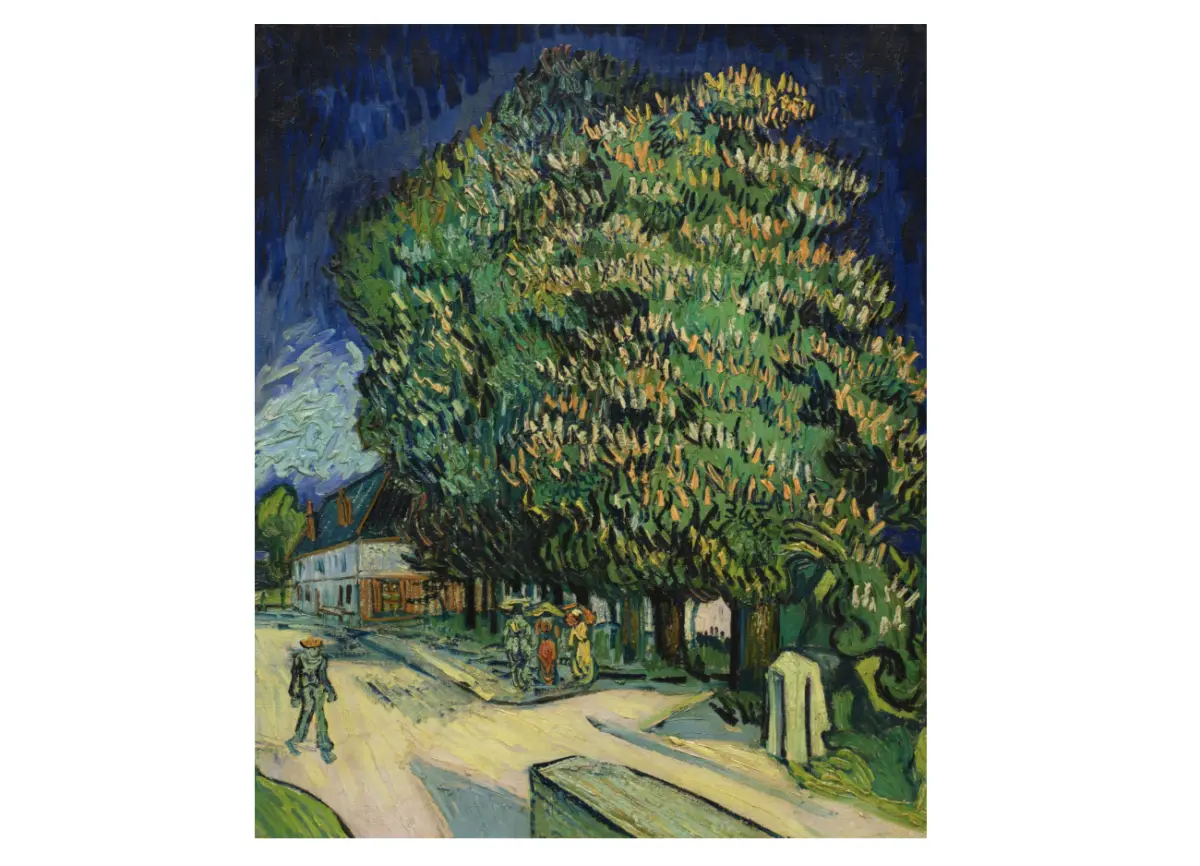
As the global art market converges on New York for the autumn marquee sales, a high-stakes title dispute has thrown a multi-million-dollar auction into turmoil. At the center of the controversy is Vincent van Gogh’s luminous 1890 masterpiece, Châtaigniers en fleurs (Blossoming Chestnut Trees), the undisputed crown jewel of the Blaquier-Arrieta collection. Valued at an astounding $180 million, the painting is slated to go under the hammer on Wednesday evening at Sotheby’s. However, its path to the auction block has been suddenly and dramatically disrupted.
In the eleventh hour before the sale, heirs of the prominent German-Jewish publisher Samuel Fischer formally demanded that Sotheby’s withdraw the work. Represented by attorney Gunnar Schnabel, the family argues that the painting was sold under the heavy financial duress of Nazi persecution in the 1930s, invoking the Washington Principles on Nazi-confiscated art.
Sotheby’s has aggressively pushed back against the claim, relying on meticulous archival research to argue that the 1936 transaction was a voluntary, market-rate sale conducted outside the borders of the Third Reich. The auction house maintains that the legal standard for duress has not been met, pointing to recent New York case law. Yet, the timing of the claim—arriving mere days before a blockbuster auction that anchors a $450 million collection—has exposed deep vulnerabilities in the multi-billion-dollar art market. Compounding the drama are recent legislative shifts, notably amendments to the federal Holocaust Expropriated Art Recovery (HEAR) Act, which have drastically altered the legal landscape for restitution claims. As legal teams spar and the consigning family signals a willingness to engage in dialogue, the art world waits to see whether Wednesday’s auction will proceed as planned or be derailed by history.
Read Also
Detailed Chronology: From Weimar Publishing to the 2026 Auction Block
To understand the complex provenance dispute surrounding Châtaigniers en fleurs, one must trace a timeline spanning nearly a century, marked by cultural eminence, fascist terror, and shifting legal battles.
1. The Fischer Era and the Rise of Nazism
Samuel Fischer, who passed away in 1934, was a towering figure in European letters. As the founder of S. Fischer Verlag, one of Germany’s most prestigious publishing houses, he championed literary giants such as Thomas Mann and Hermann Hesse. Following his death, his son-in-law, Gottfried Bermann Fischer, assumed leadership of the firm.
As the Nazi regime consolidated power and systematically banned the house’s politically sensitive authors, the family acted to preserve their business and livelihood. In 1936, the publishing house and the family relocated operations to Vienna. However, this sanctuary proved short-lived; the Anschluss of March 1938 brought Nazi terror directly to Austria. The Gestapo swiftly seized the family’s Vienna residence, their expansive library, and their remaining personal art collection.
2. The 1936 Amsterdam Sale
Crucially, however, the van Gogh in question followed a different trajectory from the assets seized in 1938. Archival records indicate that between 1932 and 1933, the Fischer family consigned Châtaigniers en fleurs—alongside two Cézannes—to the Amsterdam gallery of art dealer Paul Cassirer.
The painting remained on consignment for nearly three years, during which time it traveled for public exhibitions in Rotterdam and Bern. In June 1936, while the Netherlands remained safely outside Nazi control, the van Gogh was sold outright to an independent buyer for 68,000 Swiss francs (approximately $22,000 at the time).
According to Sotheby’s legal representatives, the family retained other artworks after this sale, many of which were subsequently confiscated by the Nazis following the 1938 annexation. Postwar inventories and brochures compiled by Gottfried Bermann Fischer to track lost and stolen family assets reportedly omitted the 1936 van Gogh, a detail Sotheby’s highlights to prove the family recognized the 1936 transaction as legitimate.
3. The Modern Discovery and the Eleventh-Hour Claim
The painting eventually found its way into the Blaquier-Arrieta collection, assembled by Argentine collectors Carlos Pedro Blaquier and Nelly Arrieta de Blaquier. Comprising 12 Impressionist and Post-Impressionist masterpieces, the collection was heavily courted by top-tier auction houses. Both Sotheby’s and Christie’s engaged in aggressive negotiations to secure the consignment, with Christie’s reportedly offering competitive, if not higher, financial guarantees across the entire collection. Ultimately, Sotheby’s won the consignment, backing the van Gogh with a substantial, undisclosed financial guarantee.
Sotheby’s publicly announced the collection in early October 2026, launching a six-week global marketing blitz. The campaign proceeded without incident until Thursday morning, November 12, when Sotheby’s leadership received formal correspondence from the Fischer heirs. The New York Times broke the story the following evening, leaving the auction house scrambling to defend its catalogue just five days before the scheduled Wednesday sale.
Supporting Context & Metrics: Valuations,
Markets, and Legal Precedents
The dispute is not merely an emotional reckoning with history; it is grounded in staggering financial metrics and evolving legal doctrines.
Financial Footprint
- $180 Million: The estimated pre-sale high value of van Gogh’s Châtaigniers en fleurs (1890), making it the undisputed anchor of the autumn auction season.
- $450 Million: The cumulative estimated value of the 12 Impressionist and Post-Impressionist paintings comprising the Blaquier-Arrieta collection.
- 68,000 Swiss Francs ($22,000): The price realized by the painting when sold through Paul Cassirer’s gallery in June 1936. Sotheby’s argues this constituted a robust, fair-market price for a van Gogh at the time, comparing it to Verger avec cyprès (1888) from the Paul Allen collection, which sold at Parke-Bernet in 1935 for $15,000 before fetching $117.2 million at Christie’s in 2022.
The Legal Framework: Duress vs. Economic Pressure
At the core of the title dispute is a complex question of New York property and restitution law: Does a painting sold outside the physical borders of Nazi Germany, to an independent buyer, for a competitive price, legally constitute a "forced sale"?
Luke Nikas, legal counsel for Sotheby’s, argues that New York courts maintain a clear distinction between the horrific, systemic conditions faced by European Jews and actionable legal duress, which requires proof that the buyer exerted illicit pressure on the seller.
Nikas cites key federal precedents:
- Zuckerman v. Metropolitan Museum of Art (2018/2019): A federal judge ruled—and an appeals court affirmed—that a 1938 Picasso sale failed to meet the rigorous legal standard for duress.
- Bennigson v. Solomon R. Guggenheim Foundation (2024/2025): A New York court reaffirmed that generalized economic pressure stemming from Nazi persecution is insufficient to establish legal duress if the buyer was entirely uninvolved in the coercion.
The Impact of the HEAR Act Amendments
However, the legal playing field shifted dramatically earlier this year. In April, U.S. lawmakers amended the Holocaust Expropriated Art Recovery (HEAR) Act, eliminating the equitable defense of laches. Previously, institutions, collectors, and auction houses routinely relied on laches to have restitution claims thrown out of court if heirs had waited too long to file suit.
Judd Grossman, a prominent New York art attorney not involved in the current dispute, noted that the removal of the delay defense has radically tilted the balance toward claimants.
"With this year’s amendments to the HEAR Act eliminating the equitable laches defense… the pendulum has swung dramatically in favor of claimants regardless of whether they have ever taken steps to vindicate their rights," Grossman observed. "We will see more of this sort of gamesmanship by claimants waiting to the very last minute to come forward before seeking their slice of the pie."
Compounding Sotheby’s institutional challenges is an internal personnel shift. Lucian Simmons, who founded Sotheby’s restitution department in 1997, departed for the Metropolitan Museum of Art in 2024, while Richard Aronowitz, former head of European restitution, moved to Christie’s in 2022. Although Sotheby’s has expanded its provenance team in recent years, the loss of these veteran specialists during high-profile disputes has drawn critical scrutiny from art market observers.
Official Statements and Stakeholder Positions
As the auction clock ticks down, the primary parties have staked out firm yet evolving positions regarding the fate of the van Gogh.
- Sotheby’s and Legal Counsel: The auction house remains defiant, asserting that archival records unequivocally prove the transaction was clean. Luke Nikas emphasized that the family’s own postwar recovery efforts and lists pointedly excluded the 1936 sale. "The family had pursued and recovered works from the 1938 forced sale, but never the works they sold in 1936, such as this van Gogh," Nikas stated.
- The Fischer Heirs: Represented by attorney Gunnar Schnabel—a veteran restitution researcher who previously investigated Nazi-era losses linked to Piet Mondrian—the heirs have challenged Sotheby’s to prove not only that a fair market price was paid, but that the family would have voluntarily parted with the masterpiece had the Nazi regime never existed. Schnabel has indicated his client’s readiness to seek a resolution under the international Washington Principles, though he declined to comment publicly on specific evidence of duress prior to publication.
- The Blaquier Family: Demonstrating a pragmatic approach to the public relations crisis, the consigning family issued a conciliatory statement expressing respect for the historical sensitivities involved. "While the information available to date has not established that the painting was sold under duress, the family welcomes constructive dialogue with the Fischer heirs and supports efforts to reach a mutually satisfactory resolution," the Blaquier family told ARTnews.
Future Outlook: Wednesday’s Auction and Industry Ramifications
As Wednesday evening approaches, Châtaigniers en fleurs remains officially scheduled to cross the auction block. Whether the painting sells, is withdrawn at the eleventh hour, or sees its proceeds escrowed pending formal mediation remains one of the art world’s most closely guarded suspense stories.
Regardless of Wednesday’s outcome, this high-profile confrontation marks a watershed moment for the international art market:
- The Weaponization of Timing: The deployment of last-minute restitution claims against heavily publicized, guaranteed marquee lots sets a potent precedent. Claimants recognize that public exposure just days before a sale exerts maximum financial and reputational pressure on auction houses.
- The Post-HEAR Act Reality: Without the laches defense to shield them from delayed claims, auction houses, galleries, and museums must adapt to a litigious environment where historical provenance challenges can emerge at any moment.
- The Imperative of Comprehensive Provenance: As secondary market prices soar into nine figures, deep historical auditing—accounting not just for 1938–1945 seizures, but for the complex economic pressures of the mid-1930s—will become non-negotiable for risk management.
For now, the global art community watches and waits. The hammer is poised to fall on a canvas painted in the twilight of van Gogh’s turbulent life, bearing the heavy, unresolved shadows of twentieth-century history.



Comments
Facebook App ID not configured. Please add it in the Customizer.