

In the contemporary landscape of boundary-pushing cinema and television, true artistic commitment is a rare and volatile commodity. It requires an unyielding adherence to a singular, often eccentric vision, driving creators to follow an idea to its absolute, uncompromised conclusion—whether that manifests as Andy Warhol’s obsessively replicated Brillo boxes, Mark Z. Danielewski’s structuralist labyrinth House of Leaves, or an apocalyptic stage play entirely dependent on memories of a single episode of The Simpsons.
Yet, few modern auteurs command this commitment to the "bit" quite like Casper Kelly. A decade after sending shockwaves across the internet with Adult Swim’s 2014 surrealist psychological trapdoor Too Many Cooks, Kelly—alongside co-writer Jamie King—has returned with a feature-length cinematic provocation that pushes the intersection of nostalgia, childhood comfort, and visceral horror to unprecedented extremes: Buddy.
Arriving at a cultural juncture uniquely fascinated by the dark subversion of wholesome mid-century and late-century children’s media, Buddy targets the sickly, over-lit edutainment ecosystem of the 1990s. Evoking the DNA of Dora the Explorer, Thomas the Tank Engine, Pee-Wee’s Playhouse, and, most centrally, the omnipresent psychological terror of Barney & Friends, Buddy transforms a pastel-drenched playground into a claustrophobic purgatory of blood, psychological gaslighting, and existential dread.
Read Also
Boasting a masterclass in ensemble performance—anchored by Keegan-Michael Key’s chilling vocal duality as the titular plush unicorn, Cristin Milioti’s grounding presence, and a powerhouse roster of young actors—Buddy is both a high-wire aesthetic experiment and a deeply layered commentary on media consumption, loneliness, and the ways in which stories serve as fragile armor against an indifferent universe.
Detailed Chronology
The Genesis of the "Bit": From Too Many Cooks to the Feature Screen
To understand the architectural genius of Buddy, one must trace the evolutionary trajectory of Casper Kelly’s directorial output. In 2014, Adult Swim released Too Many Cooks, an 11-minute surrealist video short that initially disguised itself as an innocuous, hyper-saturated opening credits sequence for a lost 1990s TGIF family sitcom.
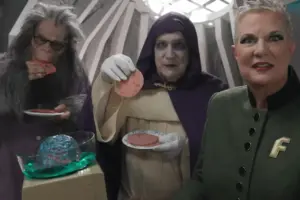
Featuring an impossibly large, smiling ensemble—complete with a cartoonist father, a stay-at-home mother, a puppet cat named "Smarf," and an escalating rotation of redundant babies and older girls—the sketch weaponized the uncanny valley of low-budget broadcast television lighting. As the runtime expanded, the comforting pastel palette curdled into a relentless, genre-hopping nightmare. A leering, machete-wielding murderer began systematically stalking, killing, and consuming the cast as they were thrust across parodies of police procedurals, military cartoons, medical dramas, and sci-fi dystopias.
Too Many Cooks went viral not merely due to late-night shock value, but because it laid bare the underlying artificiality of televisual comfort. It proved that Kelly possessed an uncanny ability to sustain an absurd, high-concept tonal ecosystem without blinking. Buddy takes this structural DNA and expands it into a feature-length narrative canvas, shifting the crosshairs from prime-time sitcoms to the pastel-tinted tyranny of children’s educational television.
Entering the Purgatory of Buddy
Buddy drops its audience instantly into a suffocatingly bright, aggressively wholesome cinematic diorama. The setting is a fenced-in suburban yard containing a house, a talking mailbox, a wishing well, a nurse’s office, a treehouse, and a jungle gym—all rendered in the sickly, oversaturated color grading characteristic of cheap 1990s children’s programming. The reality of the set feels terrifyingly flimsy, as though a firm push would cause the entire construct to collapse into a void.

The children of the yard—portrayed with a remarkable blend of sugary cheer and underlying terror—chant the familiar incantation: "Oh, Buddyyyy!" In response, the titular character—a lumbering, plush unicorn sitting idly nearby—comes to life. Voiced with mercurial genius by Keegan-Michael Key, Buddy is tasked with instructing the children on moral lessons ranging from making household chores enjoyable to conquering social anxiety.
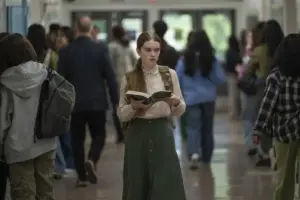
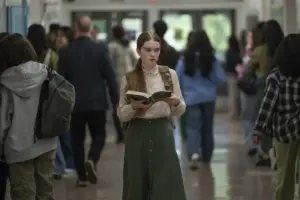
However, narrative friction is introduced immediately through Josh (Luke Speakman), a dissenting child who refuses to participate in the mandatory cheer, preferring instead to quietly read his book. This single act of defiance shatters the pristine illusion, signaling the onset of the film’s psychological and physical descent.
The Picaresque Descent into Horror
For its first cinematic third, Buddy traps the audience within a claustrophobic loop of edutainment tropes, maintaining the maddening, unyielding tone pioneered in Too Many Cooks. However, as the narrative progresses, a secondary plot fractures the single-joke premise, transforming the film into a picaresque adventure-horror.
This structural pivot has sparked debate among critics regarding whether the introduction of a more conventional narrative disrupts the purity of Kelly’s initial tonal trapdoor. Yet, this evolution serves a pragmatic purpose: it provides a sustainable trajectory for a feature-length runtime while retaining the core grotesquery. When the facade finally gives way, the film trades its sterile, over-lit pastel nightmare for visceral, blood-soaked survival horror, tracking its characters through an inescapable descent to its horrifying conclusion.
Supporting Context & Metrics
The Cultural Wave of 1990s Nostalgia Deconstruction
Buddy arrives at the crest of a significant cultural movement within contemporary horror and speculative fiction: an artistic reckoning with the innocuous media imprinted upon by Millennials and Generation Z during their formative years. Across the media landscape, creators are systematically unearthing the latent creepiness embedded in historical children’s broadcasting:
- The Bone Temple: Deconstructs the sensory overload of early-childhood staples like Teletubbies through an unsettling historical and thematic lens.
- Backrooms and Camp: Lean heavily into the aesthetic detritus, outdated technology, and late-90s/early-00s goth-witch subcultures of early internet spaces and analog media.
- Teenage Sex and Death at Camp Miasma, Obsession, and Widow’s Bay: Modern narratives deliberately isolated from the antiseptic glare of contemporary social media, choosing instead to wallow in the tactile, analog textures of late-20th-century isolation.
Within this crowded field of nostalgic subversion, Buddy stands out for its structural purity. Rather than relying solely on cynical deconstruction, it interrogates how humanity weaponizes simplistic narratives to manufacture comfort, weaponizing those exact mechanisms against the viewer.
Ensemble Performances and Character Dynamics
The success of Buddy relies entirely upon the tight-rope act executed by its cast, who must simultaneously embody cloying children’s television caricatures and individuals trapped within a malevolent dimensional prison.
| Cast Member | Character | Role Description & Performance Impact |
|---|---|---|
| Keegan-Michael Key | Buddy (Voice) | The emotional and homicidal core of the film; masterfully shifts between chirpy edutainment jollity, unhinged rage, and existential panic. |
| Cristin Milioti | Ensemble Resident | Brings grounded emotional gravity to the escalating chaos, solidifying her status as one of contemporary cinema’s most versatile actors. |
| Delaney Quinn | Freddy Gardner | The ostensible leader of the children, paired with "Strappy" (voiced by Patton Oswalt), navigating the shift from cheer to terror. |
| Caleb Williams / Tristan Broders | Wade Lyons / Oliver Brownlee | Early co-stars who signal the initial fractures in Buddy’s reality. |
| Madison Skyy Polan | Hannah Hartbeck | A late arrival into the cast who must rapidly adapt to the escalating survival stakes. |
| Luke Speakman | Josh | The rebellious reader whose refusal to play along sparks the initial narrative collapse. |
Official Statements & Creative Vision
Speaking on the conceptualization of the project, co-writer and director Casper Kelly has emphasized the thematic exploration of loneliness, gaslighting, and the psychological architecture of comfort media.

"When you look at the shows we grew up with—the aggressive positivity, the fixed smiles, the absolute denial of negative space or genuine sorrow—there is an inherent gaslighting mechanism at play," Kelly noted during early promotional junkets. "We wanted to take that artificial warmth and push it to its logical extreme. What happens when the thing designed to make you feel safe realizes it has absolute control over your reality?"
Co-writer Jamie King elaborated on the tonal balancing act required to transition a short-form sketch aesthetic into a feature film:
"The challenge wasn’t just keeping the audience scared or laughing; it was maintaining that specific, headache-inducing brightness of 90s television production values. We worked closely with our cinematography and lighting teams to ensure that even as the blood starts flowing and the narrative unspools, the frame retains that sickly, over-saturated visual texture that makes you feel like the walls are closing in."
Cast member Keegan-Michael Key reflected on the vocal challenges of breathing life—and death—into a sentient plush unicorn:
"Buddy isn’t just a monster wearing a costume; he is an embodiment of forced joy. Finding the pocket where a high-pitched, nasal children’s television voice seamlessly bleeds into bloodcurdling homicidal rage was one of the most creatively liberating experiences of my career."
Future Outlook
As Buddy continues its theatrical run, its reception signals a burgeoning appetite for high-concept, auteur-driven horror-comedy that refuses to pander to conventional demographic boxes. By successfully scaling up the surrealist anxieties of Too Many Cooks into a feature-length cinematic framework, Kelly and King have established a blueprint for how modern filmmakers can interrogate the ghosts of twentieth-century mass media.
The film’s commercial and critical trajectory suggests that audiences are increasingly eager for artistic works that "commit to the bit" with absolute conviction. Whether Buddy heralds a wider cinematic trend of elevated edutainment horror or remains a singular, towering anomaly in Casper Kelly’s filmography, it has fundamentally altered the cultural perception of the friendly neighborhood mascot. For viewers willing to surrender to its claustrophobic pastel purgatory, Buddy proves that beneath every smiling, over-lit children’s television host lies an abyss—and that staring directly into it can be remarkably, terrifyingly fun.


Comments
Facebook App ID not configured. Please add it in the Customizer.