
Executive Overview
The long-gestating, highly anticipated cinematic adaptation of C.S. Lewis’s classic fantasy universe is finally taking concrete shape under the visionary direction of Greta Gerwig. Following years of exhaustive industry speculation, strategic silences, and fervent fan debate, Netflix and its creative team have pulled back the curtain on one of the most closely guarded secrets of modern franchise filmmaking: the casting and conceptualization of Aslan, the majestic, divine lion at the heart of The Chronicles of Narnia.
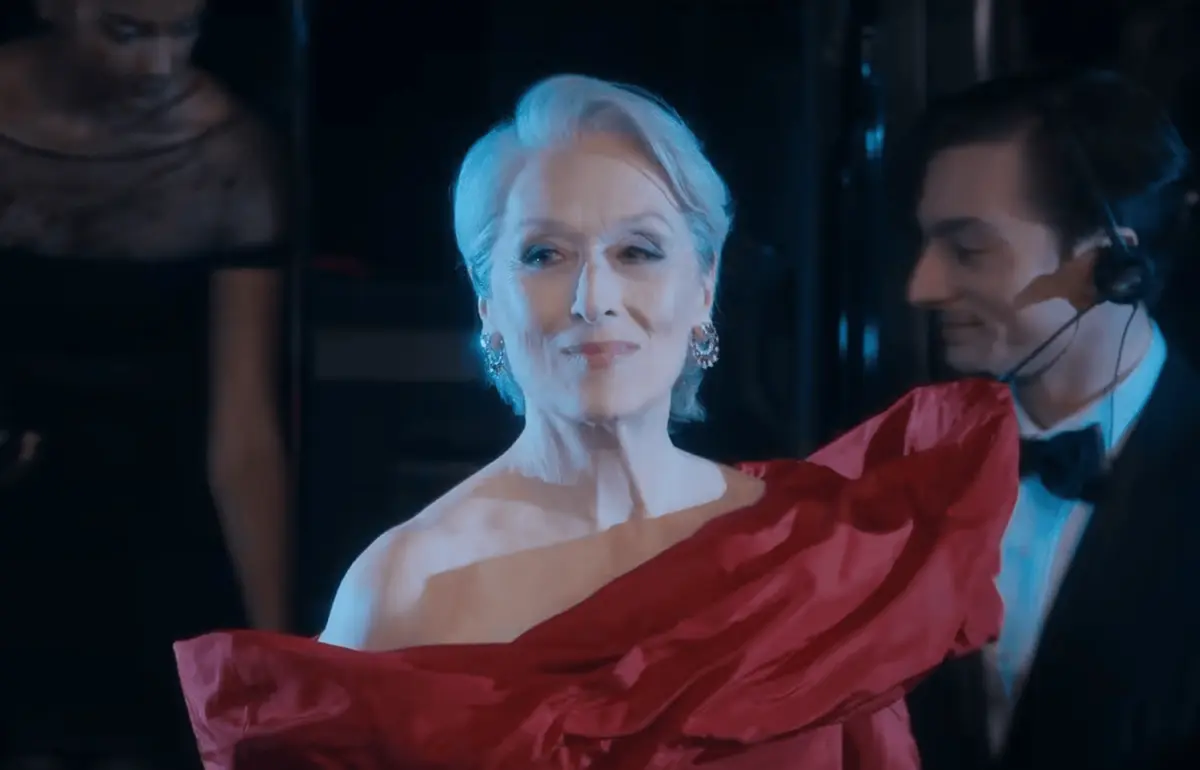
According to an exclusive cover story published by Empire magazine, legendary, multi-Academy Award-winning actress Meryl Streep has been officially confirmed to voice the iconic character of Aslan. However, this is far from a conventional reading of the literary figure. In Gerwig’s bold, auteur-driven interpretation, the great lion will feature striking, distinct visual departures from past iterations—most notably, heterochromic eyes and a bold, red-striped visage that directly pay homage to one of the 20th century’s most transformative cultural icons: David Bowie.
This creative revelation offers profound insight into the ambitious tone Gerwig is establishing for her entry into the Narnian canon. Moving beyond simple children’s fantasy tropes, the production is positioning itself as a prestige cinematic event. With a stellar, star-studded ensemble cast, a deliberate shift in the story’s historical timeline, and a dual theatrical and streaming release strategy slated for early 2027, Narnia: The Magician’s Nephew is shaping up to be one of the most scrutinized and daring blockbuster experiments of the decade.
Read Also
Detailed Chronology: From Page to Screen and the Long Road to Production
The journey of bringing Greta Gerwig’s Narnia to the screen is a tale of corporate acquisition, creative endurance, and strategic re-sequencing. To understand the significance of the Empire reveal, it is essential to trace the chronology of how this monumental project materialized.
[October 2018] Netflix Acquires Rights ──> [July 2022] Greta Gerwig Attached ──> [November 2023] Filming Timeline Set ──> [Late 2024] Casting Announcements ──> [Feb/Apr 2027] Dual ReleaseThe Acquisition of Narnia (2018–2022)
In October 2018, Netflix struck a historic multi-year agreement with The C.S. Lewis Company, securing the global rights to develop series and film projects across the entire seven-book span of The Chronicles of Narnia. For the first time in entertainment history, a single studio held the keys to the entire literary kingdom. For several years, the project remained in early development, with various creatives cycling through conceptual phases before finding a definitive creative anchor.
The Arrival of Greta Gerwig (July 2022)
The paradigm shifted permanently in July 2022, when industry trades confirmed that writer-director Greta Gerwig—fresh off the cultural juggernaut of Barbie and critically acclaimed for works like Little Women and Lady Bird—had officially signed a deal with Netflix to write and direct at least two films in the Narnia universe. Gerwig’s involvement instantly elevated the cinematic profile of the project, transforming a routine IP extraction into a prestige auteur vehicle.
Setting the Timeline and Casting Phase (2023–2024)
As pre-production ramped up throughout late 2023 and 2024, rumors began to swirl regarding which book Gerwig would tackle first. Bucking chronological publication order (The Lion, the Witch and the Wardrobe), confirmation arrived that the inaugural feature would adapt The Magician’s Nephew, the prequel novel that explores the creation of Narnia, the origins of the White Witch, and the mysterious power of the Wood Between the Worlds.
Gradually, industry leaks and official announcements began to sketch out the monumental ensemble. Emma Mackey was locked in to portray Jadis, the formidable White Witch. Concurrently, reports surfaced regarding an expansive supporting roster featuring heavy-hitters such as Daniel Craig, Carey Mulligan, and Ciarán Hinds. Yet, the identity of the actor tasked with voicing Aslan remained the industry’s most fiercely guarded secret—until the recent Empire exposé blew the doors wide open.
Supporting Context & Metrics: Deconstructing the Creative Vision
Greta Gerwig’s approach to casting and visual design relies on a delicate balance of classical gravitas and modern subversion. The decision to cast Meryl Streep as Aslan, paired with the stylistic invocation of David Bowie, is a masterclass in conceptual juxtaposition.
The Philosophy of Casting Aslan
When speaking with Empire, Gerwig elaborated on the Herculean challenge of casting a character who functions simultaneously as a divine allegory, a fierce protector, and a figure of boundless warmth.
"I wanted someone who was profound but not pretentious, who had gravitas but not morose self-seriousness," Gerwig explained. "Someone who could communicate depth and pathos as well as joy and delight. I wanted someone who was older than 70, so there was a wisdom of experience, but who also had the capacity of fresh wonder, like a child. And also to be one of the greatest actors to ever do it. That list is not a long one."
This criteria effectively narrowed the field to a microscopic elite of living performers, making Streep—with her unmatched record of critical acclaim and emotional versatility—an inspired, if unconventional, choice.
Visual Inspirations: The Bowie Connection
Perhaps the most striking detail to emerge from the recent coverage is the physical rendering of Aslan. Moving away from the photorealistic, traditional CGI lions of past cinematic adaptations, Gerwig’s Aslan will feature:
- Heterochromic eyes: Two distinct eye colors, providing an immediate, arresting visual asymmetry.
- A bold, red-striped visage: Distinct facial markings that break up traditional animalistic textures.
According to Empire, these features directly nod to the aesthetic legacy of David Bowie. By integrating the rock icon’s signature otherworldly flair into the physical design of the lion, Gerwig is signaling that this Narnia will not be bound by strict literary naturalism. Instead, it will embrace a heightened, theatrical, and deeply mythic visual language.
Temporal Shifts: Moving to the 1950s
Another critical metric of transformation is the narrative’s temporal setting. In C.S. Lewis’s original text, The Magician’s Nephew is explicitly set in the year 1900, capturing the soot, gaslamps, and rigid social structures of Edwardian London. However, production details indicate that Gerwig has opted to shift the narrative timeline forward into the 1950s.
This temporal migration aligns the origin story more closely with the publication era of the original books (written between 1950 and 1956) and infuses the period aesthetics with post-war anxieties, mid-century architecture, and an entirely different cultural resonance for the human protagonists, Digory Kirke and Polly Plummer.
Official Statements and Cast Roster
While plot details remain tightly sealed, the confirmed and rumored ensemble cast represents a formidable gathering of British and international acting talent. Below is the current breakdown of the principal creative and performance roster associated with the production:
- Meryl Streep as the voice of Aslan
- Emma Mackey as Jadis, the White Witch
- Daniel Craig (in an unconfirmed, widely reported role presumed to be Uncle Andrew Ketterley)
- Carey Mulligan (Role under wraps)
- Ciarán Hinds (Role under wraps)
- Denise Gough (Role under wraps)
- Susan Wokoma (Role under wraps)
- Kobna Holdbrook-Smith (Role under wraps)
- David McKenna (Role under wraps)
- Beatrice Campbell (Role under wraps)
Production Sign-Offs
Industry analysts have noted that Netflix’s willingness to grant Gerwig expansive creative freedom—including radical design choices for sacred literary figures—demonstrates the streamer’s immense confidence in her commercial and artistic vision. By positioning Narnia: The Magician’s Nephew as a definitive tentpole, Netflix is aiming to capture both the nostalgia of longtime literary fans and the cultural prestige associated with high-end cinematic auteurs.
Future Outlook: Release Strategy and Franchise Horizons
As the production clears its final hurdles ahead of its debut, attention has naturally turned toward the exhibition model and the long-term viability of Netflix’s Narnia cinematic universe.
A Hybrid Exhibition Model
In a notable scheduling rollout, Netflix has committed to a bifurcated release strategy that honors both the theatrical experience and home-viewing accessibility:
- Theatrical Release: February 12, 2027
- Streaming Debut (Netflix): April 2, 2027
This windowing strategy allows the film to command the big screen—maximizing its visual effects, orchestral score, and immersive world-building—roughly two months before landing in millions of living rooms worldwide. It reflects a growing industry trend where streaming giants recognize the vital marketing and cultural impact of a traditional theatrical run for major event films.
What Lies Ahead for the Wardrobe and Beyond?
With The Magician’s Nephew setting the foundational mythology—detailing how the wardrobe tree was grown, how evil first entered Narnia, and how the Professor acquired his magical house—the door is wide open for future installments. If Gerwig’s bold vision succeeds, Netflix’s sprawling adaptation could finally realize the complete, multi-film fantasy landscape that fans have dreamed of for decades.
As 2027 approaches, anticipation will only intensify. With Meryl Streep breathing life into a Bowie-inspired Aslan under Greta Gerwig’s meticulous direction, the gates of Narnia are set to open wider, and stranger, than ever before.


Comments
Facebook App ID not configured. Please add it in the Customizer.