
Executive Overview
In an aggressive push to redefine how modern consumers interact with spoken-word entertainment, Audible has officially announced a suite of transformative, AI-driven features designed to fundamentally alter audiobook discovery and consumption. Centered around an industry-first initiative called Audio Discovery, the platform is rolling out innovative tools aimed at eliminating the friction traditionally associated with finding, digesting, and returning to long-form audio stories.
Alongside Audio Discovery, the platform is introducing Personalized Collections while expanding two of its most buzzed-about beta features: Ask a Question and Recaps. By blending human
editorial curation with advanced artificial intelligence—including Audible’s proprietary virtual voice technologies and archival interview recordings—the company is attempting to solve a persistent consumer dilemma: how to navigate a massive, ever-expanding catalog without getting overwhelmed.
Read Also
Developed with direct input from authors, editors, and creators, these new features represent a holistic redesign of the listening lifecycle. Whether a user is trying to find their next hidden gem during a morning commute, clarify a complex historical reference mid-chapter, or jump back into a sprawling fantasy epic after a two-week hiatus, Audible’s latest updates promise a seamless, deeply personalized audio ecosystem.
Detailed Chronology of the Release
The deployment of these features marks the culmination of months of quiet testing, beta trials, and backend technological development aimed at harnessing the potential of generative and analytical AI in audio spaces.
The Beta Phase (Early 2025)
The foundational elements of this new ecosystem began taking shape earlier in the year when Audible quietly rolled out limited beta versions of Ask a Question and Recaps for select Audible Originals and public domain titles.
- The Goal: To test user engagement and gather data on whether real-time, context-aware assistance would improve listening retention and overall platform satisfaction.
- The Result: Early metrics exceeded expectations. Internal data revealed that users who engaged with the Ask a Question feature did not just find answers—they spent significantly more time actively listening to the titles. This clear correlation between in-story utility and extended engagement greenlit the features for broader deployment.
The Official Announcement (Late November 2025)
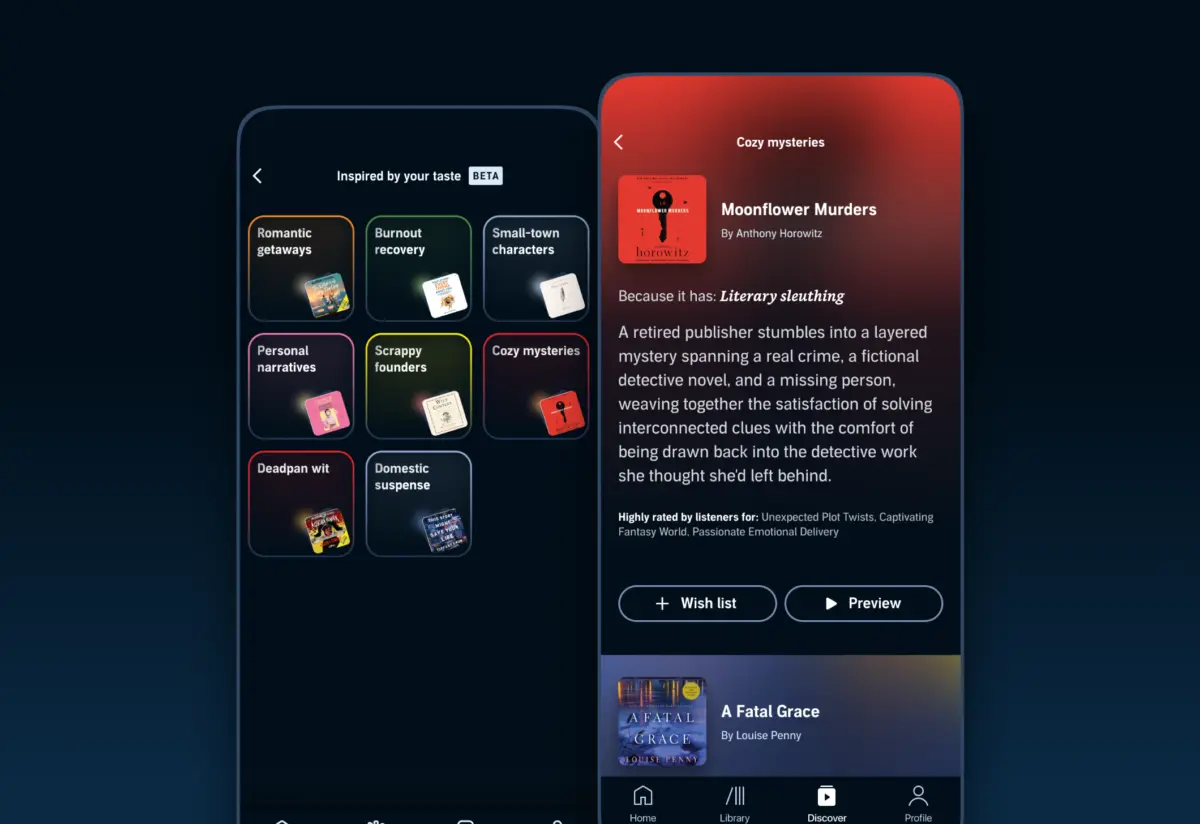
Audible officially pulled back the curtain on its comprehensive product overhaul, introducing the marquee feature: Audio Discovery. Positioned as an industry-first breakthrough in hands-free recommendation systems, Audio Discovery was engineered to combat "choice paralysis" by offering rich, multi-dimensional audio samples of books before purchase. Simultaneously, the platform announced the rollout of Personalized Collections to break away from traditional, algorithmic bestseller lists that often favor hyper-commercial titles over indie or mid-list gems.
Phased Rollout and Future Roadmap (December 2025 and Beyond)
- Immediate Availability: The brand-new Audio Discovery and Personalized Collections features are beginning their rollout immediately on select English-language titles within the United States.
- December Expansion: A broader expansion of the Ask a Question and Recaps features is scheduled to deploy across an expanded catalog of U.S. English-language titles starting this December.
- Global and Platform Scale: Available across all platforms and membership tiers for customers who have either purchased a title or accessed it through their membership, the features are slated for international expansion following the initial U.S. validation phase.
Supporting Context & Metrics: The Mechanics Behind the AI
To understand the weight of Audible’s announcement, one must look closely at the underlying technology and user behavioral metrics that informed these product developments.
Deconstructing Audio Discovery
Finding a new book on a mobile screen while driving, running, or doing chores has always been a cumbersome task. Traditional apps rely heavily on text synopses, user star ratings, and static cover art—none of which translate well to a hands-free environment.
Audio Discovery bridges this gap by transforming the recommendation process into an auditory experience:

- Hybrid Narration: Each recommendation blends a professionally narrated sample of the audiobook with a concise, AI-generated overview of the book’s core themes.
- Human-Centric Insights: Rather than relying purely on synthesized data, the overviews incorporate real commentary drawn directly from archival audio recordings of past author interviews and insights from Audible’s internal editorial team.
- Data Sources: The system aggregates publicly available metadata, professional synopses, and reader reviews to synthesize a compelling "elevator pitch" for why a specific title aligns with a user’s unique taste profile.
Personalized Collections vs. Bestsellers
For years, digital bookstores and audio platforms have been dominated by the heavy gravity of bestseller lists. While effective for blockbuster releases, this dynamic often starves lesser-known creators and niche genres of organic discovery.
Audible’s Personalized Collections leverage a hybrid approach:
- Algorithmic Taste-Matching: AI analyzes deep listening habits—such as completion rates, preferred pacing, and micro-genre preferences—to group recommendations into evocative, hyper-targeted categories (e.g., "Cozy Mysteries," "Atmospheric Sci-Fi," or "Romantic Getaways").
- Editorial Curation: AI algorithms are kept in check by human editors, ensuring that recommendations maintain literary integrity and surface "hidden gems" that automated filters might otherwise miss.
Ask a Question and Recaps: Technical Guardrails
Integrating AI into copyrighted literary works requires strict boundaries to prevent hallucinations and spoilers. Audible’s engineering team addressed these concerns with rigid design parameters:
- Strict Grounding: The Ask a Question tool is strictly anchored to the specific audiobook the user is currently consuming. Answers are capped at a concise 100-word limit, providing instant clarity on plot points, character relations, or historical contexts without sending the listener down a web-searching rabbit hole.
- Spoiler-Free Recaps: Designed for listeners returning to a book after an extended break, the Recaps feature generates an audio summary strictly covering events up to the listener’s exact pause point. By ensuring zero forward-looking plot leakage, it preserves the narrative tension essential to storytelling.
Official Statements and Industry Perspective
Company leadership has framed these technological upgrades not as a replacement for human creativity, but as a bridge designed to connect listeners more intimately with the creators they love.
"Picking your next listen should feel like getting a tip from a friend," explained Andy Tsao, Chief Product and Analytics Officer at Audible, during the rollout announcement.
"With audio discovery, you’ll get a quick audio take on why the title might be right for you, from our editors, fellow listeners, or even the author. Some of the best listening experiences are those rare finds or hidden gems, and we want to make those great discoveries happen more often and more easily."
Industry analysts view Audible’s aggressive pivot toward conversational, AI-enhanced audio interfaces as a necessary evolution in the modern streaming economy. As competition heats up between Spotify, Apple Books, and specialized podcast networks, platforms can no longer rely solely on library size. The competitive edge now belongs to the platform that can reduce cognitive load, improve user retention, and turn casual browsers into deeply engaged superfans.
Furthermore, Audible’s careful inclusion of actual author interview clips within the Audio Discovery modules demonstrates an acute awareness of creator relations. By keeping authors’ actual voices in the recommendation loop, Audible reassures the creative community that AI is being deployed to elevate human storytelling rather than automate it out of existence.
Future Outlook: What This Means for the Audio Industry
As Audible continues to scale these features throughout late 2025 and into 2026, the broader implications for the publishing and audio entertainment industries are profound.
- The Death of the Static Catalog: Platforms can no longer afford to present static grids of book covers. As consumers grow accustomed to conversational, on-demand audio discovery, competitors will be forced to develop their own hands-free recommendation architectures.
- Enhanced Creator Visibility: By shifting focus away from monolithic bestseller lists and toward hyper-personalized collections, mid-list authors and independent creators stand to capture a much higher share of organic discovery. This decentralization could radically alter how books are marketed and sold digitally.
- Redefining Long-Form Engagement: Features like Recaps and Ask a Question address the modern consumer’s fractured attention span. By making it frictionless to return to a complex 20-hour audiobook after a busy week, Audible is effectively lowering the psychological barrier to entry for long-form literature.
Ultimately, Audible’s latest gambit signals a mature phase in the evolution of digital audio. By marrying the convenience of machine learning with the irreplaceable warmth of human editorial insight and authorial voice, the company is setting a new gold standard for how stories are found, understood, and experienced in the digital age.





Comments
Facebook App ID not configured. Please add it in the Customizer.