
Executive Overview
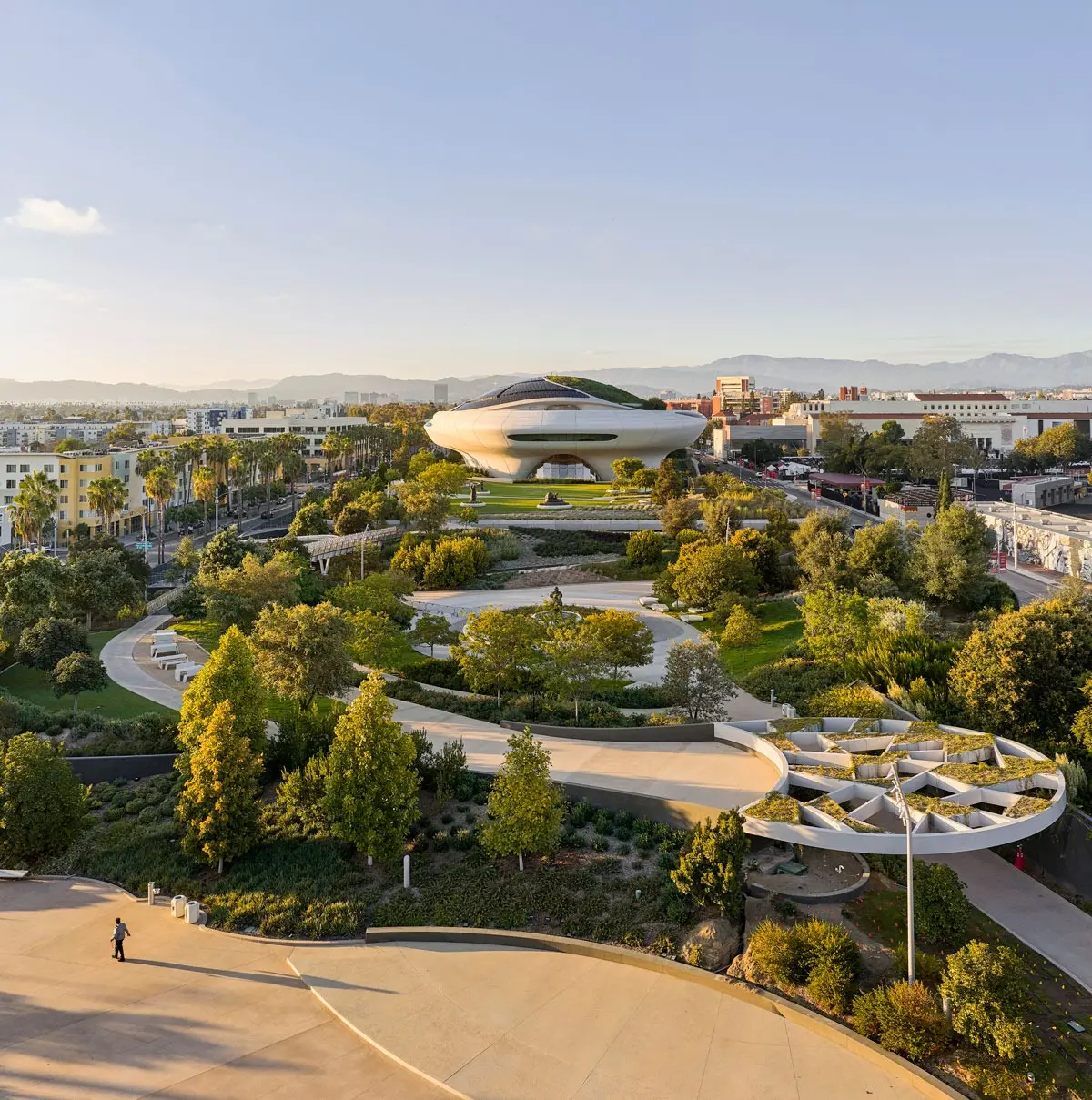
When legendary filmmaker George Lucas and his wife, Mellody Hobson, first envisioned the Lucas Museum of Narrative Art, the narrative was one of radical inclusivity. Promoted as a "people-first organization," the $1 billion institution was designed to democratize fine art by celebrating the visual culture of everyday life—comic books, pulp illustrations, storyboards, and cinematic imagery. Sited prominently within Los Angeles and occupying land leased from the state for the nominal sum of just $30 a year, the museum was hailed as a transformative civic anchor. Architect Ma Yansong of MAD Architects conceived the sprawling structure and its surrounding plaza not as an isolated cultural fortress, but as a porous, welcoming "gateway" seamlessly connecting the urban fabric with green public space.
Yet, as the museum recently swung open its doors to the public, that ambitious vision of openness crashed hard against the realities of contemporary security, vehicular traffic management, and operational control. During its inaugural weekend, visitors arriving at the expansive public plaza were met with a jarring sight: makeshift plastic-greenery-lined construction fences cordoning off the entryways from both sides. Representatives for both the museum and MAD Architects have since confirmed that these temporary barricades are merely placeholders for permanent stainless-steel gates. The plaza, conceived as a generous civic gift, will be permanently fenced off.
This unexpected turn has ignited a fierce debate among architectural critics, urban planners, and the art community. Critics point out the profound irony of a heavily subsidized, publicly accommodated institution walling off its exterior grounds. "What could have been a grand welcome has become a gated off, highly controlled space that now feels separate from the park and the neighborhood," noted the Los Angeles Times. "Sure, anyone can come, but they are no longer invited."
Read Also
Beyond the security fences, the Lucas Museum’s rocky opening weeks have exposed deeper philosophical tensions regarding its institutional mission. The physical walling-off of the courtyard mirrors a broader pattern of inward-looking policies—including significant staff layoffs, the dismantling of robust public education initiatives, and a controversial curatorial choice to strip the galleries of all didactic texts. Together, these developments paint a picture of a billion-dollar institution struggling to balance its populist rhetoric with an increasingly exclusionary operational reality.
Detailed Chronology: From Civic Vision to Gated Reality
To understand the controversy surrounding the Lucas Museum’s perimeter, it is necessary to examine the trajectory of its design, development, and public-facing promises over the past decade.
The Architectural Promise (2014–2021)
When the museum project first took shape—following failed proposals in Chicago and San Francisco—the emphasis was squarely on integration with the natural and urban landscape of Los Angeles. Selected for a site neighboring Exposition Park, the museum was designed by Ma Yansong to resemble an otherworldly, fluid spaceship that hovered above the ground, lifting its mass to create continuous, uninterrupted public terrain underneath.
The accompanying outdoor plaza was lauded as a vital public amenity. Architectural renderings and press releases consistently described a porous threshold where local residents, park-goers, and museum patrons could mingle without barriers. The spatial continuity between the surrounding parklands and the museum’s footprint was central to securing civic approvals and favorable lease terms from state authorities.
Leadership Rhetoric and Inclusive Aspirations (2020–2025)
As construction pressed forward through the challenges of the early 2020s, museum leadership frequently leaned into the language of extreme accessibility. In a definitive 2020 interview with ARTnews, then-director Sandra Jackson-Dumont articulated a mission statement rooted in radical empathy and outreach:
"We want to be a people-first organization. We want to meet people wherever they are—physically, intellectually, emotionally—and we want to be inclusive in a way that connects with who people are in their daily lives and what matters to them."
This ethos resonated with the core subject matter of the museum. By elevating narrative art—mediums historically sidelined by traditional fine-art canons—the institution positioned itself as a champion for audiences who often felt alienated by high-art elitism.
The Opening Weekend Reality Check (October 2026)
The institutional goodwill built over years of marketing collided with reality during the museum’s long-awaited public opening weekend in October 2026. Visitors approaching the multi-million-dollar campus encountered heavy, makeshift metal barriers wrapped in artificial green plastic mesh. These crude barricades effectively choked off pedestrian access to the sprawling courtyard from multiple directions.
When questioned by reporters from the Los Angeles Times, museum officials acknowledged that the setup was not temporary in spirit, even if the materials were. Spokespeople confirmed that the plaza’s primary access points will remain permanently gated off, with the temporary mesh fences slated to be swapped out for sleek, permanent stainless-steel security structures.
Supporting Context & Metrics: The Anatomy of a Billion-Dollar Paradox
The decision to gate the Lucas Museum plaza cannot be viewed in a vacuum; it sits at the intersection of municipal economics, security architecture, and internal institutional restructuring.
Financial Subsidies and Public Accountability
The friction between the museum’s physical footprint and the public is amplified by the sheer scale of financial backing and public land utilization involved:
- Capital Investment: The total cost of developing, building, and launching the Lucas Museum of Narrative Art has surpassed $1 billion, making it one of the most expensive private cultural institutions ever constructed.
- Land Lease Terms: The museum sits on land leased from the state of California for a nominal fee of just $30 per year, a concession granted largely on the premise that the institution would function as a broad-based, public-serving civic asset.
- Access Policy: While unticketed visitors are technically permitted to enter the gated plaza, the café, and the gift shop, the psychological and physical barrier of the gates fundamentally alters the nature of that access. As cultural critics have observed, transforming an open civic square into a controlled security checkpoint converts public hospitality into managed surveillance.
Internal Turmoil and Staffing Cuts
The physical fortification of the perimeter mirrors a period of profound internal contraction. In 2025, the museum underwent significant restructuring, which included gutting approximately 14 percent of its full-time staff, with a disproportionate impact falling on the education and public programming departments.
Furthermore, the departure of director Sandra Jackson-Dumont in 2025 signaled a strategic shift in leadership priorities. Without the vocal champion of the "people-first" ethos at the helm, the institution has pivoted toward a more insular operational philosophy.
Curatorial Isolation: The Absence of Didactic Texts
This inward turn is not merely architectural or administrative; it is deeply embedded in the gallery experience itself. In reviews of the newly opened museum, critics noted a striking curatorial choice: the complete absence of wall text, labels, or didactic panels providing historical or cultural context for the artworks on display.
Museum representatives defended the decision by arguing that "looking should be privileged." While prioritizing unmediated visual engagement with art has some precedent in modern exhibition design, critics argue it represents an abdication of the museum’s fundamental educational duty. Rather than broadening public access—a founding pillar of the Lucas mission—stripping galleries of context can alienate visitors who lack specialized art-historical training, effectively locking viewers out of the intellectual production of knowledge.
Official Statements and Institutional Defense
Facing a rising tide of negative press and public bewilderment, representatives for both the museum and its architectural firm have stepped forward to explain the logistical imperatives driving the design changes.
The Security and Traffic Argument
Seth Fowler, a spokesperson for the museum, defended the perimeter control in a statement to the Los Angeles Times, explaining that the change was a direct response to external environmental hazards. According to Fowler, the pedestrian plaza required physical protection from heavy car traffic flowing along both adjacent thoroughfares. Furthermore, managing the sheer volume of anticipated foot traffic necessitated controlled entry points to maintain order and crowd safety.
The Architect’s Perspective
Dixon Junliang Lu, a principal at MAD Architects, offered a design-evolution defense, noting that the perimeter strategy shifted as construction progressed. Lu explained that as the project developed, operational realities and security requirements became far more sharply defined, forcing adjustments to the initial utopian vision:
"The fence design evolved as the project development continued and the operational and security requirements became more defined."
Despite these technical justifications, the defense has done little to soothe critics who argue that world-class architecture should solve complex urban and security challenges through innovative spatial design rather than resorting to default defensive gating.
Future Outlook: Can the Lucas Museum Rebuild Trust?
As the Lucas Museum of Narrative Art settles into its long-term operations in Los Angeles, it faces a defining challenge: bridging the chasm between its populist ideological origins and its current fortification.
The installation of permanent stainless-steel gates will soon replace the makeshift plastic greenery of opening weekend, cementing the plaza’s status as a controlled compound. For a cultural landmark dedicated to the art of the people—comics, illustrations, and cinematic storytelling meant to resonate with everyday human experience—the presence of permanent security gates sends a deeply conflicting message.
Moving forward, the museum’s leadership will need to work proactively to mend relations with the local community, urban planners, and cultural critics. Restoring robust public educational programming, re-evaluating visitor engagement strategies within the galleries, and finding creative ways to soften the impact of its perimeter security will be essential steps.
Ultimately, the success of the Lucas Museum of Narrative Art will not be measured solely by the billion-dollar valuation of its endowment or the cinematic pedigree of its founders. It will be judged by whether the public feels genuinely welcomed inside its walls—or left standing outside the gate.




Comments
Facebook App ID not configured. Please add it in the Customizer.