

Executive Overview
In a celebration that bridged the gap between ecological urgency and artistic expression, acclaimed poet Fiona Benson has been officially crowned the winner of the prestigious 2026 Laurel Prize. Announced during a high-profile evening ceremony held as part of the Contains Strong Language festival in Salford, Benson secured the top honor for her widely acclaimed collection, Midden Witch, published by Jonathan Cape.
The Laurel Prize, now in its sixth consecutive year, stands as one of the literary world’s most significant accolades dedicated entirely to nature and environmental poetry. Established by UK Poet Laureate Simon Armitage and run in close association with The Poetry School, the prize specifically seeks out works that elevate public consciousness regarding the dual realities of the climate crisis—highlighting both the profound existential challenges facing our natural world and the imaginative, actionable solutions required to combat them.
Benson’s victory sees her walk away with the substantial £5,000 first-place prize. She triumphed over a fiercely competitive shortlist featuring four other exceptional contemporary collections, each of which was awarded £1,000 in recognition of their contribution to eco-poetry. This year’s judging panel—comprising esteemed poets David Morley and Imtiaz Dharker, alongside environmental policy expert Bethan Laughlin—faced the arduous task of narrowing down a slate of submissions that reflected the breadth, depth, and escalating urgency of modern environmental writing.
Read Also
Midden Witch, which previously earned recognition as a Poetry Book Society choice in the summer of 2025, weaves together folklore, historical persecution, and ecological anxieties. Published by Jonathan Cape, the collection has been lauded by critics for its fierce reclamation of marginalized voices—specifically the healers, artists, and prodigies historically branded as witches—and recasting them as stewards of the earth. As ecological collapse accelerates globally, the 2026 Laurel Prize underscores the vital role that poetry plays in framing the climate crisis not merely as a scientific emergency, but as a deeply cultural and spiritual reckoning.
Detailed Chronology: The Road to the 2026 Laurel Prize
The journey toward the 2026 Laurel Prize ceremony in Salford was marked by months of rigorous evaluation, public anticipation, and literary milestones. Understanding the trajectory of Fiona Benson’s win requires a closer look at the timeline that brought Midden Witch from manuscript to the apex of environmental literature.
Summer 2025: The Genesis of Recognition
The foundational momentum for Midden Witch began well before the Laurel Prize judges convened. In the summer of 2025, the collection was selected as a Poetry Book Society Choice, a distinction that signaled to the broader literary community that Benson’s latest work was operating at the peak of its powers. This early endorsement placed the book on the radar of poetry enthusiasts and critics alike, setting the stage for its later consideration by major prize committees.
Spring–Summer 2026: The Longlist and Shortlist Selection
As submissions rolled in for the sixth iteration of the Laurel Prize, the coordinating bodies—working alongside The Poetry School and under the watchful eye of founder Simon Armitage—compiled a diverse pool of entries. The 2026 submissions reflected an increasing cross-pollination between rigorous scientific observation and lyrical lamentation.
When the shortlist was finally locked in, it showcased a transatlantic and multi-publisher snapshot of contemporary eco-poetry:
- Ethnology by Cathy Galvin (published by Bloodaxe Books), an exploration of human culture’s deep roots in the physical landscape.
- Natural History by Brandon Kilbourne (published by Graywolf Press), bringing an acute, scientifically informed eye to the biological intricacies of the natural world.
- Tipping Point by Jane Lovell (published by Night River Wood), a visceral response to the fragile thresholds of modern ecosystems.
- The Storm’s Flora by Laura Wainwright (published by Seren Books), capturing the fierce, untamable weather patterns and resilient botanical life of coastal and rural terrains.
- Midden Witch by Fiona Benson (published by Jonathan Cape), the eventual winner, bridging historical trauma and ecological devastation.
September 25, 2026: The Salford Ceremony
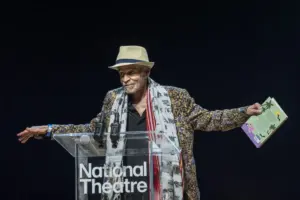
The culmination of the 2026 Laurel Prize cycle occurred on the evening of September 25, 2026, in Salford. As part of the vibrant Contains Strong Language festival—the BBC and partner organizations’ flagship annual poetry celebration—the ceremony drew notable figures from across the British and international literary landscapes.
Tension filled the venue as the judges prepared to announce the winner. When Fiona Benson’s name was called for Midden Witch, it marked the capstone of an evening dedicated to celebrating the ways language can confront, mourn, and ultimately help salvage a changing planet. Alongside Benson, the four shortlisted poets—Galvin, Kilbourne, Lovell, and Wainwright—were formally commended and awarded their £1,000 runner-up prizes, cementing a stellar year for environmental verse.
Supporting Context & Metrics: The Evolution of the Laurel Prize
To fully appreciate the weight of Fiona Benson’s victory, it is essential to examine the institutional framework of the Laurel Prize, the criteria that govern it, and the broader socioeconomic context in which environmental poetry operates today.
Origins and Vision: Simon Armitage and The Poetry School
Launched six years ago by UK Poet Laureate Simon Armitage, the Laurel Prize was conceived to fill a glaring gap in the literary awards landscape. While numerous prizes exist for general poetry, fiction, and non-fiction, few institutions explicitly reward writing that engages with the non-human world, climate breakdown, and ecological degradation.
Partnering with The Poetry School, Armitage envisioned a prize that would not only celebrate artistic excellence but also actively mobilize public awareness. By incentivizing writers to turn their craft toward the biosphere, the Laurel Prize has helped legitimize "eco-poetry" as a central, urgent subgenre of modern literature rather than a niche pastoral pastime.
The Financial and Institutional Framework
The Laurel Prize is bolstered by competitive financial backing designed to give working poets the breathing room to pursue ambitious projects.
- First-Prize Winner: £5,000 (awarded to Fiona Benson for Midden Witch)
- Shortlisted Poets: £1,000 each (awarded to Cathy Galvin, Brandon Kilbourne, Jane Lovell, and Laura Wainwright)
In an economic climate where poets frequently struggle to monetize their labor, these cash injections—coupled with the prestige of the Laurel name—offer meaningful career acceleration. Furthermore, partnerships with organizations like the Poetry Book Society ensure that winning and shortlisted titles receive direct commercial distribution boosts, reaching dedicated subscribers and retail networks through initiatives such as member discounts.

Deconstructing Midden Witch
At the heart of the 2026 award is Fiona Benson’s Midden Witch. Published by Jonathan Cape, the collection has been expertly summarized by its publisher as "the thrilling story of the healers, artists and prodigies once persecuted as witches."
While at first glance historical persecution and environmental poetry might appear to occupy different spheres, Benson’s work brilliantly sutures them together. The historical "witch"—traditionally a woman deeply attuned to the properties of herbs, the cycles of the moon, the weather, and the regenerative capacities of the land—is framed in Midden Witch as an early ecological casualty. The patriarchal and institutional forces that sought to eradicate these figures are implicitly and explicitly linked to the extractive, dominating impulses that now drive global climate change.
By reclaiming these figures, Benson constructs a poetic lineage of resistance. Her verse acts as a midden—an archaeological deposit of domestic refuse, shells, and discarded bones—refusing to let lost histories and degraded landscapes be forgotten. It is this complex thematic layering that ultimately swayed the 2026 judging panel.
Official Statements & Expert Perspectives
The announcement of the 2026 Laurel Prize winner prompted widespread acclaim from the literary community, the judging panel, and cultural commentators.
The Judges’ Verdict
The 2026 panel—consisting of poets David Morley and Imtiaz Dharker, alongside environmental policy expert Bethan Laughlin—provided a unique interdisciplinary approach to evaluating the shortlist. Bridging creative writing and environmental science, the judges emphasized that the winning collection successfully married technical poetic mastery with urgent ecological truth.
While specific individual remarks from the ceremony highlighted the unprecedented strength of the shortlist, the collective sentiment of the panel underscored a vital truth: poetry possesses a unique capacity to bypass political polarization and speak directly to human empathy.
In a joint statement regarding the ethos of the Laurel Prize, organizers reiterated the core mission of the award:
"We live in an era where scientific data alone is no longer enough to motivate systemic change. We need art that makes us feel the loss of our rivers, our forests, and our species. The Laurel Prize exists to champion those writers who use the precision of language to defend the living world."
Publisher and Society Reactions
Representatives from Jonathan Cape expressed immense pride in Benson’s win, noting that Midden Witch represents a high-water mark for contemporary British poetry. The synergy between Cape’s editorial vision and Benson’s uncompromising poetic voice has once again yielded a landmark text.
Concurrently, leadership from The Poetry Society and the Poetry Book Society highlighted the growing appetite among readers for environmentally conscious literature. With Midden Witch having captured the imagination of poetry subscribers since its summer 2025 selection, its ascension to the Laurel Prize podium confirms that readers are actively seeking out art that wrestles with the realities of the Anthropocene.
Future Outlook: The Growing Imperative of Eco-Poetry
As the celebrations in Salford conclude, the implications of Fiona Benson’s victory extend far beyond a single evening of accolades. The 2026 Laurel Prize arrives at a critical juncture in global history, where climate anxiety, biodiversity loss, and ecological degradation dominate public consciousness.
The Maturation of Eco-Poetry as a Literary Force
In its sixth year, the Laurel Prize has solidified its reputation as the premier barometer for environmental literature in the English-speaking world. No longer viewed as mere "nature writing" characterized by romanticized pastoralism, modern eco-poetry—as exemplified by Benson, Galvin, Kilbourne, Lovell, and Wainwright—is unflinching, political, scientific, and deeply elegiac. It confronts industrial pollution, species extinction, and systemic ecological injustice head-on.
What Lies Ahead for Fiona Benson
For Fiona Benson, winning the 2026 Laurel Prize introduces Midden Witch to an even wider international readership. As public events, festival invitations, and academic discussions surrounding the collection multiply, Benson’s voice will undoubtedly play a leading role in shaping how the literary community articulates the ecological crises of the late 2020s.
Furthermore, the continued success of the Laurel Prize—bolstered by the enduring vision of Simon Armitage and the logistical backbone of The Poetry School—guarantees that future generations of writers will have a dedicated platform to channel their ecological grief and hope into enduring art.
As we look toward the seventh year of the Laurel Prize and beyond, works like Midden Witch serve as both a warning and a consolation: reminders that even in the face of unprecedented environmental disruption, human language retains the profound power to bear witness, to remember, and to spark transformation.



Comments
Facebook App ID not configured. Please add it in the Customizer.