
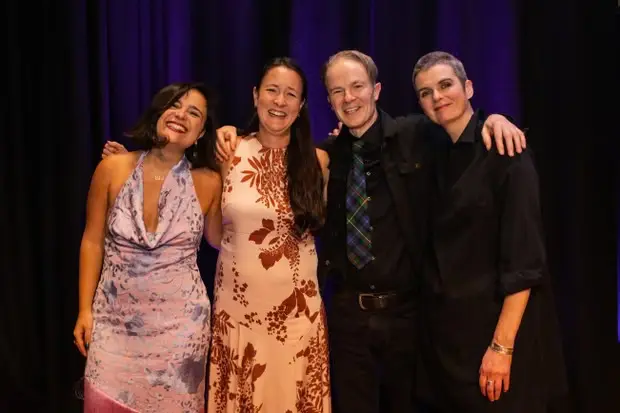
London, United Kingdom — On the evening of Saturday, October 24, 2026, the cultural heart of London’s Southbank Centre beat to a lyrical rhythm as the Queen Elizabeth Hall played host to one of the most anticipated literary events of the calendar year: the annual Forward Prizes for Poetry.
Against a backdrop of packed auditorium seats and palpable creative anticipation, the ceremony unfolded as a celebration of the breadth, emotional depth, and political acuity of contemporary verse. Guiding the evening was the legendary host Joelle Taylor, whose electrifying presence set a tone of reverence and celebration. Alongside Taylor, the chair of the judging panel, Sarah Moss, and fellow judge Michael Mullen took to the stage to unveil the literary talents who triumphed across the four prestigious categories.
The 2026 ceremony proved to be a masterclass in curation, honoring works that traverse deep personal grief, transnational identity, the shadows of collective catastrophe, and the nuanced humor of everyday geography. This year’s winners—Sarah Howe, Nur Turkmani, Tara Bergin, and Biff Smith—cemented a powerful truth: that poetry remains humanity’s most resilient archive.
Read Also
Executive Overview: A Landmark Year for Poetry
The Forward Prizes, established in 1992 to celebrate excellence in poetry and widen its audience, have long served as a bellwether for the literary zeitgeist. The 2026 iteration was no exception. With categories spanning single poems (both written and performed), debut collections, and major single collections, the awards showcased a diverse cross-section of voices pushing the boundaries of form and content.
At the apex of the evening, Sarah Howe claimed the coveted £10,000 Forward Prize for Best Collection for Foretokens (Chatto & Windus). The win marks a triumphant return to the prize circuit for Howe, whose debut collection, Loop of Jade, made history as the first debut to win the T.S. Eliot Prize.
Meanwhile, the fiercely competitive Jerwood Prize for Best First Collection went to Nur Turkmani for October (Hajar Press), a haunting and meditative debut examining Lebanese history, trauma, and societal rupture. In the single-poem categories, Tara Bergin captured the Best Single Poem – Written prize with "The Fear," published in The Stinging Fly, while Biff Smith claimed the Best Single Poem – Performed accolade for "Dumbarton East," a wry, deeply moving piece brought to life via Loud Poets.
The evening was more than a mere distribution of trophies; it was a vibrant testament to the enduring power of language to make sense of a fragmented world.
Detailed Chronology of the Gala Evening
The evening of October 24 began long before the house lights dimmed at Queen Elizabeth Hall. Arriving guests—comprising publishers, poets, critics, and devoted readers—filled the Southbank Centre’s foyer spaces, exchanging predictions and celebrating the vitality of the UK and international poetry scenes.
Opening and Introductory Remarks
As the audience took their seats, the house lights faded to be replaced by a warm, focused stage glow. Joelle Taylor strode to the podium. Known for her magnetic stage presence and fierce advocacy for spoken word, Taylor immediately commanded the room. She spoke eloquently about poetry’s role as a sanctuary and a mirror during times of global uncertainty.
Following Taylor’s introductory remarks, the judging panel—led by novelist and academic Sarah Moss alongside judge Michael Mullen—took the stage to reflect on the immense challenge of reading through hundreds of submissions to arrive at this year’s shortlists. Moss emphasized that the winning texts were chosen not merely for technical proficiency, but for their ability to forge an immediate, unbreakable emotional bond with the reader and listener.
Unveiling the Winners
The rhythm of the announcements built steadily toward the evening’s crescendo:
- Best Single Poem – Performed: Biff Smith took the first major win of the night for "Dumbarton East," demonstrating the kinetic energy of live verse.
- Best Single Poem – Written: Tara Bergin was announced as the winner for "The Fear," praised for its quiet, timeless resonance.
- The Jerwood Prize for Best First Collection: Nur Turkmani accepted the award for October, drawing warm applause for a work that navigates collective trauma with profound grace.
- Best Collection: The evening culminated with Sarah Howe winning the headline prize for Foretokens, an emotional high point that brought the audience to their feet.
The night concluded with the traditional gathering of the winners on stage—arms interlocked, smiling broadly—capturing a spirit of camaraderie that defied the competitive nature of literary awards.
Deep-Dive Analysis of the Winning Works
Sarah Howe and Foretokens (Best Collection Winner)
Sarah Howe’s victory with Foretokens (published by Chatto & Windus) represents a major milestone in contemporary British poetry. Coming over a decade after her landmark debut, Loop of Jade, Foretokens grapples with the seismic shifts of mid-life: the disorienting, wondrous terrain of new parenthood, the profound grief accompanying the death of her father, and the delicate unspooling of her mother’s early life in Hong Kong.
Howe’s poetic DNA is deeply rooted in formal precision, intellectual curiosity, and emotional transparency. A prime example of this sensibility is her poem "A History of My Relationship with My Mother in Twenty-three Arguments about the Laundry," which was first published in The Poetry Review in Autumn 2023. The piece brilliantly uses the mundane domestic chore of washing clothes as a conceptual framework to explore maternal friction, cultural inheritance, and unspoken affection.
Howe’s artistic footprint extends far beyond the printed page. She has consistently engaged in interdisciplinary collaborations, proving poetry’s ability to converse with visual art, historical scholarship, and digital media. Notably, she partnered with poet Fred D’Aguiar on a collaborative project involving The Poetry Society, Oxford University, and poetrycinema to produce filmpoems for TIDEfest 2021—part of the wider TIDE (Travel, Transculturality and Identity in England, 1550–1700) research project. For that commission, Howe authored the poem "Stoneware dish: Longquan kilns," inspired by a historical artifact and transformed into a striking animation by filmmaker Aindri C.
Furthermore, Howe and D’Aguiar participated in a National Portrait Gallery commission, writing a new poem in response to Pierre Mignard’s 1682 painting, Louise de Kéroualle, Duchess of Portsmouth with an unknown girl. This deep historical and visual literacy permeates Foretokens, making her Forward Prize win a richly deserved recognition of a maturing master craftsperson.
Nur Turkmani and October (Jerwood Prize for Best First Collection)
In winning the Jerwood Prize for Best First Collection, Nur Turkmani has announced herself as a formidable new voice on the international literary landscape. Published by Hajar Press, Turkmani’s debut collection, October, spans several pivotal Lebanese Octobers.
The collection acts as a lyric archive, meditating deeply on rupture, historical trauma, and personal transformation. Against the backdrop of collective catastrophe, Turkmani traces the quiet, devastating undoing and remaking of human relationships. The judges lauded the collection for its unflinching courage and its ability to locate moments of transcendent beauty amid societal collapse. October is not just a regional chronicle; it is a universal exploration of how humans endure when the ground beneath them literally and metaphorically gives way.
Tara Bergin and "The Fear" (Best Single Poem – Written)
Tara Bergin’s victory in the Best Single Poem – Written category for "The Fear"—originally published in the esteemed literary journal The Stinging Fly—cements her reputation as a poet of rare economy and penetrating insight.
In their citation, the judging panel offered glowing praise:
"The poem transmits across the generations and across experience, and that collective fear we all share about its legacy for those that follow. It’s a simple poem and yet it does so much. It’s not only timely; it’s timeless."
Bergin’s achievement lies in her ability to distill vast, anxiety-laden existential dread into language that feels entirely natural, stripping away poetic artifice to reveal raw, pulsating truth.
Biff Smith and "Dumbarton East" (Best Single Poem – Performed)
Representing the vibrant energy of the spoken word community via Loud Poets, Biff Smith took home the Best Single Poem – Performed award for "Dumbarton East."
Judging performance poetry presents a unique critical challenge: balancing the literary integrity of the text on the page with the dynamic, ephemeral charisma of live delivery. The judges noted that this year’s shortlist was packed with exceptional contenders, but Smith’s work ultimately triumphed.
The panel praised Smith for his "philosophical and subtle" poem, highlighting the "inherent humour" woven into lines that explore themes of geography, working-class memory, and belonging. "Dumbarton East" succeeds because it treats the spoken word not merely as a vehicle for theatricality, but as a vessel for complex, grounded human thought that resonates long after the final syllable fades.
Official Statements and Critical Reception
The announcement of the 2026 winners generated an immediate wave of acclaim across the UK literary ecosystem, reinforcing the cultural significance of the Forward Prizes.
Chair of judges Sarah Moss reflected on the rigorous selection process:
"Reading for the Forward Prizes is an immersion in the current state of human consciousness. Our shortlists—and our eventual winners—demonstrated that poetry today is unafraid to tackle the heavy burdens of grief, parenthood, geopolitics, and history, while simultaneously retaining a fierce commitment to joy, humor, and formal invention."
Publishers and literary institutions also weighed in. Chatto & Windus celebrated Sarah Howe’s victory as a testament to the enduring power of deep-research poetry, while Hajar Press hailed Nur Turkmani’s Jerwood Prize win as a historic moment for independent publishing and marginalized narratives.
Cultural commentators noted that the 2026 awards marked a distinct shift toward poetry that bridges the personal and the historical. Whether examining sixteenth-century trade routes through contemporary art, navigating the turbulent streets of Beirut, or sitting with the quiet terrors of parenting, this year’s winning poets proved that verse remains our most agile instrument for recording the complexities of modern existence.
Future Outlook: What the 2026 Awards Mean for the Landscape of Poetry
As the dust settles on the Queen Elizabeth Hall stage, the literary community is already looking toward the horizon to gauge the ripple effects of the 2026 Forward Prizes.
- Elevating Independent and Marginalized Voices: The success of publishers like Hajar Press and independent literary magazines such as The Stinging Fly underscores the vital role that grassroots and specialized presses play in discovering world-class talent. The spotlight of the Forward Prizes will undoubtedly drive broader readership to these independent pillars.
- The Interdisciplinary Future: Sarah Howe’s victory, buoyed by her extensive history of cross-medium projects (spanning filmpoems, historical artifacts, and gallery commissions), signals a growing appetite for poetry that refuses to exist in a vacuum. Expect to see more poets engaging directly with visual arts, digital media, and academic research in the coming years.
- The Vitality of Spoken Word: Biff Smith’s win for Best Single Poem – Performed highlights the ongoing democratization and professionalization of spoken word poetry. By celebrating performance alongside traditional print, the Forward Prizes continue to validate the oral tradition as an equal partner in contemporary literature.
Ultimately, the 2026 Forward Prizes for Poetry have left an indelible mark on the literary year. They remind us that whether whispered in a quiet room or performed live under the theatrical lights of the Southbank Centre, poetry possesses an unmatched capacity to anchor us in our shared humanity.
Published Sunday, October 25, 2026.




Comments
Facebook App ID not configured. Please add it in the Customizer.