
Executive Overview
For nearly a decade, the political marriage between Donald Trump and the American religious right has been one of the most durable, if transactional, alliances in modern political history. For millions of conservative evangelicals, traditional Catholics, and orthodox Protestants, Trump has served as a resilient, albeit unconventional, vehicle for securing landmark policy victories. From reshaping the federal judiciary—culminating in the overturning of Roe v. Wade—to championing religious liberty and pushing back against progressive cultural tides, the MAGA movement provided a formidable fortress for conservative Christian ambitions.
Throughout this decade-long partnership, allies in the pulpit and the pews maintained a convenient theological shield: Trump, they argued, was an "imperfect vessel." Like biblical figures such as King Cyrus of Persia, he did not need to embody personal holiness to advance divine purposes. As long as he delivered on policy and tipped his hat to Christian sensibilities, his personal spiritual deficits could be overlooked.
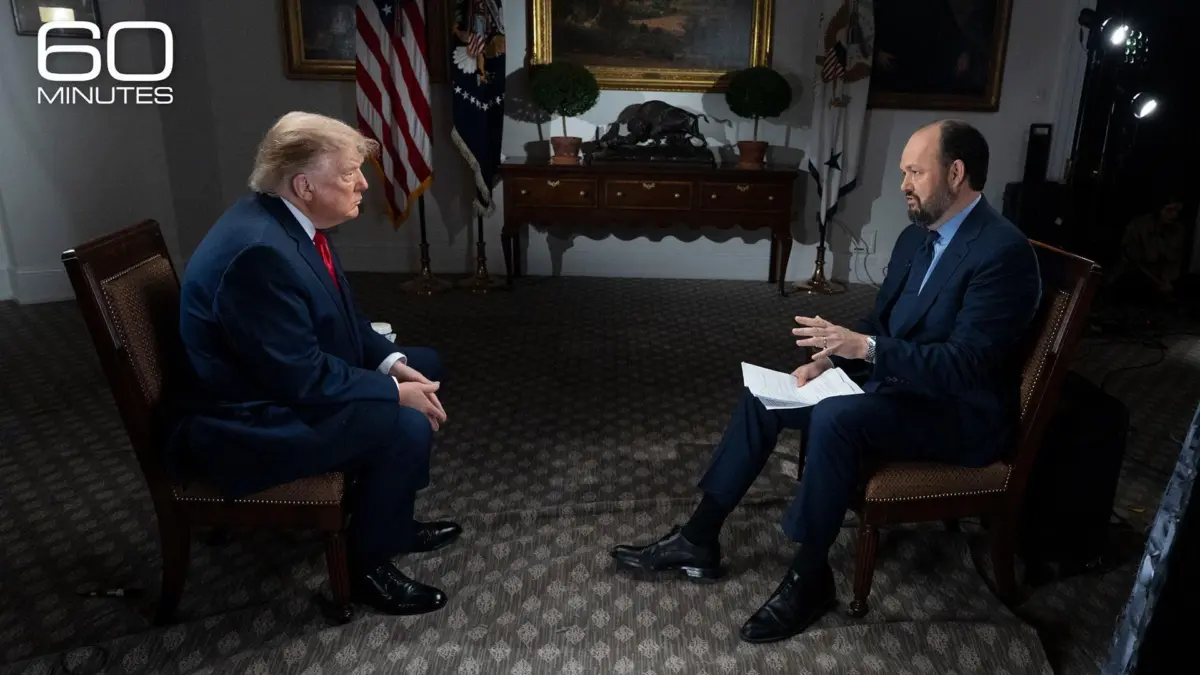
However, a candid and unfiltered exchange on CBS’s 60 Minutes with interviewer Ross Douthat has systematically stripped away that plausible deniability. Confronted with fundamental questions regarding his eternal salvation and the non-negotiable Christian mandate of forgiveness, Trump offered a brutally honest rejection of core orthodox tenets. Declaring that he harbors an unyielding hatred for his political adversaries and refusing to forgive them—even if his salvation or God demanded it—Trump sparked an unprecedented theological and political backlash.
Read Also
Coming on the heels of staggering midterm election losses that left the Republican Party reeling and Trump’s grip on the GOP looking increasingly tenuous, these remarks have triggered soul-searching across the religious right. Prominent theologians, pastors, and conservative intellectuals who once reliably rushed to his defense are now publicly confronting a grim reality: Donald Trump is not merely an imperfect believer; by his own admission, he rejects the foundational prerequisites of the Christian faith. As the movement navigates uncharted waters following historic electoral defeats, a provocative question now looms over the American conservative landscape: What does the religious right look like if it finally gives up on Trump?
Detailed Chronology: The 60 Minutes Interview and the Cascading Backlash
The friction point began taking shape during a wide-ranging interview with The New York Times columnist and conservative author Ross Douthat on 60 Minutes. For years, interviewers have occasionally probed Trump regarding his personal faith, usually eliciting generic assurances that he is a "good Christian" who loves God and attends church. This time, however, the line of questioning cut straight to the bone of orthodox Christian soteriology (the theology of salvation) and moral behavior.
The Exchange That Shook the Pews
Douthat pressed the former president on two interconnected inquiries: Where does Trump believe he will go when he dies, and could he forgive his political enemies if his eternal salvation depended upon it?
Trump’s response was characteristically direct, yet devastating to the narrative carefully constructed by his evangelical apologists:
"Well, I’m a religious person, so in theory I go to heaven," Trump stated. "I hope so. I don’t want to go to hell."
When Douthat pushed further, asking if he could extend forgiveness to high-profile political foes such as former FBI Director James Comey and former House Speaker Nancy Pelosi, Trump discarded any pretense of Christian charity:
"Well, then I wouldn’t be real, would I? I mean, if I said to you, sure, the easy answer to that is ‘Oh, yes, I could forgive,’" Trump told Douthat. "The answer is no. I want to be honest, no."
When asked if his stance would hold even if God commanded it before the final judgment, Trump doubled down:
"Before the judgment, no. I do hate some of my enemies… I probably cannot do that, no, because I do hate some of my enemies and I always will."
Immediate Shockwaves Across the Theological Spectrum
Within hours of the broadcast, clips of the interview circulated widely across social media platforms, igniting immediate shock among believers. While secular critics viewed the comments as predictable hubris, the profound impact was felt within the intellectual and spiritual leadership of the Christian conservative movement.
Unlike previous controversies—such as his sharing of AI-generated imagery depicting himself as Jesus Christ, which drew swift pushback before being quietly deleted—this misstep could not be brushed aside as a social media gaffe or a joke. Trump had not been caught mocking a bishop or sharing a tone-deaf meme; he had articulated a worldview fundamentally antithetical to the central pillar of Christian doctrine: unearned grace through repentance and the mandatory imperative to forgive those who trespass against us.
Prominent figures who had spent years counseling, defending, and partnering with Trump were suddenly forced to address the widening chasm between Christian orthodoxy and MAGA orthodoxy. The unified wall of defense began to show structural fractures that advisors and surrogates struggled to patch.
Supporting Context & Metrics: The Shifting Foundations of the Religious Right
To understand the gravity of Trump’s comments, one must examine the demographic and theological weight of the evangelical and conservative Christian voting bloc within the Republican coalition.
The Evangelical Baseline and the "Imperfect Vessel" Defense
For decades, white evangelical Protestants have formed the bedrock of the modern GOP. In the 2016, 2020, and 2024 election cycles, Trump captured roughly 80% to 84% of white evangelical voters. This unwavering support persisted despite multiple marital infidelities, accusations of sexual misconduct, vulgar rhetoric, and numerous indictments.
The rationale was transactional yet robustly theological. Leaders often invoked the biblical precedent of King Cyrus—a pagan ruler used by God to liberate the Israelites—to argue that a leader’s personal morality was secondary to their utility in advancing conservative legal and cultural goals. Prominent pastors argued that they were electing a "commander-in-chief, not a theologian-in-chief."
The Erosion of Plausible Deniability
However, this defense always relied on a thread of plausible deniability: the assertion that despite his rough edges, Trump possessed a private faith, respected Christian leaders, and harbored a baseline understanding of salvation.
Trump’s 60 Minutes confession sheared that thread completely. By explicitly stating that he harbors permanent hatred toward his enemies and refuses to forgive them—even under divine ultimatum—he divorced himself from the core ethos of the Sermon on the Mount. As sociologists tracking religious voting patterns note, while evangelical voters have historically been willing to forgive personal moral failures in politicians (viewing all humans as sinners), they draw a hard line at an unrepentant, self-declared refusal to adhere to the basic commands of Christ.
Midterm Defeats and Vulnerability
This theological rupture coincides with a perilous political moment for the former president. Following stunning Republican losses in the recent midterm elections—where candidates closely tied to Trump underperformed significantly—his absolute mastery over the party apparatus has faced unprecedented internal questioning. When a leader is winning, ideological and theological compromises are easily swallowed. When that same leader presides over historic electoral losses, the calculus changes drastically. Allies and donors begin to calculate whether the political cost of standing by a defiant, post-Christian figure still outweighs the benefits.
Official Statements and Theological Critiques
The response from prominent Christian leaders, theologians, and commentators highlights the depth of the current crisis. Rather than circling the wagons, key figures within the conservative movement took to public forums to express profound spiritual alarm.
Franklin Graham’s Soteriological Correction
One of the most telling reactions came from Franklin Graham, president of Samaritan’s Purse and the Billy Graham Evangelistic Association, who has long been one of Trump’s most visible and steadfast evangelical defenders. Without directly calling out Trump by name, Graham posted a stark doctrinal reminder on X (formerly Twitter) that directly contradicted the president’s televised statements:
"Heaven has borders. Heaven has unique and very strict entrance requirements. To enter Heaven, the Bible tells us that you must acknowledge your sins, turn from them in repentance, and receive Jesus Christ by faith."
Graham continued, emphasizing a point that dismantled Trump’s self-described "religious" identity:
"Religion can’t save you — only a relationship with the Savior, Jesus Christ, can save you. Do you have that assurance?"
By publicly underscoring these strict requirements immediately following Trump’s interview, Graham signaled to the evangelical base that spiritual salvation cannot be faked or assumed based on political alignment.
Dr. Albert Mohler on the Urgency of the Gospel
Dr. Albert Mohler, president of the Southern Baptist Theological Seminary and a leading voice in American theological conservatism, addressed the interview on his podcast with solemn gravity. Mohler did not mince words regarding Trump’s spiritual standing:
"It’s also very clear that [Trump] certainly needs to hear the gospel."
Mohler announced a posture of spiritual intervention rather than political defense, stating he would be "praying for him, with a renewed sense of urgency, that he has an experience of grace that he comes to know the Lord Jesus Christ as savior, that he knows the forgiveness of sins." Mohler’s framing relegated Trump from a champion of the faith to an unregenerate soul desperately in need of fundamental conversion—a massive rhetorical retreat from earlier descriptions of Trump as an ally advancing the kingdom of God.
Rod Dreher and the "Dante’s Inferno" Critique
From the Eastern Orthodox intellectual tradition, prominent author and commentator Rod Dreher offered a scathing cultural and spiritual indictment of Trump’s unrepentant malice. Writing on social media, Dreher did not focus merely on theological technicalities, but on the moral decay reflected in the president’s public statements:
"The pettiness and hatred in that man’s heart… He is literally a character in Dante’s Inferno. Despite being given so much in life, he hates his enemies more than he fears God."
Dreher further diagnosed Trump’s pivot as a descent into a nihilistic, "post-Christian" identity—one that revels in grievance rather than redemption. This critique resonates deeply among traditionalist and orthodox Christians who fear that tying the church irrevocably to a leader who openly rejects Christian charity will permanently corrode the moral authority of the gospel.
Future Outlook: Navigating Uncharted Waters
As the dust settles from the 60 Minutes interview and the bruising aftermath of the midterm elections, the American religious right finds itself at a historic crossroads. The alliance between conservative Christians and Donald Trump is entering an unmapped and volatile phase.
Will the Base Abandon Trump?
Pragmatism suggests that a full divorce is unlikely in the immediate future. The institutional infrastructure of the religious right—including powerful lobbying groups, media networks, and activist organizations—remains deeply entwined with the MAGA ecosystem. Millions of grassroots Christians still view Trump as their primary bulwark against cultural secularization, judicial drift, and progressive governance.
However, polling trends and anecdotal evidence indicate a growing enthusiasm gap. A subset of theologically committed Christians—particularly younger evangelicals and orthodox Catholics—are experiencing profound alienation. They are increasingly exhausted by a political movement that demands moral relativism and celebrates vindictiveness as strength.
The Emerging Post-Trump Theological Landscape
For years, observers like Ross Douthat have posed hypothetical questions about the future of American conservatism in a post-Christian or post-Trump reality. Now, those hypotheticals are pressing in as active concerns.
If the religious right gradually decouples its spiritual identity from Donald Trump, it faces several potential pathways:
- A Return to Principle-Driven Conservatism: A segment of Christian leaders may seek to reclaim moral autonomy, emphasizing that the church’s primary mission is the proclamation of the gospel and moral consistency, independent of partisan loyalty.
- Deepening Fractures and Denominational Friction: The debate over Trump has already exposed deep generational and cultural divides within denominations like the Southern Baptists, Presbyterian churches, and Catholic dioceses. These internal struggles are likely to intensify.
- Political Realignment: As Trump’s grip on the GOP loosens following electoral setbacks, emerging conservative leaders may test whether they can mobilize the evangelical base without adopting the unrepentant, grievance-driven posture that defined the Trump era.
Conclusion
Donald Trump’s candid admission on 60 Minutes—that he cannot and will not forgive his enemies, and that his hope for heaven rests merely on being "religious" rather than redeemed—was more than a political gaffe. It was a theological earthquake that fractured the fragile truce between the Christian right and its populist champion.
By removing the last vestiges of plausible deniability, Trump has forced conservative Christians to confront an uncomfortable truth: the transactional marriage of convenience has exacted a devastating spiritual toll. As the religious right surveys the wreckage of recent election losses and confronts the unrepentant posture of its leader, the defining question of the coming decade is no longer whether Trump can deliver political victories. It is whether the religious right can survive its enduring embrace of a man who proudly declares he hates his enemies more than he fears God.




Comments
Facebook App ID not configured. Please add it in the Customizer.