
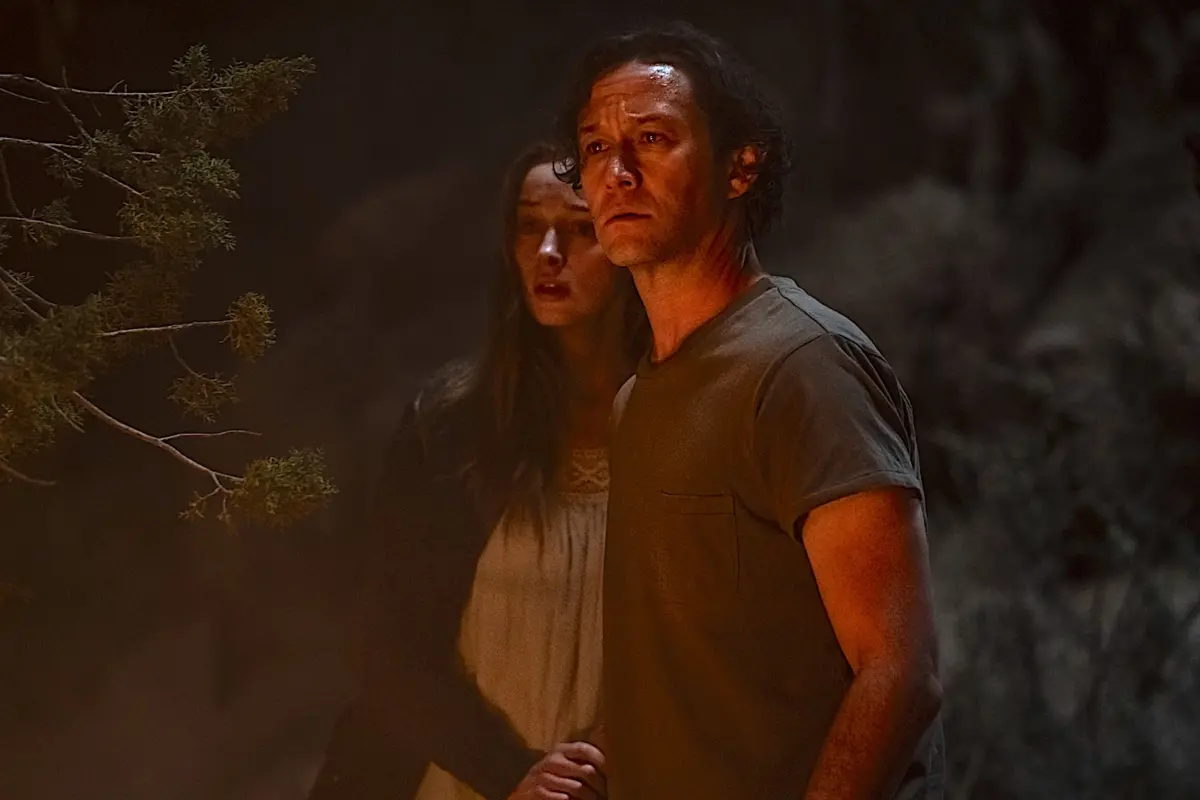
The cinematic landscape is bracing itself for a profoundly unsettling arrival as the official trailer for Pendulum drops, signaling the arrival of a distinctly bizarre and deeply unnerving psychological horror film. Serving as the feature-length directorial debut of screenwriter Mark Heyman—whose celebrated pedigree includes penning the scripts for Darren Aronofsky’s psychological ballet thriller Black Swan and the supernatural terror of The Boogeyman—Pendulum promises to deliver a masterclass in atmospheric dread. Produced under the watchful eye of Aronofsky himself, the film’s pedigree ensures a pedigree of prestige horror that leans heavily into visceral unease, existential paranoia, and surrealism.
Slated for a theatrical release on January 1, 2027, Pendulum is positioning itself to be the premier cinematic head trip to ring in the New Year. The narrative follows a married couple, Patrick (portrayed by Joseph Gordon-Levitt) and Abigail (played by Phoebe Dynevor), as they journey to a remote New Mexico new-age retreat. Seeking refuge and emotional restoration in the wake of an unspecified traumatic event, the couple soon finds themselves entangled in a web of psychological manipulation. While Patrick is willing to go to any lengths to safeguard his vulnerable wife, he quickly grows deeply suspicious of the retreat’s enigmatic, charismatic leader (Jacki Weaver). Simultaneously, however, Abigail falls progressively deeper under the leader’s hypnotic spell.
As the lines between genuine spiritual rehabilitation and a sinister, consuming reality begin to blur, the trailer tantalizes audiences with a central, deeply unsettling question: Are the supernatural manifestations haunting the narrative genuinely occurring, or are they merely localized hallucinations born from the profound trauma and psychological fracturing of Patrick and Abigail’s minds? Director Mark Heyman has further stoked fan speculation by revealing that the feature is deeply personal, drawing directly from his own family lore and childhood landscape. Bolstered by an all-star ensemble cast featuring Anna Deavere Smith, Jena Malone, and Norman Reedus, Pendulum is shaping up to be one of the most anticipated and psychologically taxing horror releases of the decade.
Read Also
Detailed Chronology: From Concept to Production and the Road to 2027
The genesis of Pendulum can be traced back through Mark Heyman’s extensive career in psychological thrillers, where he has consistently specialized in stories examining the fragility of the human mind. Having established his reputation as a master of tension-heavy storytelling through Black Swan—which explored the agonizing psychological descent of a dancer—and The Boogeyman, Heyman’s transition to the director’s chair felt like a natural, albeit daunting, evolution. For his feature directorial debut, the filmmaker chose to return to his roots, both literally and figuratively.
The New Mexico Connection
The production’s timeline took a deeply personal turn when Heyman decided to shoot the film on location in New Mexico. Growing up in the region imbued the project with a specific, tangible atmosphere that a soundstage or a stand-in location could never replicate. According to production notes, filming in the sprawling, desolate, and historically rich landscapes of the American Southwest fundamentally altered the tone of the production. The stark vistas, isolated compounds, and vast, empty skies served as an external reflection of the characters’ internal isolation.
Heyman has noted that shooting in the exact geographic region where the real-life events inspiring his family lore took place elevated every single scene. The inherent surrealism of the New Mexican desert—with its shifting light, oppressive heat, and sense of ancient isolation—infused the cast and crew’s performances with an authentic, creeping dread.
The Casting Pipeline and Pre-Production
Casting for Pendulum began quietly, but the project quickly attracted top-tier talent drawn to Heyman’s script and Aronofsky’s involvement as producer. The securing of Joseph Gordon-Levitt as Patrick provided the film with an anchor of intense, relatable emotional strain. Gordon-Levitt, known for his versatility across dramatic and blockbuster roles, brings a desperate, protective energy to a husband watching his wife slip away.
Phoebe Dynevor, whose breakout performances demonstrated a profound ability to navigate complex emotional landscapes under societal and internal pressure, was cast as Abigail. The dynamic between Gordon-Levitt and Dynevor forms the emotional bedrock of the film, capturing the painful strain that trauma places on a marital bond. Academy Award nominee Jacki Weaver rounds out the central trio as the enigmatic, chilling retreat leader, wielding a quiet, terrifying authority that commands every frame she inhabits.
As pre-production rolled into principal photography, the ensemble was further enriched by the additions of veteran actress Anna Deavere Smith, genre icon Jena Malone, and The Walking Dead star Norman Reedus. Each casting choice was calculated to build a tightly knit ensemble capable of executing the delicate tonal balancing act required by Heyman’s script—a script that constantly forces the audience to question character motivations and reality itself.
Post-Production and the 2027 Release Strategy
Following the completion of principal photography in New Mexico, Pendulum entered a rigorous post-production phase. Given the psychological nature of the horror—which heavily utilizes sound design, editing rhythms, and ambiguous visual motifs to keep viewers off balance—the editing process has been meticulously guarded.
Rather than opting for a late-year horror dumping ground, the studio and producers made the strategic decision to schedule the theatrical premiere for January 1, 2027. This bold move positions Pendulum as an aggressive, high-concept alternative to traditional holiday fare, inviting audiences to begin the new year with a cinematic shock to the system. The rollout of the official teaser trailer has already cemented the film’s aesthetic identity, trading cheap jump scares for a sustained, suffocating atmosphere of dread.
Supporting Context & Metrics: The Psychology of Cults and Trauma in Horror
To fully appreciate the narrative framework of Pendulum, one must examine the broader cultural and psychological themes it explores: trauma bonding, the mechanics of new-age exploitation, and the cinematic tradition of the unreliable narrator.
Trauma and the Allure of Alternative Healing
The catalyst for Patrick and Abigail’s journey into the New Mexico desert is a shared, unspecified traumatic event. In psychological terms, trauma radically alters an individual’s sense of safety, agency, and reality. When conventional medical or psychological avenues fail to provide immediate relief, survivors often turn to alternative, high-risk environments in a desperate bid to reclaim their lives.
New-age retreats, wellness cults, and esoteric healing communities have long been fertile ground for exploitation. These environments typically operate by breaking down an individual’s existing psychological defenses under the guise of "purification," "ego death," or "spiritual alignment." In Pendulum, this dynamic is weaponized. Abigail, weakened by her trauma, becomes an easy target for Jacki Weaver’s enigmatic leader, who offers profound healing while slowly usurping Abigail’s autonomy. Patrick, watching his wife drift into the fold, experiences a parallel psychological crisis: hyper-vigilance. His desperate attempts to protect her transform into a consuming paranoia, begging the question of whether the true danger lies within the retreat’s esoteric practices or within Patrick’s own unraveling mind.
The Line Between the Supernatural and the Psychotic
One of the most compelling aspects highlighted in the Pendulum trailer is its deliberate ambiguity regarding supernatural elements. Horror cinema has a rich history of blurring the lines between external demonic or spiritual forces and internal psychological disintegration. Films like Roman Polanski’s Repulsion, Stanley Kubrick’s The Shining, and Ari Aster’s Midsommar masterfully exploit this grey area.
By grounding the narrative in personal family lore, Mark Heyman suggests that the terrors in Pendulum are rooted in generational or lived truths. However, the use of surrealist imagery, jarring soundscapes, and unsettling visual cues in the trailer leaves room for interpretation. Are the anomalies witnessed by the characters physical manifestations of a dark, occult practice at the retreat, or are they visual representations of shared acute stress disorder, gaslighting, and paranoia? This narrative tightrope walk is precisely what elevates Pendulum from a standard creature feature to an elevated psychological thriller.
Official Statements: Insights from the Creative Team
The promotional rollout for Pendulum has been accompanied by candid, enthusiastic statements from its principal creators, shedding light on the deeply personal nature of the project.
Director Mark Heyman did not mince words when discussing the emotional weight of his directorial debut:
"Pendulum is deeply personal and inspired by my family lore. Shooting it in New Mexico, where I grew up and the real events took place, elevated every scene and made it all the more surreal. Add to that a cast firing on all cylinders, and you have a horror movie I’m immensely proud of and excited to unleash on audiences come the new year. What better way to ring in 2027 than with a freaky head trip?"
Heyman’s reference to "family lore" introduces a chilling layer of authenticity to the proceedings. While the supernatural elements of the film may be amplified for cinematic effect, the emotional core—the feeling of being trapped in a landscape that refuses to yield, bound to people whose motives are entirely opaque—draws from a well of genuine lived experience.
Darren Aronofsky, whose production banner has consistently championed boundary-pushing, auteur-driven cinema, has similarly praised Heyman’s transition to the director’s chair. Having collaborated closely on Black Swan, Aronofsky recognized Heyman’s unique ability to merge high-art psychological inquiry with visceral genre thrills. The producer’s involvement ensures that Pendulum maintains a rigorous commitment to visual storytelling, refusing to rely on expository dialogue when a camera angle, lighting shift, or lingering silence can communicate the mounting terror more effectively.
Cast members have echoed the director’s sentiments, describing the New Mexico shoot as an intensely immersive experience. Joseph Gordon-Levitt reportedly leaned heavily into the physical and emotional exhaustion required to portray a man whose reality is systematically disintegrating, while Phoebe Dynevor navigated the subtle, insidious transformation of a woman succumbing to psychological dominance.
Future Outlook: What Pendulum Means for the 2027 Horror Landscape
As the entertainment industry looks ahead to the theatrical calendar, Pendulum is strategically positioned to redefine expectations for early-year releases. Traditionally, January has been utilized as a quiet period for studios to burn off delayed or lesser-anticipated titles. By planting a prestige, auteur-led psychological horror film smack on January 1, 2027, the filmmakers and distributors are making a bold statement about the film’s commercial and critical viability.
Elevated Horror’s Continued Dominance
The success of studios like A24, Neon, and various boutique horror arms over the past decade has proven that audiences possess an insatiable appetite for "elevated horror"—films that prioritize atmosphere, thematic depth, and psychological nuance over cheap jump scares and gore. With Mark Heyman at the helm, backed by Darren Aronofsky’s production expertise and an exceptional ensemble cast featuring Gordon-Levitt, Dynevor, Weaver, Smith, Malone, and Reedus, Pendulum possesses all the requisite components to capture both critical acclaim and box office momentum.
Anticipation and Fan Engagement
In the months leading up to its premiere, the primary driver for Pendulum will be the mystery surrounding its plot mechanics. As internet detectives and horror aficionados dissect every frame of the teaser trailer, debate the true nature of the New Mexico retreat, and parse Heyman’s comments regarding his family lore, the film is poised to generate a powerful viral discourse.
Will the supernatural elements prove to be terrifyingly real, or will the final frame reveal that the most dangerous monsters are the ones we construct within our own traumatized psyches? Answers will arrive when Pendulum opens in theaters on January 1, 2027. Until then, audiences are left to dwell in the discomfort, revisiting the trailer and bracing themselves for what promises to be one of the most intellectually and emotionally punishing cinematic trips of the decade.





Comments
Facebook App ID not configured. Please add it in the Customizer.