
Executive Overview
In a significant development for the landscape of late-night television and political satire, comedian and cultural commentator Jon Stewart has officially cemented his future with Comedy Central’s flagship program, The Daily Show. Announced on Monday, the multi-year extension will see Stewart remain as the signature Monday night host and executive producer through 2028. This decisive move ensures that one of the most trusted and influential voices in American media will remain at the helm of the satirical news empire through the crucial upcoming political cycles, anchoring the franchise well into the latter half of the decade.
The announcement was formally delivered by Skydance Television, reflecting the shifting corporate architecture of the entertainment industry following the completion of Skydance Media’s high-profile merger with Paramount Global earlier this year. Under the newly restructured corporate entity, now operating as Skydance Corp., the commitment to The Daily Show signals an institutional reliance on established, award-winning intellectual property and culturally resonant programming to drive both linear ratings and Paramount+ streaming metrics.
Stewart’s initial return to the franchise in February 2024 was widely celebrated as a journalistic and comedic triumph, revitalizing a franchise that had spent the better part of 2023 navigating a transitional phase with a rotating cast of guest hosts. By securing his services alongside a formidable roster of rotating weekly correspondents—including Ronny Chieng, Josh Johnson, Jordan Klepper, and Michael Kosta—Skydance and Comedy Central have successfully stabilized the program’s creative direction. This comprehensive report explores the chronology of Stewart’s return, the evolving corporate landscape of the network, the structural mechanics of the show’s hosting rotation, and the broader cultural implications of this long-term extension.
Read Also
Detailed Chronology of a Resurgence: From 1999 to the 2028 Extension
To fully understand the gravity of Jon Stewart’s 2028 contract extension, one must examine the historical trajectory of The Daily Show and the cyclical nature of Stewart’s relationship with the program. Launched originally in 1996 under the stewardship of inaugural host Craig Kilborn, the show was initially conceived as a breezy, pop-culture-heavy alternative to traditional late-night talk shows. Kilborn’s tenure, which lasted until 1998, established the foundational format of the faux-news desk, but it lacked the sharp, systemic political critique that would later define the brand.
The Golden Era (1999–2015)
When Jon Stewart assumed the anchor chair in January 1999, he systematically transformed The Daily Show from a standard cable comedy program into a vital cultural and political institution. Over the next sixteen years, Stewart’s tenure coincided with some of the most tumultuous periods in modern American history, including the 2000 presidential election, the September 11 attacks, the wars in Iraq and Afghanistan, the 2008 financial crisis, and the rise of partisan media ecosystems.
Stewart’s brand of deadpan incredulity, combined with rigorous media criticism—famously crystallized in his dismantling of CNN’s Crossfire in 2004—earned him the trust of millions of viewers who felt disenfranchised by traditional news media. By the time he stepped down in August 2015, handing the reins to South African comedian Trevor Noah, Stewart had accumulated numerous Emmy Awards and cemented his legacy as a defining architect of 21st-century political satire.
The Trevor Noah Years and the 2023 Interregnum (2015–2023)
Trevor Noah brought a distinctly global, sharp-witted perspective to the anchor desk, guiding The Daily Show through the chaotic political landscape of the Trump administration and the COVID-19 pandemic. Noah’s successful seven-year run concluded in December 2022, when he announced his departure to focus on international stand-up touring and other creative endeavors.
The departure of Noah plunged The Daily Show into an extended period of experimentation. Throughout 2023, the network abandoned the traditional single-host model, opting instead for a rotating lineup of high-profile guest hosts. Figures such as Leslie Jones, Chelsea Handler, Al Franken, Sarah Silverman, D.L. Hughley, and longtime correspondent Michael Kosta took turns behind the desk. While this strategy generated short-term buzz and kept the show culturally relevant, it also highlighted the immense challenge of replacing a generational talent and underscored the need for a permanent, stabilizing creative anchor.
The 2024 Triumph and 2028 Commitment
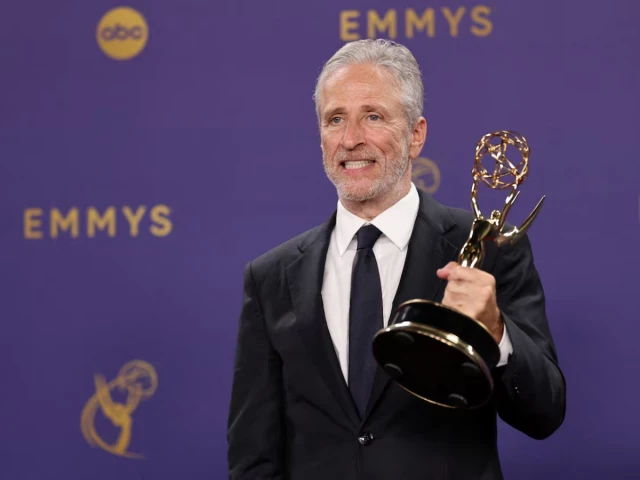
The turning point arrived in early 2024 when Comedy Central announced that Jon Stewart would return to the fold on a part-time basis—hosting every Monday night and overseeing the creative direction of the entire weekly production as an executive producer. The comeback was an immediate ratings and critical success, culminating in a Primetime Emmy Award for Outstanding Talk Series in September 2024.
With the ink now dry on a contract extension that runs through 2028, Skydance Television has effectively institutionalized this hybrid model. Stewart will continue to guide the intellectual tone of the broadcast through the remainder of the decade, ensuring editorial continuity through significant domestic and international political shifts.
Supporting Context & Metrics: Ratings, Reach, and Corporate Realignment
The decision to lock in Jon Stewart through 2028 is backed by robust viewership data, digital engagement metrics, and a newly reorganized corporate ecosystem. In the modern television landscape, late-night success is no longer measured solely by traditional Nielsen overnight ratings; rather, it is a multi-platform enterprise dependent on viral social media clips, streaming retention on services like Paramount+, and linear cable viewership.
Digital Dominance and Streaming Integration
The Daily Show occupies a unique space within Paramount Global’s digital ecosystem. While episodes continue to air live on Comedy Central, they become available for streaming on Paramount+ the following day. This digital-first accessibility has proven vital in capturing younger demographic cohorts—Millennials and Generation Z—who consume television primarily on-demand and through short-form video essays.
Under Stewart’s 2024–2028 structure, digital clipping has reached unprecedented heights. Segments dissecting media hypocrisy, legislative gridlock, and election cycles routinely generate tens of millions of views across YouTube, TikTok, and X (formerly Twitter). By maintaining Stewart’s voice on Mondays—the traditionally crucial day for setting the weekly political news agenda—Comedy Central ensures a reliable influx of viral content that drives subscriber acquisition and retention on Paramount+.
The Skydance-Paramount Merger
The financial and operational backing for this long-term extension stems directly from the corporate transformation of Paramount Global. Earlier this year, Skydance Media completed its high-profile merger with Paramount Global, forming a unified corporate entity known as Skydance Corp. Under the leadership of figures like George Cheeks, co-chair and chief content officer of Skydance Television, the newly minted conglomerate has placed a strategic emphasis on high-margin, culturally impactful franchises.
Investing heavily in The Daily Show signals to Wall Street and industry competitors that Skydance is committed to maintaining Comedy Central’s status as a premier destination for political satire. By securing Stewart’s exclusive services through 2028, the network has eliminated executive uncertainty, providing a stable foundation upon which advertising sales, talent management, and international distribution can be planned well in advance.
Official Statements and Industry Reaction
The announcement of Stewart’s extended contract elicited widespread commentary from television executives, production personnel, and media analysts, all of whom emphasized the unique cultural capital Stewart brings to the enterprise.
George Cheeks, co-chair and chief content officer of Skydance Television, released an official statement highlighting the collaborative success of the past two years:
"We are excited to continue our partnership with Jon and his award-winning news team. Jon’s unmatched ability to cut through the noise of the modern media landscape with sharp wit, uncompromising integrity, and profound insight has never been more vital. As we look toward the future, ensuring that Jon remains at the center of ‘The Daily Show’ universe is a cornerstone of our creative strategy."
In tandem with Cheeks’s remarks, production insiders have underscored the seamless synergy between Stewart’s Monday hosting duties and the stellar weekday contributions of the show’s core correspondents. The show’s production team, led by showrunner and executive producer Jen Flanz, has cultivated a collaborative newsroom environment that allows for rigorous investigative comedy, field pieces, and deep-dive panel discussions.
Industry analysts have similarly praised the deal as a masterclass in risk mitigation. By securing Stewart for the Mondays-only slot, the network avoids the burnout historically associated with the five-night-a-week late-night grind, while still leveraging his star power to anchor the brand. Meanwhile, the Tuesday-through-Thursday rotation allows emerging comedic talents to develop their own distinct broadcasting styles under the umbrella of a trusted, legacy franchise.
The Collaborative Engine: The Weekday Hosting Rotation
While Jon Stewart remains the undisputed captain and spiritual center of The Daily Show, the success of the modern format relies heavily on a sophisticated, multi-host ensemble. This collaborative approach not only prevents host fatigue but also injects diverse comedic voices and generational perspectives into the nightly broadcasts.
The Senior Editorial Team
The Tuesday-through-Thursday hosting duties are anchored by a powerhouse roster of correspondents and contributors who have deep institutional knowledge of the show’s mechanics:
- Ronny Chieng: Known for his blistering, high-energy takedowns of cultural absurdities, international geopolitics, and economic anxieties, Chieng brings a sharp, globally minded skepticism to the anchor desk.
- Josh Johnson: A critically acclaimed stand-up comedian and Emmy-winning writer, Johnson has emerged as a fan favorite for his deadpan delivery, insightful racial commentary, and deeply personal storytelling.
- Jordan Klepper: A veteran contributor whose fearless field reporting—particularly his undercover work at political rallies and protests—has become legendary, Klepper brings a masterclass in satirical confrontation to his hosting stints.
- Michael Kosta: Combining his background as a professional tennis player with a biting, self-deprecating comedic style, Kosta provides a versatile, highly accessible presence capable of navigating everything from pop culture fluff to dense economic policy.
This rotating ecosystem ensures that viewers receive a dynamic, multi-faceted critique of the news cycle rather than a single monotonous perspective. It also serves as an invaluable incubator for the next generation of late-night comedic talent, reinforcing The Daily Show’s historic legacy as a launchpad for premier comedy writers and performers.
Future Outlook: Satire in an Era of Media Fragmentation
As The Daily Show looks ahead to its trajectory through 2028, the program faces a media and political environment vastly different from the one Stewart inhabited during his original 1999–2015 run. The proliferation of hyper-partisan cable news networks, algorithmic social media echo chambers, decentralized content creation, and the rise of artificial intelligence have fundamentally altered how the public consumes and processes information.
In this hyper-fragmented landscape, the traditional role of the late-night satirist has evolved from a mere provider of comedic relief into a critical arbiter of cultural reality. Viewers increasingly look to programs like The Daily Show not just for laughs, but for a coherent, values-driven synthesis of daily news events that often feel overwhelming or intentionally obscured by institutional spin.
By locking in Jon Stewart through 2028 under the Skydance Corp. banner, Comedy Central has insulated itself against the volatility of the contemporary television market. Stewart’s editorial independence, combined with the structural agility provided by the weekday correspondent rotation, positions the program to navigate future electoral cycles with unwavering authority.
Ultimately, the 2028 extension is more than just a standard network talent renewal; it is a reaffirmation of the enduring power of political satire as a democratic check on power. As the political and cultural horizons shift over the coming years, Jon Stewart and his team will remain firmly stationed at the intersection of comedy and journalism, holding power to account with the exact same incisive wit that has defined their legacy for nearly three decades.


Comments
Facebook App ID not configured. Please add it in the Customizer.