
Executive Overview
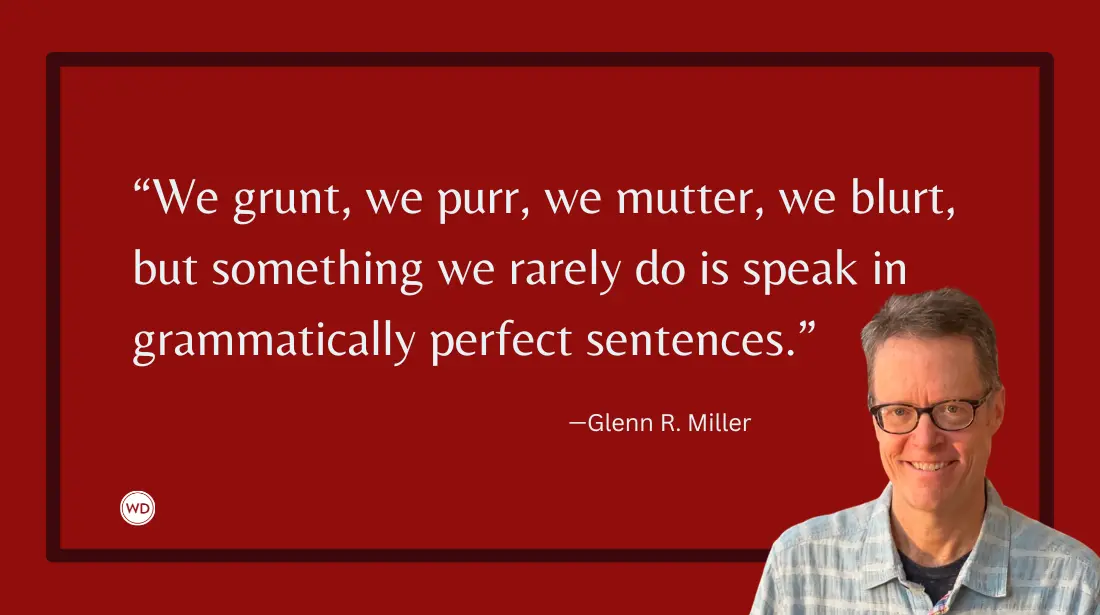
When author Glenn R. Miller published his debut book, Doorman Wanted, the highest compliment he received from book club members was entirely unexpected. Readers did not initially praise the complexity of the plotting, the atmospheric world-building, or the narrative pacing. Instead, they repeatedly focused on the dialogue: "It was just like the way, you know, real people—us, we—talk, not book characters. I just found it, like, just… lifelike."
For Miller, whose professional background spanned four decades as a television news producer, public television producer, and corporate media executive, this was the ultimate validation. Throughout his career, his livelihood depended on writing words meant not for the silent, contemplative page, but for the teleprompter—to be spoken aloud by news anchors and corporate chief executives.
In the broader literary landscape, mastering the art of dialogue remains one of the most elusive skills for emerging fiction writers. While narrative prose establishes setting and background, dialogue anchors the reader directly in the present moment, pacing the story and revealing character through cadence, interruption, and subtext. By examining the methodologies of broadcast journalism, analyzing the techniques of masters like Elmore Leonard and Richard Price, and looking at the structural rhythm of human speech, writers can transform wooden exchanges into vibrant, breathing interactions that resonate with authenticity.
Read Also
Detailed Chronology: From the Newsroom to the Novelist’s Desk
To understand how Miller developed his philosophy on dialogue, one must trace his journey through the evolution of broadcast writing over the past forty years. The foundational lesson that shaped his entire career occurred early on, during his stint working with a veteran news anchor in Green Bay, Wisconsin.
The Green Bay Revelation
Fresh out of his initial training, Miller had submitted a script written with the structured, formal syntax typical of print journalism. The anchor called him over, reviewed the pages, and delivered a piece of advice that would permanently alter Miller’s creative output:
"Glenn, you write as if you’re writing for a newspaper. When I read your stories, I sound stilted. Make it conversational. I want the viewers to think they’re hearing gossip from the next-door neighbor."
This critique shifted Miller’s perspective from visual-textual translation to auditory performance. From that day forward, every script, corporate presentation, and eventually every novel manuscript was subjected to a rigorous physical test: reading it aloud.
The Evolution of the Writing Process
Miller’s creative workflow reflects this broadcast-born discipline. Writing dialogue silently on a computer screen, he discovered, creates a blind spot for unnatural cadences. Stiff rhythms and overly formal phrasing often look acceptable to the eye while reading internally, yet immediately trip the tongue when spoken aloud.
- Drafting and Internal Audition: The writer composes a scene and immediately reads the lines out loud to test their rhythmic flow.
- Repetition and Refinement: Miller notes that catching stiff speaking rhythms often requires multiple out-loud readings over successive editing passes.
- The Audience Test: Once satisfied with the drafts, he reads the sections aloud to his wife. Invariably, external ears catch missed nuances, awkward pauses, or unnatural sentence structures that escaped the author’s solitary review.
This iterative, performance-based cycle bridges the gap between written text and genuine human interaction, proving that authentic dialogue cannot be successfully engineered in total silence.
Supporting Context & Metrics: The Anatomy of Human Speech
What actually constitutes "lifelike" speech? Sociolinguistic studies and creative writing analysis reveal that real human conversation bears little resemblance to the polished exchanges found in poorly written fiction.
The Illusion of Grammatical Perfection
In everyday life, humans rarely speak in grammatically complete sentences. Authentic speech is characterized by:
- Fragments and Interruptions: Speakers frequently start in one direction, cut themselves off mid-thought, and pivot to an entirely new subject.
- Paralinguistic Cues: Grunts, purrs, mutters, and blurts carry as much communicative weight as the words themselves.
- Overlapping Dialogue: Real conversations are messy. Individuals constantly cut in on each other, swept up by the flow of communication, sometimes finishing a thought or hijacking the conversation entirely.
When an author writes exchanges where characters speak in flawless, unbroken paragraphs, it rarely rings true to the reader. The absence of natural hesitation and interruption signals that the writer has failed to test the dialogue against actual human behavior.
The Strategic Use of "Handles"
Every human speaker utilizes "handles"—those recurring pet phrases, verbal tics, or conversational filler sounds that punctuate their speech. While traditional writing advice often warns against clichés, real people rely on them heavily:
- Emphasizers: Ending sentences with "right?", "okay?", or "know what I mean?"
- Openers: Kicking off thoughts with "So," or "Well…"
- Corporate and Cultural Filler: Overusing phrases like "at the end of the day" or conversational softening agents such as "Well, I’m not going to lie to you…"
Miller compares these conversational handles to salt in a stew: used in precise moderation, they add distinct regional and psychological flavor; used in excess, they ruin the entire dish.
Pacing and Word Count
Comedian and author Nate Bargatze frequently mines the inherent challenges of the medium for humor, joking that the fundamental problem with books is simply the sheer volume of words. Turn the page, and there are just more words.
While experimental authors like Thomas Bernhard eliminate paragraph breaks entirely, or Jonathan Coe—in The Rotters Club—drafts a nearly 14,000-word sentence before remembering the period key, the average reader requires structural relief. Dialogue acts as a pacing mechanism. It breaks up dense walls of narrative exposition, transforming passive observation into active participation.
Masterclass in Dialogue: Lessons from Leonard, Price, and the Stage
Examining the giants of crime fiction and screenwriting reveals how elite writers leverage dialogue to do the heavy lifting of characterization and world-building.
Elmore Leonard’s Minimalist Philosophy
Elmore Leonard is widely celebrated for prose that leaps off the page without relying on exhaustive physical description. Leonard famously subscribed to the philosophy that readers do not need to know whether a protagonist is wearing a blue shirt, parts their hair on the left, or bears a minor scar.
"Let the damn reader do some work," Leonard asserted.
In novels like Swag, Leonard reveals who a character is entirely through their spoken words and how others respond to them. The rhythm, vocabulary, and defensive or aggressive inflections of the dialogue establish character identity immediately, eliminating the need for tedious physical inventories.
Richard Price and the Critical Acclaim
Another titan of dialogue-driven fiction is Richard Price (Clockers, The Lush Life). Price’s characters are so vividly realized through their speech patterns that prominent critics have elevated his work to the highest tier of modern literature.
In her review of The Lush Life, legendary New York Times book critic Michiko Kakutani famously wrote:
"No one writes better dialogue than Richard Price—not Elmore Leonard, not David Mamet, not even David Chase."
This grouping of novelists alongside playwrights and television creators like Mamet and Chase highlights an essential cross-pollination in the literary world.
The Influence of Playwrights and Screenwriters
Stage plays and screenplays represent the purest form of performance-driven text. Because their ultimate destination is the stage or screen rather than the library shelf, theatrical scripts demand absolute fidelity to natural human interaction. For novelists striving to master authentic dialogue, reading and analyzing scripts from the world of film and theater offers an invaluable masterclass in pacing, subtext, and oral rhythm.
Future Outlook: The Evolving Standard of Literary Voice
As the publishing industry continues to evolve in an era dominated by digital media, audiobooks, and podcasts, the demand for naturalistic, compelling dialogue is higher than ever. With the explosion of the audiobook market—where stories are quite literally brought to life by professional voice actors—the mechanical limitations of stilted prose have become glaringly apparent.
Writers who adopt the broadcast-era discipline of reading their work aloud, studying the cadence of unscripted speech, and trusting their readers to fill in the narrative gaps will define the future of compelling fiction. By treating dialogue not merely as a vehicle for exposition, but as an auditory performance piece, contemporary authors can ensure their characters do not merely speak from the page—they live in the minds of their readers.




Comments
Facebook App ID not configured. Please add it in the Customizer.