
Executive Overview
Just two weeks after celebrating a historic and unexpected triumph in the 2026 midterm elections, the Democratic Party has traded its fleeting moment of unity for a high-stakes internal power struggle. The illusion of "Democrats in array" has shattered, replaced by an aggressive leadership contest that exposes a deeper, more volatile fault line running through the heart of the American left.
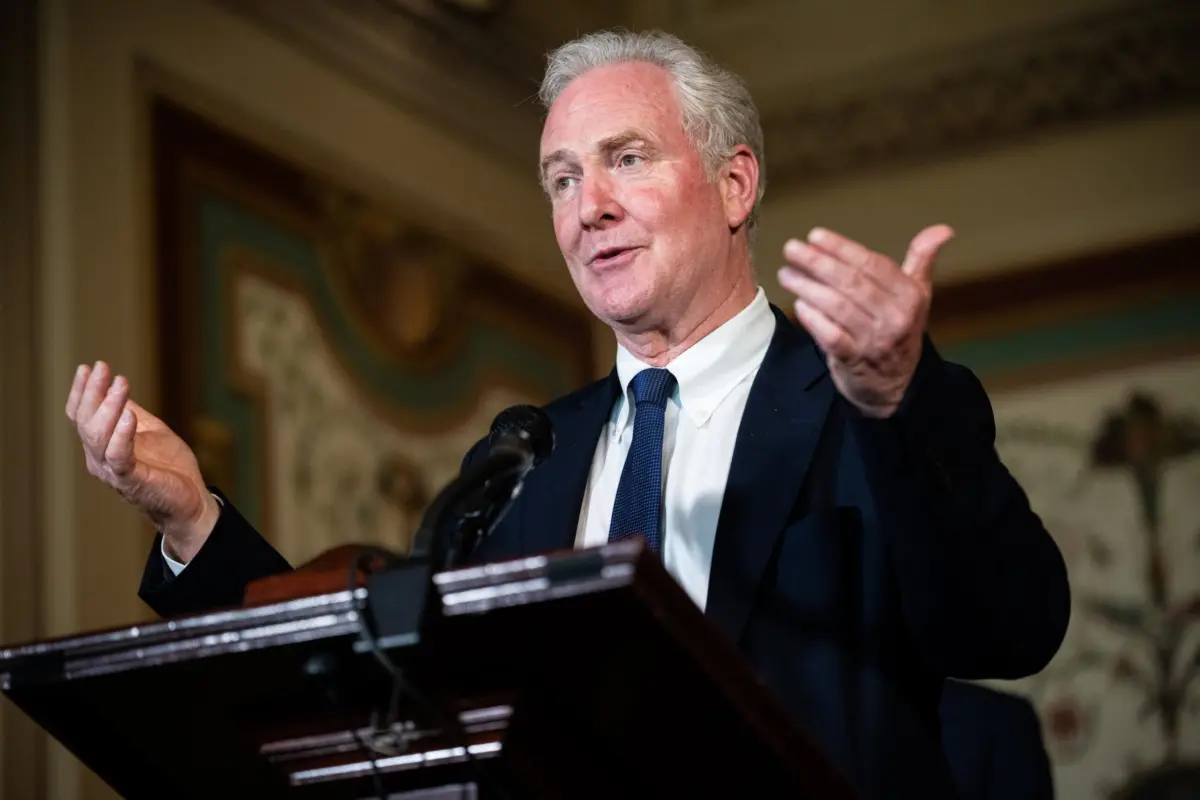
On Thursday evening, Senator Chris Van Hollen of Maryland officially launched a direct challenge against incumbent Senate Democratic Leader Chuck Schumer. Appearing on MS NOW with host Jen Psaki, Van Hollen framed his candidacy not merely as a personnel change, but as an existential necessity for a party struggling to interpret the mandate delivered by the American electorate. Promising a bolder, more confrontational legislative agenda, Van Hollen’s insurgency capitalizes on growing grassroots discontent with the institutional status quo.
While the Senate plays host to the only active, open leadership challenge—with Schumer facing a closed-door caucus vote early next month—the House of Representatives is experiencing its own version of leadership angst. Although Minority Leader Hakeem Jeffries remains the overwhelming favorite to assume the speakership in January without a formal Democratic challenger, subterranean frustrations regarding his strategic vision have bubbled to the surface.
Read Also
Political analysts emphasize that these intra-party friction points are not driven by the traditional ideological proxy war between progressives and moderates. Instead, they represent a generational and tactical rebellion. An energized, angry Democratic base is demanding unapologetic "fighters" to spearhead the party into what promises to be a ferocious, combative final two years of the Trump administration. With majorities secured through at least the 2028 election cycle, party members are acutely aware that the leadership chosen today will dictate whether Democrats merely manage political survival or decisively seize legislative power.
Detailed Chronology: The Spark and Spread of the Senate Rebellion
The events culminating in Van Hollen’s historic challenge unfolded over a tense, fast-moving fortnight following the November 2026 midterms.
The Aftermath of the 2026 Midterms
When the final ballots were tallied in mid-November 2026, pollsters and political scientists alike were forced to rewrite their models. Democrats had secured victories by a margin described by election forecasters as historic, outperforming historical trends for a party holding the White House. Rather than inducing institutional complacency, however, the scale of the victory emboldened the party’s insurgent wing. Activists and newly elected lawmakers argued that the historic margins were not an endorsement of congressional leadership’s cautious positioning, but a mandate to aggressively dismantle the political status quo.
The Thursday Night Announcement
The subterranean rumblings turned into a political earthquake on Thursday evening. Senator Chris Van Hollen stepped onto the set of MS NOW to officially declare his candidacy for Senate Democratic Leader. Challenging Chuck Schumer—who has held the position since 2017—Van Hollen delivered a stark critique of the party’s historical operating procedures.
"It is about answering the call of the American people," Van Hollen told Jen Psaki during his announcement. "The call was really to reject the status quo and to reject business as usual. And to do that, I think we need new leadership."
Gaining Momentum from Fresh Faces
Van Hollen’s bid immediately found traction among the party’s incoming freshman class. Notably, newly elected Senators Abdul El-Sayed of Michigan and Peggy Flanagan of Minnesota threw their weight behind the Maryland senator. Both El-Sayed and Flanagan had charted paths to victory by defeating establishment-backed, leadership-aligned Democrats in their respective primaries. Their immediate endorsement signaled to Capitol Hill veterans that Van Hollen’s campaign was not a lonely protest, but the vanguard of a broader caucus-wide realignment.
The Road to the December Vote
With the formal nomination process underway, the race shifts behind closed doors. The decision will be finalized in a high-stakes, closed-door caucus vote scheduled for early next month. Senator Schumer, approaching his mid-seventies and boasting nearly a decade of experience steering the Senate caucus, has projected absolute confidence. Allies of the incumbent leader insist he retains the commitments necessary to secure reelection. Yet, political insiders note that the mere existence of a credible, high-profile challenge fundamentally alters the dynamic of Senate leadership, stripping Schumer of the frictionless coronation he might have expected just a month ago.
Supporting Context & Metrics: The Anatomy of a Grassroots Insurgency
To understand why a party fresh off a historic midterm victory is consuming itself in leadership battles, one must look beyond Washington and examine the psychological state of the Democratic base.
Beyond Left vs. Right: The Search for "Fighters"
For decades, internal Democratic schisms were easily categorized through a predictable ideological lens: progressives versus moderates, the Bernie Sanders wing versus the Clinton-Pelosi establishment. Today, political observers note that this binary fails to capture the reality of the 2026 landscape.
The current divide is tactical and visceral. The grassroots base—having navigated years of bitter legislative gridlock, judicial setbacks, and the ongoing tumult of the Trump administration—is exhausted by incrementalism. They are searching for "fighters." Whether a lawmaker identifies as progressive or moderate matters less to this energized electorate than their willingness to aggressively utilize congressional power, wield the subpoena pen, and engage in bare-knuckle political combat.
The Leadership Disconnect
Critics within the caucus argue that both Chuck Schumer and Hakeem Jeffries reflect an older, more deferential style of institutional politics. While Schumer has built a reputation as a master of legislative mechanics and procedural horse-trading, and Jeffries is celebrated for his disciplined messaging and tactical coordination, critics argue neither projects the fierce, disruptive energy required to meet the moment.
As journalists tracking the internal debates have noted, the frustration is rooted in a fear that current leadership views politics through the lens of preservation rather than conquest. With the political wind at their backs, the party’s rank-and-file want leaders who treat the opposition not as colleagues across an aisle, but as opponents who must be decisively defeated.
Electoral Longevity and the 2028 Horizon
Compounding this urgency is the unique temporal horizon of the current congressional majority. Because Democrats outperformed expectations so decisively in the midterms, election data suggests they are exceptionally well-positioned to retain their congressional majorities through at least the 2028 cycle.
This creates a high-stakes paradox. The leadership decisions made today will not merely shape the remainder of the current term; they will establish the institutional infrastructure for the 2028 presidential election. If Democrats capture the White House in 2028 while maintaining control of Congress, they will possess their freest legislative hand since the historic majorities of 2008. Ensuring that aggressive, forward-thinking leaders are at the helm now is viewed by insurgents as a prerequisite for capitalizing on that future windfall.
Official Statements and Stakeholder Perspectives
The leadership showdown has drawn rapid responses from across the political spectrum, highlighting the deep tactical divisions within the Democratic caucus.
Senator Chris Van Hollen’s Campaign Platform
In his rollout interviews and public statements, Van Hollen has labored to present his challenge not as a personal indictment of Chuck Schumer, but as an institutional necessity. Emphasizing his record as a seasoned legislator who understands the levers of power, Van Hollen argues that the party must modernize its approach to opposition politics.
"We cannot meet the extraordinary challenges of this political moment by recycling the strategies of the past," Van Hollen’s campaign stated following his MS NOW appearance. "The American people voted for systemic change. They expect a Senate leadership team that is willing to take risks, challenge entrenched power structures, and articulate a fearless vision for the future."
Senator Chuck Schumer’s Defense
In contrast, allies of Senate Leader Chuck Schumer have rallied around his proven ability to herd cats, manage complex coalitions, and deliver legislative victories under adverse conditions. Schumer, who has navigated the Senate through some of the most turbulent legislative terrain in modern American history, maintains that institutional memory and strategic discipline are more valuable than disruptive posturing.
"Senator Schumer has a proven track record of standing up to the opposition and delivering for the American people," a senior Senate Democratic aide noted on condition of anonymity. "The caucus values his steady hand, his strategic acumen, and his ability to keep the party unified when the stakes are highest. He is confident in the support of his colleagues."
The House Perspective: Hakeem Jeffries and the Quiet Grumbling
Over in the House, Minority Leader Hakeem Jeffries faces a different kind of challenge. While his path to the speaker’s gavel appears numerically secure, discontent simmers beneath the surface. House progressives and populist members have privately expressed anxiety that Jeffries’ cautious, institutionalist style may squander the momentum generated by the midterms.
While Jeffries has publicly projected supreme confidence and maintained tight discipline within the House caucus, his allies have pushed back against characterizations that he is out of touch with the base. They point to his aggressive fundraising, his effective management of a razor-thin minority throughout the previous term, and his strategic positioning ahead of the new congressional session as evidence of elite leadership capability.
Future Outlook: A Preview of Higher-Stakes Battles to Come
As the dust settles on the initial announcements and the countdown to December’s closed-door votes begins, political analysts are looking past the immediate personnel fights to examine what this civil war portends for the broader American political landscape.
The Economic Policy Trap
Looking ahead toward a potential unified government in 2028, policy analysts warn that Democratic leaders will face a brutal economic reckoning. As noted by macroeconomic commentators, the party currently appears to be boxed in by an "impossible trio" of economic promises made to the electorate.
To satisfy disparate factions of the party, Democratic candidates have implicitly or explicitly promised to protect and expand vital social safety nets, dramatically lower taxes for the middle class, and aggressively rein in the national debt. Basic fiscal reality dictates that maintaining all three simultaneously is mathematically impossible. Whichever leaders ultimately helm the party will be forced to make agonizing concessions, breaking one—if not more—of these core economic pledges. The ability of leadership to manage this inevitable fallout will define the success or failure of the progressive project for a generation.
The 2028 Leadership Transition
Even if Chuck Schumer successfully beats back Van Hollen’s challenge in the upcoming December vote, his tenure is operating on borrowed time. Up for reelection in 2028, Schumer faces the very real prospect of either retiring from the upper chamber or confronting a formidable, insurgent primary challenge in his home state of New York.
Consequently, the intra-party debate playing out in the closing weeks of 2026 is best understood as a dress rehearsal. It is the opening salvo in a much larger, higher-stakes war for the ideological and tactical soul of the Democratic Party—a war that will ultimately determine whether the left can successfully transition from an opposition party into a dominant, transformative governing force for the decades ahead.




Comments
Facebook App ID not configured. Please add it in the Customizer.