
Executive Overview
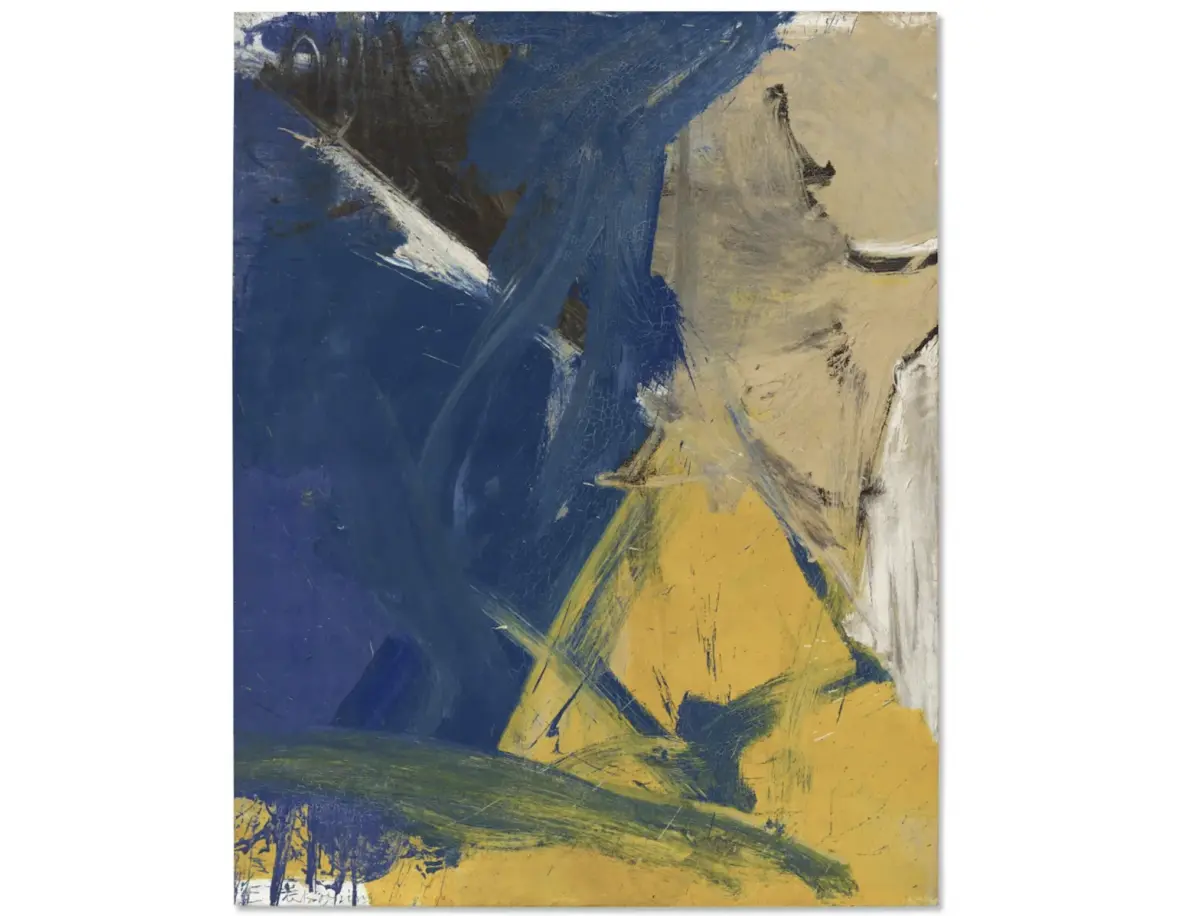
In a high-profile move that underscores the evolving financial and curatorial strategies of major American cultural institutions, New York’s Whitney Museum of American Art is preparing to send Willem de Kooning’s masterwork Yellow River (1958) to the auction block. The large abstract canvas, defined by hefty, expressive sweeps of blue and yellow, is slated to anchor Christie’s upcoming 20th-century evening sale, carrying a hefty pre-sale estimate of $12 million to $18 million.
The decision to part with the painting comes just three years after the museum formally took possession of the work as a promised gift from the family of David M. Solinger, a transformative figure in the Whitney’s history who served as its first president from outside the founding Whitney family. According to reports from Artnet News and documentation from Christie’s auction catalog, all proceeds from the sale will be funneled directly back into the museum’s acquisition fund to benefit and diversify its permanent collection.
While the deaccessioning—the controversial museum practice of selling works from permanent holdings—is bound to spark debate among purists, it aligns seamlessly with the Whitney’s strategic blueprint. The institution has increasingly leaned into collection optimization to close historical gaps, fund new acquisitions, and redefine what it means to be a modern museum of American art. Despite parting with Yellow River, the Whitney retains a deep bench of de Kooning masterpieces, ensuring that the legendary Abstract Expressionist remains well-represented within its galleries even as the institution pivots toward a more dynamic, fluid approach to collection management.
Read Also
Detailed Chronology: From the Artist’s Studio to the Auction Block
To fully understand the significance of Yellow River heading to Christie’s, one must trace its journey across nearly seven decades of American art history, private devotion, and institutional stewardship.
1958–1959: Creation and Immediate Acclaim
Painted in 1958, Yellow River captures Willem de Kooning at a pivotal inflection point in his storied career. Having achieved international renown for his ferocious, figurative Woman series earlier in the decade, the Dutch-American artist was steadily pivoting toward pure abstraction. This transition was profoundly influenced by the atmospheric landscapes, urban density, and sweeping highway systems of New York and its surrounding environs.
The painting made its public debut at New York’s prestigious Sidney Janis Gallery in 1959. The exhibition was an instantaneous commercial and critical triumph; according to historical accounts preserved by Christie’s, an astonishing 19 of the 22 works featured in the show were snapped up by collectors before noon on opening day. Among those captivated buyers was David M. Solinger.
1959–1996: The Solinger Collection
David M. Solinger was much more than a passionate art collector; he was a titan in the legal and cultural landscape of mid-century New York. An avid patron of Abstract Expressionism, Solinger purchased Yellow River directly from the Sidney Janis Gallery in 1959. His attachment to the canvas was deeply personal. According to auction records, Solinger cherished the work so profoundly that it hung for a considerable time at the foot of his bed, offering him a vibrant explosion of color to greet every morning.
Solinger’s relationship with the Whitney Museum deepened significantly in 1966 when he was appointed the institution’s first president from outside the founding Whitney family. During his tenure, he helped steer the museum through a period of immense growth and modernization, cementing its status as a vital home for homegrown avant-garde art. Following Solinger’s death in 1996, the painting passed to his wife, Betty Ann Besch Solinger, who shared his deep-seated dedication to the arts and philanthropy.
2011–2023: Promised Gift, Exhibition, and Formal Accession
The trajectory of Yellow River toward the Whitney began in earnest in 2011, when Betty Ann Besch Solinger formally promised the painting to the museum. In celebration of the pledge, the institution mounted an exhibition featuring the work that same year, allowing the public to enjoy the monumental canvas.
However, the bureaucratic and legal processes of museum acquisitions can be lengthy. Although the promise was made in 2011, the gift was not formally completed until 2023, following the passing of Betty Ann Besch Solinger in 2022. For a brief window, the painting officially entered the Whitney’s permanent collection—only for leadership to determine, just three years later, that its ultimate utility to the museum might best be realized through the open market.
Supporting Context & Metrics: The Mechanics of Deaccessioning
Deaccessioning remains one of the most sensitive mechanisms in the museum ecosystem. To evaluate the Whitney’s decision regarding Yellow River, it is essential to examine the financial metrics, institutional policies, and broader industry standards governing the practice.
The Financial Stakes
- Pre-Sale Estimate: $12 million – $18 million.
- Auction Venue: Christie’s 20th Century Evening Sale.
- Sale Date: November 17.
- Designated Use: 100% of the net proceeds will be restricted to the acquisition of new works for the museum’s permanent collection, ensuring the deaccessioning cycle directly feeds future cultural preservation.
Precedents at the Whitney
This is not an isolated experiment for the Whitney Museum. The institution previously tested the waters of strategic deaccessioning in 2023, when it sent a carefully curated group of historic American paintings to Sotheby’s. That offering was headlined by Edward Hopper’s atmospheric canvas Cobb’s Barns, South Truro (1930–33), which commanded an estimated $8 million to $12 million.
Those sales were executed as part of a broader, methodical reassessment of the museum’s holdings. Rather than selling works out of financial distress—a practice strictly condemned by museum governing bodies—the Whitney has utilized deaccessioning as a proactive curatorial tool to refine, update, and balance its collection.
Ethical Boundaries and Industry Standards
In the museum world, the Association of Art Museum Directors (AAMD) maintains strict guidelines regarding deaccessioning. Under AAMD rules, funds generated from the sale of deaccessioned artwork may only be used for two purposes: acquiring new art or paying for the direct care of the existing collection (such as conservation work). Using deaccessioning proceeds for operating expenses, salaries, or building maintenance is strictly prohibited and can result in severe professional sanctions.
The Whitney’s internal collection policy reflects these ethical boundaries. While the institution maintains a baseline expectation that works gifted or purchased are intended to remain in the collection permanently, it permits targeted sales designed to improve, refine, or strategically realign its holdings.
Official Statements and Institutional Strategy
The shift toward a more dynamic collecting strategy at the Whitney is not a knee-jerk reaction to market fluctuations, but the result of rigorous institutional planning.
Redefining American Art
When the Whitney undertook its major deaccessioning push in 2023, Jane Panetta—then serving as the museum’s curator and director of the collection—articulated the philosophical underpinning of these sales to ARTnews.
"We’re always thinking about how one defines ‘the museum of American art,’ being mindful of wanting the collection to accurately represent the United States," Panetta explained at the time. "We think that means the collection has to evolve. We have to try and close critical gaps, and having endowment funds for acquisitions is a key means to doing that."
This sentiment forms the core of the Whitney Museum’s 2023 Collection Strategic Plan. The publicly available document formally recommends making deaccessioning a regular, calculated component of the institution’s long-term collecting strategy. The logic is straightforward: as American art history expands to include a wider, more diverse array of voices, mediums, and perspectives, museums with deep historical holdings in specific mid-century movements must make room—both physically and financially—for underrepresented narratives.
Mitigating Risk Through Depth
Importantly, the sale of Yellow River does not leave a gaping hole in the Whitney’s representation of Willem de Kooning. The museum maintains a robust inventory of masterpieces by the artist, including the monumental Door to the River (1960). Dating from roughly the same crucial period as Yellow River, Door to the River allows the Whitney to continue showcasing de Kooning’s mastery of abstract gesturalism without compromising the narrative arc of its permanent galleries.
Future Outlook: What Yellow River’s Sale Signals for the Art Market
As Yellow River prepares to cross the auction block at Christie’s, the ripple effects will likely be felt across the broader museum and art market landscape.
For the art market, the appearance of a museum-deaccessioned de Kooning with impeccable provenance—having transitioned directly from the collection of a legendary museum president and his family—serves as a major anchor for the fall auction season. High-net-worth collectors and institutional buyers are expected to compete aggressively for a canvas with such pristine art-historical credentials and exhibition history.
For the museum sector, the Whitney’s ongoing embrace of strategic deaccessioning signals a maturing institutional mindset. As encyclopedic and specialized museums alike grapple with ballooning operating costs, shifting demographics, and demands for more inclusive storytelling, the traditional model of static, immutable collections is giving way to active stewardship. By pruning works where they hold surplus strength to fund acquisitions in neglected areas, institutions like the Whitney are proving that looking forward sometimes requires letting go of the past—even when that past is hanging brightly at the foot of your bed.




Comments
Facebook App ID not configured. Please add it in the Customizer.