In the modern digital landscape, parents face a persistent and exhausting dilemma: how to wind down children’s evenings without leaning on screens as the default babysitter. From activity kits that quickly lose their novelty to board games that vanish into cluttered cupboards and educational apps that ultimately pivot from learning to distraction, the quest for meaningful, screen-free engagement often feels like an uphill battle.
Enter a surprisingly radical, low-tech solution that is quietly transforming household routines across the country: interactive, guided family storytelling. At the forefront of this movement is House of Heroes, a subscription-based adventure platform tailored for children aged 4 to 11. By combining the old-fashioned warmth of a parent reading aloud with the agency of interactive decision-making, the platform offers a refreshing alternative to digital entertainment.
Rather than staring at a tablet or navigating complex rulebooks, families embark on 20-to-25-minute verbal adventures set in the magical world of Eternia. In these narratives, the child is not just a passive listener or a digital avatar, but the definitive hero of the story. This professional review examines the mechanics, developmental impacts, and broader implications of returning to the spoken word to solve the modern screen-time crisis.
Detailed Chronology & Mechanics: How Interactive Storytelling Works
The genesis of platforms like House of Heroes lies in a simple yet profound pedagogical realization: children crave autonomy, but they also crave undivided attention from the adults in their lives. Traditional reading sessions offer connection, but are typically linear; choose-your-own-adventure books offer choice, but often require older reading skills or tedious page-flipping that breaks the conversational flow.
House of Heroes streamlines this dynamic into a frictionless experience:
Word-for-Word Scripting: Every adventure is completely written out, line by line. Parents do not need to improvise, invent plot twists, or memorize complex lore.
The Hand-Off of Agency: The parent reads the opening scenario aloud. At critical junctures, the narrative pauses, and the child is asked to decide what happens next.
Immediate Consequence: Every choice made by the child directly influences the plot’s progression, giving them absolute ownership over the outcome without requiring creative writing or artistic effort from the adult.
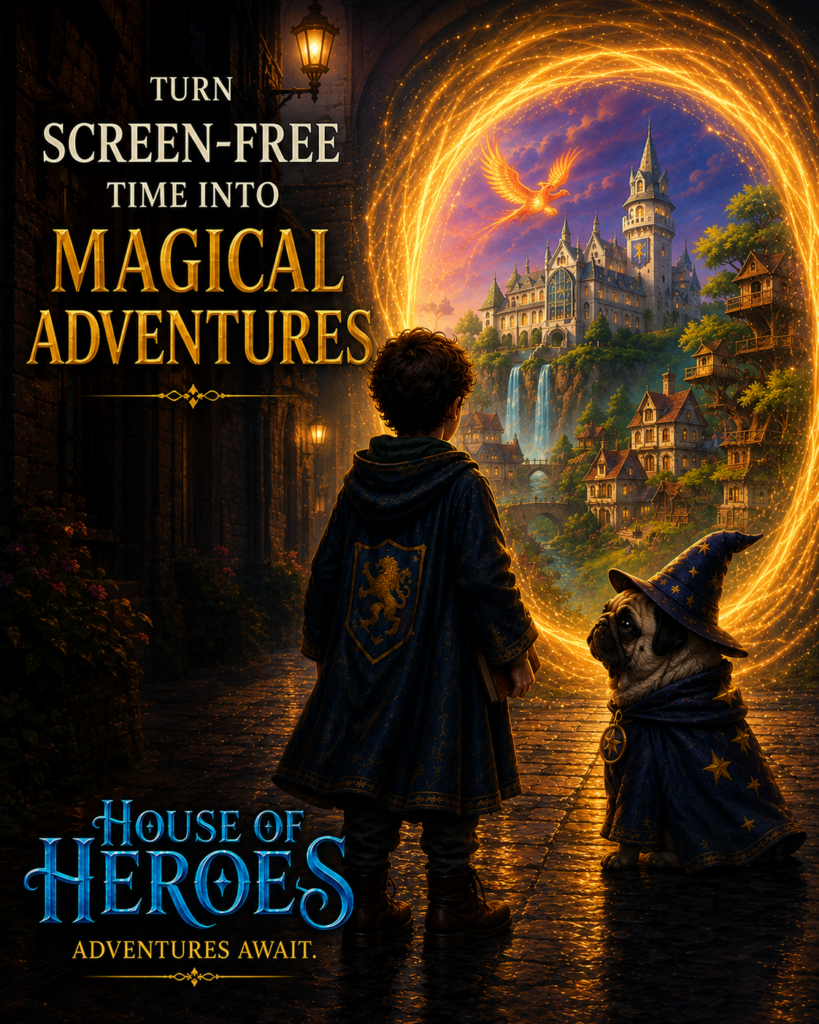
The Setting: Adventures unfold in Eternia, centering around a specialized academy where the child interacts with a growing cast of memorable characters—ranging from a pug wizard headmaster and an owl-human roommate to a meticulous cloak-maker.
Clocking in at roughly 20 to 25 minutes, these sessions hit a psychological sweet spot for weeknight routines. They are substantial enough to feel like a special, shared event, yet concise enough to fit comfortably into the countdown to bedtime without disrupting sleep schedules.
Supporting Context & Metrics: Tackling the Screen-Time Crisis and Building Soft Skills
The Screen-Time Conundrum
Modern developmental research continuously highlights the challenges associated with evening screen time. Devices emit blue light that interferes with melatonin production, while algorithmic content is specifically engineered to trigger dopamine loops that make transitions away from screens notoriously difficult. Prying a tablet or phone from a child’s hands at the end of the day is a well-known friction point for families.
By eliminating the screen entirely, House of Heroes removes the cognitive dissonance of using a digital device to "relax" a child. The medium is entirely human: a voice, a listener, and shared imagination.
Incidental Learning and Character Development
What sets guided storytelling apart from passive entertainment is how organically it fosters social-emotional learning (SEL). Without heavy-handed lecturing or traditional academic frameworks, stories are engineered to test specific values:
Courage: Navigating the unknown when outcomes are uncertain.
Empathy: Making choices that support or protect fellow characters, even when it requires sacrifice.
Persistence: Overcoming obstacles rather than abandoning a difficult path.
Additionally, recurring narrative interludes—such as visits from a dwarf character named Master Tolm—provide meta-conversations about grit and kindness. These moments bridge the gap between fantasy storytelling and real-world emotional intelligence, operating more like natural family discussions than formal educational lessons.
Official Statements and Industry Perspectives
Child development experts and participating parents have increasingly noted the psychological benefits of shared verbal play over automated digital consumption.
"When a child’s choices actively shape a narrative delivered by a trusted caregiver, two vital psychological needs are met simultaneously: autonomy and attachment," notes early childhood developmental literature. "The child learns that their voice matters, while the parent reinforces relational security."
Early adopters of the House of Heroes platform have echoed these sentiments, highlighting the shift from forced compliance to genuine enthusiasm:
"It is the first activity in a very long time that has made my child ask—unprompted, before I suggested anything—whether we could do it again tonight," shares one participating parent.
"Twenty minutes of being fully present, reading a story together, and watching your child’s face when they realize their decision matters… that is the kind of connection that does not happen by accident."
Future Outlook: The Evolution of Low-Tech Family Engagement
As digital saturation deepens across all age groups, a cultural counter-movement is emerging. Families are actively seeking out "analog revivals"—experiences that leverage human connection, imagination, and tactile or verbal engagement over pixels and processors.
Platforms that successfully merge narrative structure with participatory parenting are uniquely positioned to shape the future of family entertainment. By removing the administrative burden from parents (no rules to memorize, no dice to roll, no prep work required), House of Heroes proves that low-tech solutions can compete with high-tech distractions simply by offering something screens never can: authentic, unscripted human presence.
For families looking to test the waters, the platform offers a free introductory adventure where children help the pug wizard escape from angry cats and arrive at the gates of Eternia. As subscription platforms continue to roll out weekly guided adventures, the horizon looks bright for a generation of children learning that the most powerful interactive technology in the world is still the human voice.















Comments
Facebook App ID not configured. Please add it in the Customizer.