
Executive Overview
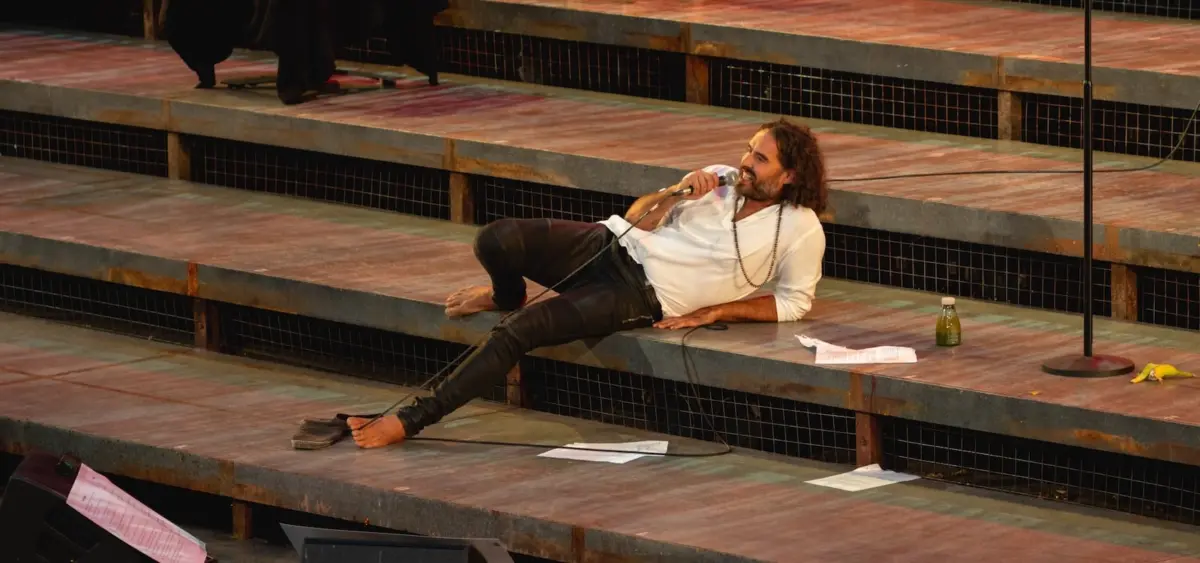
The seismic fallout from the legal collapse of high-profile British comedian Russell Brand—culminating in a sentence exceeding a decade behind bars for multiple counts of rape and sexual assault—alongside severe, multi-year investigative findings implicating fellow entertainer David Walliams, has exposed a profound moral rot at the intersection of modern celebrity culture and political institutionalism. These developments are far more than isolated tragedies of individual depravity. Instead, they serve as a glaring indictment of a cultural establishment that routinely provides sanctuary to predators under the guise of artistic license and iconoclastic rebellion.
For decades, cultural elites across the political spectrum have operated as willing enablers, trading ethical consistency for proximity to fame and revolutionary posturing. This dynamic resurrects George Orwell’s timeless critique of Salvador Dalí—the medieval legal fiction known as "benefit of clergy," wherein artists and entertainers are granted virtual immunity from accepted moral standards and criminal culpability. Today, this privilege is extended not to masters of technical brilliance, but to tasteless performers whose public acts of misogyny, transgressive performance art, and predatory behavior were celebrated as avant-garde rebellion.
Simultaneously, these scandals lay bare the internal contradictions of the sexual revolution. By decoupling sex from lifelong commitment, fidelity, and self-sacrifice, and reducing it to a recreational commodity, contemporary culture has systematically undermined the traditional safeguards of the family and community. In doing so, it has created a frictionless environment for predators to exploit women, while cultural guardians—particularly on the political left—practice a rank hypocrisy that prioritizes ideological alignment over the fundamental protection of women’s rights. As society stumbles from one manufactured shock to the next, the hollow chorus of "if only we had known" rings ever more false from elites who knew precisely who they were consorting with all along.
Read Also
Detailed Chronology
The structural decay that enabled the actions of Brand and Walliams did not happen in a vacuum; it unfolded over years of institutional normalization, public posturing, and systemic evasion of accountability.
- The 2000s—The Rise of Transgressive Celebrity: Russell Brand and David Walliams ascend to household-name status within the British media landscape. Brand builds his brand explicitly on lewd, boastful accounts of sexual conquests, public admissions of predatory behavior, and boundary-pushing shock tactics. Walliams gains fame through mainstream sketch comedy, frequently utilizing blackface and provocative tropes that escape serious institutional sanction under the banner of comedic subversion.
- The 2010s—Political Co-Option and Left-Wing Embraces: As Brand pivots from mainstream media personality to counter-cultural political activist, he is eagerly courted by segments of the British political left. Figures associated with New Labour and modern progressive movements—including Owen Jones, Ed Miliband, and prominent municipal leaders—frequently platform Brand, treating his brand of anti-establishment populism as a valuable asset for youth engagement, utterly ignoring or minimizing his well-documented history of misogyny.
- The Multi-Year Investigation: Simultaneously, investigative journalists at The Guardian and ITV News quietly begin compiling years of victim testimony, industry complaints, and internal cover-up accounts detailing systematic sexual abuse, grooming, and workplace misconduct by both Brand and Walliams.
- September–October 2023—The Initial Public Reckoning: Dispatches, The Times, and The Sunday Times broadcast explosive investigative documentaries detailing multiple allegations of rape, sexual assault, and emotional abuse against Russell Brand spanning the height of his fame. Brand issues preemptive denials, framing the allegations as part of a coordinated media smear. Political figures who once sought photo opportunities with him scramble to distance themselves.
- November 9—The Legal Reckoning: Russell Brand faces a decisive trial, resulting in a conviction on one count of rape and three counts of sexual assault. He is sentenced to over ten years in federal-equivalent imprisonment. Concurrently, the culmination of The Guardian and ITV News investigations formally brings widespread public accusations of sexual assault and grooming against David Walliams, thrusting the British entertainment industry into an existential crisis regarding its internal policing and protection mechanisms.
Supporting Context & Metrics
To understand how figures like Brand and Walliams managed to evade scrutiny for years, one must examine the sociological frameworks governing modern fame. Cultural sociologist Philip Rieff’s prophetic analysis of societal shifts offers a vital lens through which to view these developments. Rieff argued that as Western civilization transitioned away from traditional institutions like the family and the church—structures that inherently demand a sacrifice of the self—society would increasingly prioritize personal happiness, therapeutic gratification, and instant relief from pain and boredom.
In this landscape, the medical and entertainment industries flourish, and a new class of "holy men" emerges: the celebrities and entertainers who define their cultural authority precisely by trampling on boundaries, traditions, and sacred norms. Traditional cultural elites invert their historical function. Instead of transmitting moral values and social guardrails from one generation to the next, they act as active dismantlers of those norms. "Benefit of clergy" is no longer restricted to clerical courts; it is democratized to encompass all manner of iconoclasts—sexual, political, and institutional.
Furthermore, the mechanics of the sexual revolution played an indispensable role in fostering this ecosystem. By redefining sex from a profound, sacred act anchored in lifelong commitment and mutual vulnerability into a casual, recreational consumer good, the cultural shift inadvertently privileged predatory dynamics. Feminist scholar Shulamith Firestone’s critiques of biological family structures were co-opted by a hyper-capitalist entertainment complex that commodified human intimacy. As feminist writer Julie Bindel astutely observes, the most damning aspect of this culture is the rank hypocrisy of progressive men:
"They posture and present themselves as great friends of feminists who speak of right-wing men as the enemy—and against women’s rights… So-called progressive men, supporting grotesquely abusive and exploitative capitalist industries… cannot have their cake and eat it. They need to be named and shamed as the sexists that they are."
The following comparative metrics illustrate the structural shift in institutional complicity over the past two decades:
| Metric / Indicator | Pre-Sexual Revolution Era | Contemporary Celebrity Culture |
|---|---|---|
| Institutional Accountability | High; strict moral codes enforced by community, church, and family structures. | Low; decentralized standards favoring individual expression and brand protection. |
| Elite Complicity | Condemnation or marginalization of moral transgressors. | Active protection and co-optation ("benefit of clergy" for iconoclasts). |
| Public Rationalization | Transgressions viewed as direct violations of social contract. | Transgressions excused as artistic license, rebellion, or eccentric genius. |
| Impact on Victims | Systemic silencing, though largely bounded by institutional moral consensus. | Institutional gaslighting, public denial ("if only we had known"), and deferred justice. |
Official Statements and Institutional Reactions
The fallout from the sentencing of Brand and the exposure of Walliams has forced institutions, media outlets, and political figures onto the defensive, producing a predictable cycle of distanced disavowals and belated recognitions.
A spokesperson for the broadcast networks involved in the joint investigative reporting emphasized the rigorous nature of the journalism required to pierce the veil of celebrity immunity:
"For years, powerful networks of protection, fear, and institutional inertia shielded these individuals from public scrutiny. Our exhaustive investigation proves that no amount of cultural capital or political charm should ever place an individual above the rule of law or exempt them from basic human accountability."
Legal analysts observing the landmark sentencing of Russell Brand noted the gravity of the judicial outcome, which shatters the illusion of untouchability long cultivated by the British comedy circuit:
"The sentence handed down today sends an unequivocal message: the historical deference shown to powerful entertainers under the banner of creative eccentricity is over. The courts have affirmed that fame is not a mitigating factor in violent sexual crimes."
Meanwhile, political figures who previously associated with Brand found themselves issuing hasty clarifications. Representatives for former progressive leaders stressed that past associations were transactional and made without full awareness of the severity of his private conduct—a defense that critics have rightly dismissed as implausible given that Brand’s entire public persona was built upon lewd misogyny and the aggressive objectification of women.
Future Outlook
As the dust settles on the immediate legal and media storms surrounding Russell Brand and David Walliams, the broader cultural landscape faces an uncomfortable reckoning. It is highly doubtful that the underlying mechanisms of elite complicity will undergo a genuine, voluntary transformation. Cultural elites remain fundamentally wedded to an anti-cultural iconoclasm that celebrates the constant overthrow of established norms, making them perpetually vulnerable to the next charismatic fraud who promises revolutionary disruption in exchange for moral absolution.
Looking ahead, several critical trajectories are likely to define the discourse surrounding celebrity accountability and the sexual landscape:
- The Erosion of "Benefit of Clergy": Public tolerance for institutional cover-ups in the entertainment, media, and political spheres is reaching a historic low. Victims are finding more robust, independent avenues—via investigative journalism and digital networks—to bypass traditional corporate gatekeepers who historically protected abusers.
- Re-Evaluating the Sexual Revolution’s Toll: A growing intellectual and cultural movement, spanning traditionalist and radical feminist perspectives alike, is increasingly willing to interrogate the human cost of the commodification of sex. The realization that the unchecked normalization of pornography, transactional intimacy, and casual exploitation disproportionately harms women is forcing a re-examination of 1960s-era liberationist dogmas.
- The Crisis of Political Hypocrisy: Both the political left and right must confront their respective indulgences in celebrity-driven politics. While the right faces scrutiny over the populist elevation of flawed figures like Donald Trump, the left must urgently purge its ranks of the rank hypocrisy identified by Julie Bindel—whereby progressive posturing on women’s rights is routinely contradicted by alliances with predatory icons.
Ultimately, society will continue to be insulted by subsequent scandals and the inevitable, hollow chorus of "if only we had known" from institutions that chose willful ignorance over moral courage. Until cultural elites abandon the medieval practice of granting "benefit of clergy" to modern entertainers, the cycle of exploitation, complicity, and belated justice will inevitably repeat itself.




Comments
Facebook App ID not configured. Please add it in the Customizer.