
By The Editors
November 13, 2026
Executive Overview
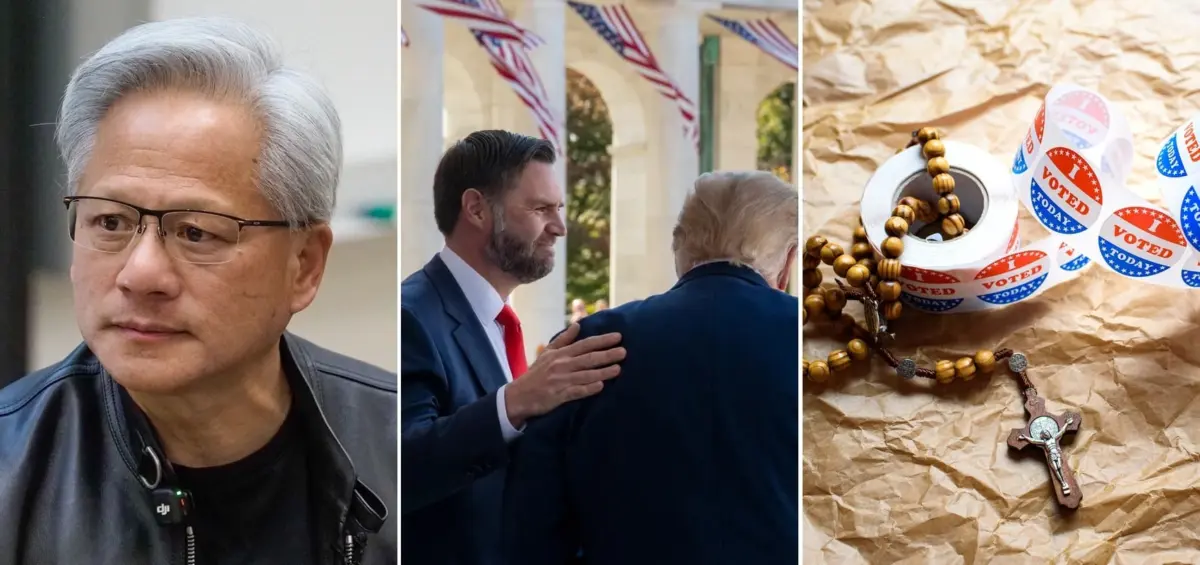
In an era defined by rapid technological disruption and hyper-polarized political realignment, traditional categories of culture, faith, and governance are undergoing a stress test. The latest editorial roundtable hosted by First Things confronts three defining fault lines shaping the contemporary landscape: the burgeoning scandal surrounding tech visionary Jensen Huang, the ideological fractures and uncertain future of the so-called "new right," and the perennial, increasingly complex question of whether a cohesive "Catholic vote" truly exists in modern American politics.
These themes, while distinct on the surface, are deeply intertwined. They reflect a broader cultural anxiety over where power actually resides—whether in the boardrooms of Silicon Valley, the shifting alliances of populist politics, or the pews of America’s churches. As institutions strain to maintain legitimacy, the intersections of technology, statecraft, and religious identity have become the primary battlegrounds for the future of Western society. This report offers a comprehensive examination of the discussions underpinning these critical topics, providing historical context, analytical depth, and a forward-looking perspective on the challenges ahead.
Read Also
Detailed Chronology: The Convergence of Tech, Politics, and Faith
To understand the current juncture, one must trace the sequence of events that brought these distinct crises to a head in the autumn of 2026. The convergence of corporate governance scandals, populist political shifts, and religious identity politics did not occur in a vacuum; rather, it represents the culmination of years of structural friction.
Phase One: The Rise and Reckoning of Silicon Valley Exceptionalism
For the past decade, leaders of the tech sector—most notably artificial intelligence pioneers and semiconductor magnates—enjoyed a semi-sacred status. Viewed as undeniable engines of progress, figures like Nvidia CEO Jensen Huang were largely insulated from the traditional political and ethical scrutiny applied to industrial titans of the past.
However, by mid-2026, the unchecked expansion of Big Tech collided with geopolitical realities, supply chain vulnerabilities, and ethical questions regarding automated governance. The eruption of the "Jensen Huang scandal" marked a watershed moment. What began as inquiries into corporate influence and strategic resource allocation quickly snowballed into a broader public debate regarding the accountability of unelected tech executives who wield more influence over global infrastructure than many sovereign states.
Phase Two: The Ideological Turbulence of the "New Right"
Simultaneously, the political coalition broadly labeled as the "new right"—a heterodox alliance of populist nationalists, post-liberal intellectuals, and economic protectionists—began experiencing severe internal friction. Initially galvanized in the late 2010s and early 2020s by a shared skepticism of globalization, technocracy, and progressive cultural hegemony, the movement reached a critical juncture by late 2026.
As the realities of governance and legislative compromise set in, ideological purists clashed with pragmatists over the future direction of the movement. Questions regarding industrial policy, foreign intervention, and the role of the state in regulating corporate entities exposed deep divisions. The "new right" found itself wrestling with a fundamental paradox: how to utilize state power to dismantle entrenched progressive institutions without replicating the overreaches of the very technocratic state they sought to reform.
Phase Three: The Mythos and Reality of the Catholic Electorate
Intersecting with these political and technological upheavals is the persistent question of religious voters, particularly American Catholics. For decades, political strategists treated the "Catholic vote" as a crucial swing demographic, periodically attempting to court it with targeted policy appeals. Yet, as the editorial board discusses, the notion of a unified Catholic voting bloc has grown increasingly illusory.
Divided by socioeconomic class, race, geographic location, and sharply divergent interpretations of Catholic social teaching, modern Catholics reflect the broader fragmentation of the American republic. Traditionalist communities prioritizing moral and liturgical orthodoxy find themselves at odds with progressive Catholics emphasizing social justice and environmental stewardship, while a vast middle swath navigates daily economic pressures that transcend partisan talking points.
Supporting Context & Metrics
To fully grasp the gravity of these developments, it is essential to examine the underlying data and historical contexts driving contemporary anxieties.
The Technocratic Footprint and Public Trust
According to recent sociological data compiled through mid-2026, public trust in major technology institutions has declined by nearly 34% over the past five years. While consumers remain eager for advancements in artificial intelligence and semiconductor manufacturing, there is a palpable sense of unease regarding the concentration of power in Silicon Valley.
- Corporate Influence: The top five tech conglomerates now account for a market capitalization that rivals the combined GDP of several G7 nations.
- AI Governance: Over 68% of surveyed citizens express concern that corporate leaders, rather than democratically elected bodies, are dictating the ethical frameworks governing advanced automation.
The Demographic Shifts Within the Religious Electorate
Polling data from the 2024–2026 electoral cycles underscores the dissolution of monolithic religious voting patterns.
- Polarization: White working-class Catholics have increasingly aligned with populist conservative movements, driven by cultural concerns and economic nationalism.
- Diversification: Hispanic Catholics, who now comprise over 40% of the U.S. Catholic population, exhibit complex voting behaviors that defy easy partisan categorization, often blending socially conservative views with demands for economic equity and immigration reform.
- The "Nones" vs. the Faithful: The decline of nominal religious affiliation has paradoxically intensified the political polarization of those who remain actively engaged in church life, making religious institutions focal points of ideological contestation rather than unifying community anchors.
Official Statements and Discourse Analysis
The dialogue captured in the latest First Things podcast reflects the urgency felt by cultural critics and intellectuals navigating this volatile terrain. While not issuing a formal legislative decree, the editorial board’s discourse highlights several key analytical insights regarding the state of modern discourse:
- On Corporate Power: The conversation stresses that the Jensen Huang controversy is symptomatic of a deeper malaise—the failure of traditional regulatory frameworks to keep pace with algorithmic and industrial innovation. The editors note that when corporate titans operate beyond civic accountability, democratic governance is reduced to a spectator sport.
- On Populist Realignment: Addressing the future of the "new right," the discussion evaluates the tension between short-term political posturing and long-term institutional building. The consensus suggests that a movement relying solely on grievance politics without a robust, coherent vision for civil society and economic justice is inherently unstable.
- On the Fragmentation of Faith and Politics: Regarding the Catholic vote, the editors dismantle the reductive electoral math employed by mainstream campaign strategists. They argue that attempting to fit ancient theological traditions into modern partisan boxes does a disservice both to the integrity of the Church and to the moral imagination required to heal a fractured nation.
Future Outlook: Navigating Uncharted Waters
As we look toward the remainder of the decade, the trajectory of these three intersecting crises will likely determine the shape of American civic and cultural life for a generation.
1. The Accountability of Tech Infrastructure
The fallout from the Huang scandal signals that the era of uncritical tech veneration is drawing to a close. Policymakers across the ideological spectrum are recognizing that national sovereignty requires robust domestic oversight of critical technologies, particularly semiconductors and artificial intelligence. Moving forward, the debate will not be about whether to regulate Big Tech, but how to do so without stifling innovation or ceding ground to geopolitical adversaries.
2. The Maturation of Post-Liberal Thought
For the "new right," the coming years will serve as a crucible. To transition from a reactive opposition movement into a lasting intellectual and political tradition, its leaders must move beyond critique and offer concrete, constructive blueprints for economic renewal, family stability, and institutional restoration. Failure to do so risks splintering the coalition into factional infighting and irrelevance.
3. The Witness of the Church in a Post-Christian Era
Finally, the enduring puzzle of the Catholic voter points to a deeper spiritual reality: the primary allegiance of the faithful transcends earthly political parties. As the political landscape grows increasingly hostile to traditional moral frameworks, the church’s role is not to act as a voting bloc for transient political platforms, but to serve as a counter-cultural beacon of truth, charity, and enduring hope.
For listeners wishing to engage with the full conversation in detail, the complete podcast episode is embedded below. You can also follow First Things on SoundCloud, or subscribe via Apple Podcasts and Spotify for long-term convenience and access to future archives.




Comments
Facebook App ID not configured. Please add it in the Customizer.