
Executive Overview
Humor writing remains one of the most elusive and technically demanding disciplines in literature. At its core, the challenge is deceptively simple: humor is radically subjective. What induces a fit of laughter in one reader may provoke only a cringe or absolute indifference in another, while shifting genre conventions dictate entirely different rules for what constitutes a joke. Navigating this unpredictable terrain requires far more than natural wit; it demands an analytical understanding of timing, subversion, structural escalation, and psychological resonance.
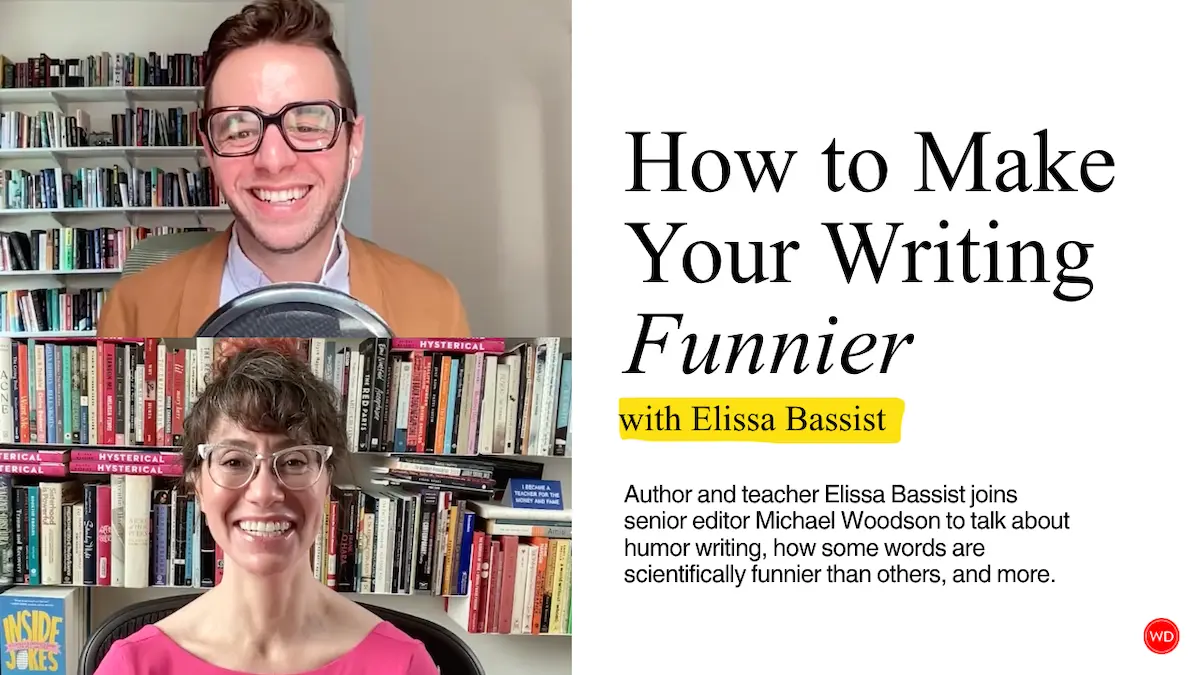
To demystify this intricate process, Writer’s Digest Presents dedicated Season 5, Episode 11 to a masterclass on the anatomy of funny writing. Senior Editor Michael Woodson sat down with acclaimed author, humorist, and educator Elissa Bassist—author of the Thurber Prize for American Humor semi-finalist memoir Hysterical and the newly released guide INSIDE JOKES: A Comedy and Creativity Guide for All Writers.
The comprehensive discussion dives deep into the machinery of comedy. Woodson and Bassist explore actionable techniques for writers seeking to elevate their prose, examining how to commit fully to a comedic bit, how to audit and analyze what genuinely makes an individual laugh, and how to surgically transform a flat, declarative sentence into a dynamic comedic moment. This feature explores the core insights of that conversation, contextualizing Bassist’s extensive industry background and offering an authoritative roadmap for writers looking to inject humor into any genre, from fiction and memoir to journalism and creative essays.
Read Also
Detailed Chronology: The Anatomy of a Masterclass
The latest episode of Writer’s Digest Presents unfolds as a clinical yet deeply entertaining exploration of how humor operates on the page. Rather than treating comedy as an innate, mystical gift bestowed upon a lucky few, Woodson and Bassist deconstruct it as a craft built on recognizable mechanics, repetitions, and structural choices.
Setting the Stage: The Subjectivity Problem
The conversation opens with a foundational dilemma: why is humor so notoriously difficult to write? Bassist and Woodson examine the inherent subjectivity of laughter. Unlike suspense, which relies on primal adrenaline, or romance, which taps into universally understood yearnings for connection, comedy is filtered through a reader’s cultural background, personal experiences, emotional state, and worldview.
Because genre defines humor differently—a satirical essay operates under entirely different constraints than a witty piece of dialogue in a hardboiled detective novel—writers often struggle to find their footing. Bassist addresses this paralysis by reframing humor not as a tightrope walk meant to please everyone, but as a precise form of communication that rewards specificity and vulnerability.
Committing to the Bit
A central pillar of the discussion focuses on the concept of "committing to the bit." In comedy, hesitation is fatal. Writers frequently undermine their own jokes by over-explaining them, softening the punchline, or signaling an apology to the reader for being absurd.
Bassist elaborates on the necessity of total commitment. When a writer introduces an outrageous premise, hyperbole, or structural motif, they must lean into it aggressively. The humor often arises not from the initial absurdity itself, but from the relentless, logical escalation of that absurdity. By treating a ridiculous premise with utter seriousness, the writer creates a comedic tension that pays off exponentially for the reader.
Deconstructing Personal Comedy DNA
How does a writer develop a distinct comedic voice? According to Bassist, the journey begins with rigorous self-audit. Writers are encouraged to study what makes them laugh, rather than attempting to reverse-engineer what they think the broader literary marketplace currently demands.
By analyzing their own consumption habits—whether it’s specific stand-up specials, absurd footnotes in nonfiction, dark comedies, or witty text exchanges with friends—writers can identify the structural beats, cadences, and thematic obsessions that define their personal comedic DNA. Translating this internal amusement onto the page bridges the gap between authentic voice and technical execution.
Turning Sentences into Jokes
Moving from theory to tactical execution, the conversation shifts to the micro-level of writing: the sentence. Bassist outlines practical strategies for transforming a standard, informative sentence into a functional joke.
This process often involves identifying predictable rhythms and subverting them, utilizing unexpected juxtapositions, employing hyperbole with surgical precision, or weaponizing specificity. A vague complaint is rarely funny; a hyper-specific, highly calibrated grievance, however, universally resonates. Through various examples, the episode illustrates how shifting a single word or rearranging a clause can instantly elevate flat prose into a memorable comedic beat.
Supporting Context & Metrics: The Mind Behind the Method
To fully appreciate the wisdom shared in Season 5, Episode 11, it is essential to examine the background of Elissa Bassist. Her authority on the subject is forged through decades of multidisciplinary experience across the literary, comedic, and academic landscapes.
+-----------------------------------------------------------------+
                    ELISSA BASSIST: AT A GLANCE
+-----------------------------------------------------------------+
| • Memoirist: Author of "Hysterical" (Thurber Prize Semi-Finalist)
| • Guidebook Author: "INSIDE JOKES: A Comedy and Creativity Guide"
| • Industry Veteran: Active in media & publishing since 2007
| • Educator: Taught across 20+ writing programs and workshops
| • Multifaceted Roles: Editor, TV/film assistant, producer, barista
| • Geographic Base: Brooklyn, New York (Therapist's favorite)
+-----------------------------------------------------------------+
A Multifaceted Literary Career
Bassist has been a fixture in media and publishing since 2007, occupying nearly every conceivable role within the ecosystem. Her professional footprint spans work as an editor, managing editor, TV and film writer’s assistant, producer, live performer, public speaker, and—in a nod to the classic starving artist resume—a barista.
Her written work has appeared in over 30 prominent publications and literary anthologies, showcasing her versatility across formats. This breadth of experience gives her a uniquely panoramic view of how stories are built, packaged, and consumed across different mediums.
Critical Acclaim and Hysterical
Bassist’s literary breakthrough solidified her status as a vital voice in contemporary humor writing. Her memoir, Hysterical, earned widespread critical acclaim and was named a semi-finalist for the prestigious Thurber Prize for American Humor—the highest recognition of humor writing in the United States.
Hysterical explores themes of voice, silence, and the cultural conditioning that tells women they aren’t funny, or that their pain shouldn’t be met with laughter. The memoir serves as an extended masterclass in how to weaponize humor to process trauma, dismantle societal expectations, and reclaim personal narrative authority.
Empowering the Next Generation of Writers
Beyond her solo work, Bassist is a dedicated educator. Over the course of her career, she has taught creative writing for more than 20 distinct writing programs and institutions. Her pedagogy focuses heavily on unblocking creativity, stripping away the intimidation of the blank page, and helping writers find humor in unexpected places.
Her latest release, INSIDE JOKES: A Comedy and Creativity Guide for All Writers, acts as a natural extension of this teaching philosophy, distilling her years of classroom experience and professional writing into an accessible manual designed to demystify comedy for writers of all backgrounds and genres.
Official Statements & Key Insights
The dialogue between Michael Woodson and Elissa Bassist yielded several profound takeaways that redefine how writers should approach the intersection of craft and comedy. Below are synthesized insights capturing the philosophy presented in the episode:
-
On Embracing Vulnerability:
"Humor is often the fastest route to emotional truth. When we allow ourselves to look foolish, petty, or deeply human on the page, we invite the reader into a shared conspiracy of recognition. The funniest writing almost always stems from a place of absolute, unshielded honesty."
-
On the Mechanics of Revision:
"A joke rarely arrives fully formed in the first draft. The real magic happens during revision—when you look at a deadpan sentence and ask yourself, How can I push this 10% further? What is the most absurd, logical conclusion to this thought? Comedy is an act of engineering, not just inspiration."
-
On Committing to the Bit:
"Writers get scared. They write a genuinely funny, weird sentence, and then immediately follow it up with a sensible paragraph to reassure the reader that they are, in fact, a serious person. Don’t do that. Trust the bit. Stay in the room with the absurdity."
Future Outlook: The Expanding Role of Humor in Modern Literature
As the publishing landscape continues to evolve, the demand for authentic, resonant, and dynamic storytelling has never been higher. Readers saturated by 24-hour news cycles and algorithmically generated content are increasingly gravitating toward books that offer distinct human voices. Humor—when executed with skill and emotional intelligence—acts as an essential anchor, providing relief, perspective, and connection.
The release of INSIDE JOKES: A Comedy and Creativity Guide for All Writers and its deep-dive feature on Writer’s Digest Presents signal a broader shift in how writing programs view comedy. No longer treated as an accidental byproduct of talent, humor is increasingly recognized as an essential literary tool that can be studied, practiced, and mastered.
For writers looking to sharpen their skills, the roadmap is clear: study what makes you laugh, refuse to apologize for your comedic impulses, commit fully to the bits you build on the page, and remember that technical precision is just as vital in comedy as it is in poetry or investigative journalism. By demystifying the machinery of laughter, resources like Season 5, Episode 11 of Writer’s Digest Presents ensure that the next generation of storytellers will be better equipped to make us laugh, think, and feel—all at the exact same time.




Comments
Facebook App ID not configured. Please add it in the Customizer.