
Executive Overview
In the summer of 2025, a visitor walking through the streets of Paris might have stumbled upon an ambitious, immersive theatrical experience dedicated to the life and literature of Jules Verne. Part historical reenactment, part speculative dreamscape, the production carried participants through the physical manifestation of nineteenth-century imagination: the cluttered print shop of Verne’s publisher Hetzel, the metallic bulkheads of the Nautilus, the opulent Parisian club where Phileas Fogg wagered his fortune on an eighty-day global sprint, and finally, the raucous floor of the Baltimore Gun Club. There, the character Barbicane harangued his peers with a grand manifesto: humanity must point its artillery at the heavens and fire a projectile at the Moon.
Yet, the production’s masterstroke arrived in its final scene, vaulting audiences a full century forward into a meticulously recreated NASA Mission Control center. As participants sat at terminals labeled Navigation, Telemetry, and CAPCOM—with rocket equations scrawled on adjacent whiteboards honoring pioneers like Konstantin Tsiolkovsky, Hermann Oberth, and Wernher von Braun—an actor began a countdown. At zero, every participant was called upon to utter a single word: "Go." Go for launch.
The implication hung thick in the electrified air of the room: a straight, unbroken line connects Verne’s fictional, Florida-launched moonshot of 1865 to the roaring reality of Apollo 11 lifting off from Cape Canaveral in 1969. Verne foresaw it, and therefore, it came to be—or perhaps, it came to be because Verne foresaw it.
Read Also
This narrative is as comfortable as it is ubiquitous. It echoes from the tongue of Neil Armstrong broadcasting home from the lunar return vector, and it populates endless internet lists chronicling "Every Time Science Fiction Became Science Fact." But this cultural obsession with technological prescience—celebrating Verne and his successors as visionary fortune-tellers who accurately mapped out submarines, moonshots, and aircraft—masks a deeper intellectual complacency. By flattening science fiction down to a predictive checklist of gadgets, society reduces complex sociological literature into an inventory for future engineering departments. In doing so, we ignore the profound social critiques, political warnings, and systemic interrogations embedded within speculative fiction from its very inception.
Detailed Chronology: From the Inkwell to the Launchpad
To understand how speculative fiction transitioned from social critique to predictive blueprint, one must trace the historical trajectory of industrial modernity, the institutionalization of science, and the evolving cultural mythos of "Progress."
The Nineteenth-Century Industrial Imaginary
During the nineteenth century, Jules Verne lived through an era where the material conditions of human life were shifting at a speed unprecedented in recorded history. Steam power, the expansion of railways, industrial manufacturing, and the professionalization of scientific inquiry fundamentally reworked society. Verne was not a solitary, isolated genius struck by miraculous lightning bolts of prophetic insight; rather, he was an avid consumer, synthesizer, and extrapolator of contemporary scientific discourse.
When Verne penned Twenty Thousand Leagues Under the Seas (1870), introducing Captain Nemo and his groundbreaking electrical submarine, the Nautilus, he was not inventing underwater navigation out of whole cloth. Throughout the 1860s and 1880s, navies across Europe were deeply consumed by submarine development. Compressed-air submersibles were already a reality of naval experimentation, and the global arms race was fixated on discovering how to harness electricity for silent, sustained underwater propulsion. Imperial powers, particularly Great Britain, lived in perpetual anxiety that a rival state—most notably Germany—would crack the technological code first, spawning an entire literary subgenre of invasion literature and future-war fiction.

Verne absorbed these conversations that were quite literally "in the water" and transformed them into narrative architecture. Nemo was not merely a cool gadget pilot; he was a complex, anti-colonial political radical—a deposed Indian prince utilizing the autonomy of his autonomous submersible to wage asymmetric warfare against the imperial trade networks and communication lines of Europe.
The Baltimore Gun Club and the Geopolitics of Space
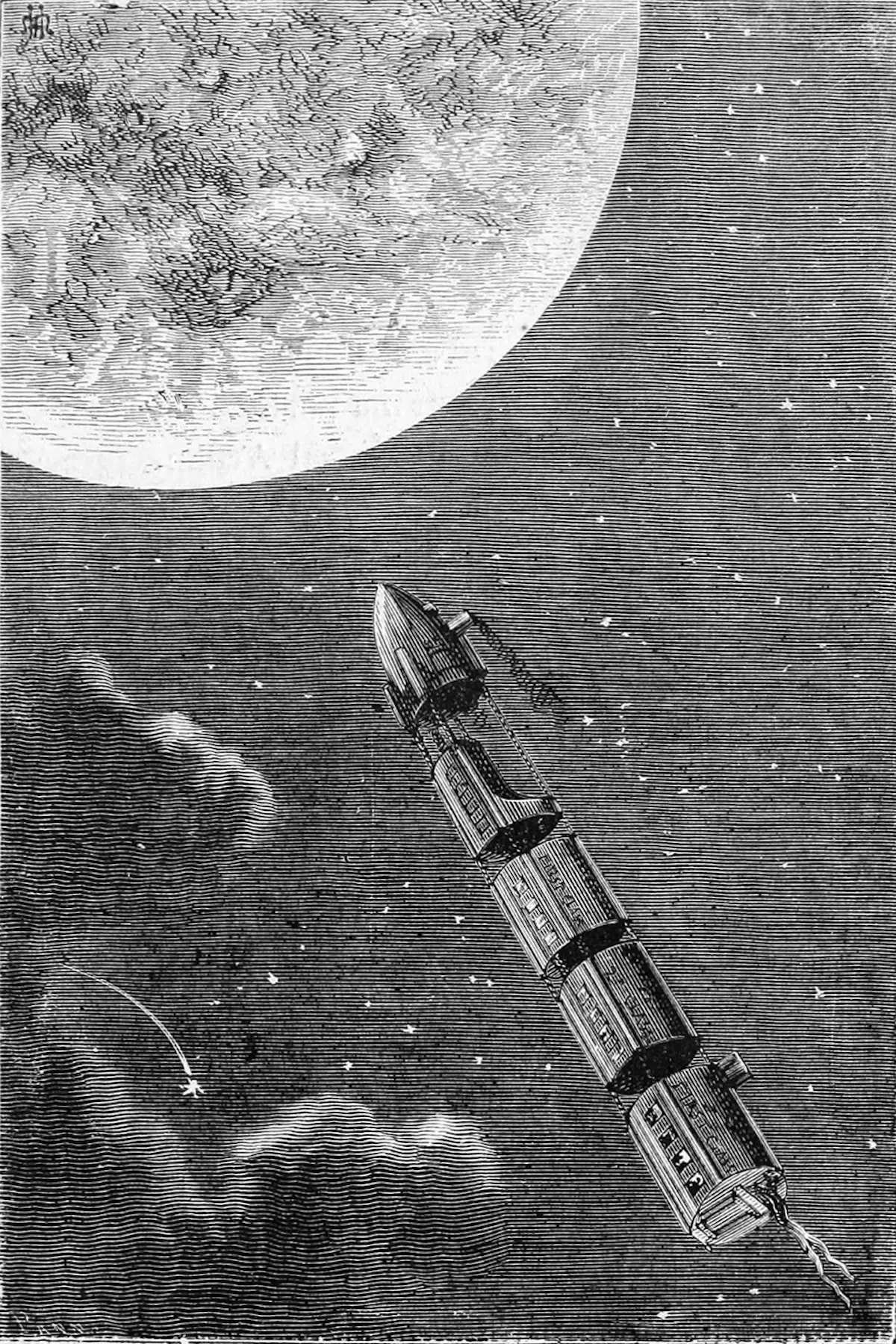
Similarly, From the Earth to the Moon (1865) is frequently misunderstood as a literal roadmap for the Apollo program. The novel’s characters, members of the Baltimore Gun Club, are veterans of the American Civil War left with a catastrophic surplus of military expertise, industrial capital, and ballistic technology when the fighting stops. To occupy themselves, they decide to turn a colossal cannon toward the lunar surface, framing the endeavor as an "affair of national honor."
When the real-world Space Race unfolded a century later, it did not materialize from a pure, disinterested impulse for human curiosity. It was the direct geopolitical fallout of an arms race, fueled by the acquisition of German rocket scientists and ballistic technology developed for intercontinental warfare during World War II. The United States and the Soviet Union reached for the stars because the technological architecture required to do so was inextricably bound to the Cold War military-industrial complex.
Verne understood this dynamic implicitly. His true prescience did not lie in calculating escape velocity or guessing that Florida would serve as a geographical launch site; it lay in his recognition that space exploration and grand technological leaps are never pure acts of wonder. They are deeply political projects, saturated with nationalist posturing, economic motivations, and human violence.
Supporting Context & Metrics: The Myth of Inevitable Progress
The habit of mapping science fiction against real-world technological milestones reinforces a specific philosophical framework: the dogma of continuous, linear technological Progress.
The Invention of Infinite Improvement
To contemporary minds, the idea that human society naturally improves with every passing decade feels like an immutable law of nature. Historically, however, this was not the default worldview of human civilization. The concept of continuous, open-ended improvement—the belief that science and technology will march forward indefinitely to better the human condition—is an intellectual innovation of the seventeenth-century Scientific Revolution, first articulated by figures like Francis Bacon.
It was not until the nineteenth century that this philosophy began yielding tangible, daily changes for the average citizen via industrialization. Society embraced the ideology of "modernity," positioning imperial Western powers as the vanguard of an unstoppable upward trajectory.

Verne’s characters often vocalize this exact mindset. In From the Earth to the Moon, the eccentric dreamer Michel Ardan insists that voyaging to the moon is inevitable because "it simply follows the law of progress." Yet, modern readers frequently misattribute Ardan’s breathless optimism to Verne himself. Verne’s earliest, unpublished manuscript, Paris in the Twentieth Century, offers a chillingly dystopian vision of a future where unfettered capitalism and cold technology have utterly eradicated human art, empathy, and nature.
Flattening the Nuance
When modern media outlets compile charts titled "Every Time Science Fiction Became Science Fact" or critique past decades for failing to deliver the flying cars promised by Back to the Future, they commit a critical error: they flatten the text.
Speculative fiction frequently operates not by predicting the future, but by exaggerating the tendencies of the present to issue a warning. Consider works like Margaret Atwood’s The Handmaid’s Tale or cautionary tales of ecological collapse and nuclear devastation. Authors do not invent these scenarios as a bucket list for engineers to check off. When cultural discourse reduces speculative literature down to a list of cool inventions, it sanitizes the critique. It risks constructing what internet culture famously satirized as "the torment nexus"—the real-world realization of a fictional device explicitly invented in a novel to warn society against its creation.
Official Statements and Cultural Parallels
The conflation of aspiration with prediction is nowhere more apparent than in humanity’s ongoing romance with space exploration, particularly the enduring cultural footprint of Star Trek.
The intersection between real-world space agencies and Gene Roddenberry’s seminal franchise is a matter of historical record. NASA named its pioneering space shuttle Enterprise in direct honor of the television series. Generations of aerospace engineers, mission controllers, and astronauts grew up consuming science fiction, often utilizing the terminology and ethos of Star Trek as a professional shorthand.
During milestones such as the Artemis mission deployments, online science communities frequently frame these events as the incremental fulfillment of Roddenberry’s utopian vision. Yet, such celebratory rhetoric often bypasses the underlying ideological assumptions embedded within the source material. As cultural critic and scholar analyses often point out, Star Trek is fundamentally predicated on an expansionist, colonialist premise: the endless charting and claiming of the "final frontier."
While the show famously wrestled with complex moral and social dilemmas, its core narrative engine relies on perpetual territorial expansion. When we treat its television scripts as an inevitable future blueprint, we risk eliding critical contemporary questions:

- Do we possess the ethical right to export terrestrial extraction models into the cosmos?
- Are we sufficiently prioritizing the preservation of "Planet A" while chasing the speculative promise of "Planet B"?
- How do we ensure that we institutionalize Star Trek’s stated values of universal peace, equity, and social well-being, rather than simply replicating its starships?
Future Outlook: Reclaiming the True Value of Speculative Fiction
As humanity looks toward sustained lunar habitation through the unfolding Artemis framework—with contemporary space news routinely evoking Jules Verne as a prophetic anchor—our relationship with speculative literature demands a fundamental recalibration.
The danger of the "prophecy" paradigm is that it fundamentally misunderstands the function of the genre. As the legendary science fiction author Frederik Pohl famously observed, a truly great science fiction writer does not simply predict the automobile; they predict the traffic jam.
Jules Verne did not give humanity a user manual for submarines and rockets. He gave us a mirror. He examined how human relationships, political ambitions, and societal structures are mediated, fractured, and reshaped by the tools we build.
If we wish to honor the true legacy of Jules Verne, Arthur C. Clarke, and the vast pantheon of speculative fiction creators, we must look past the superficial novelty of shiny gadgets and flying machines. We must stop treating science fiction as a crystal ball forecasting an inescapable destiny, and start engaging with it as what it has always been: a rigorous, deeply human laboratory for questioning the ethics, costs, and consequences of the futures we choose to build.





Comments
Facebook App ID not configured. Please add it in the Customizer.