
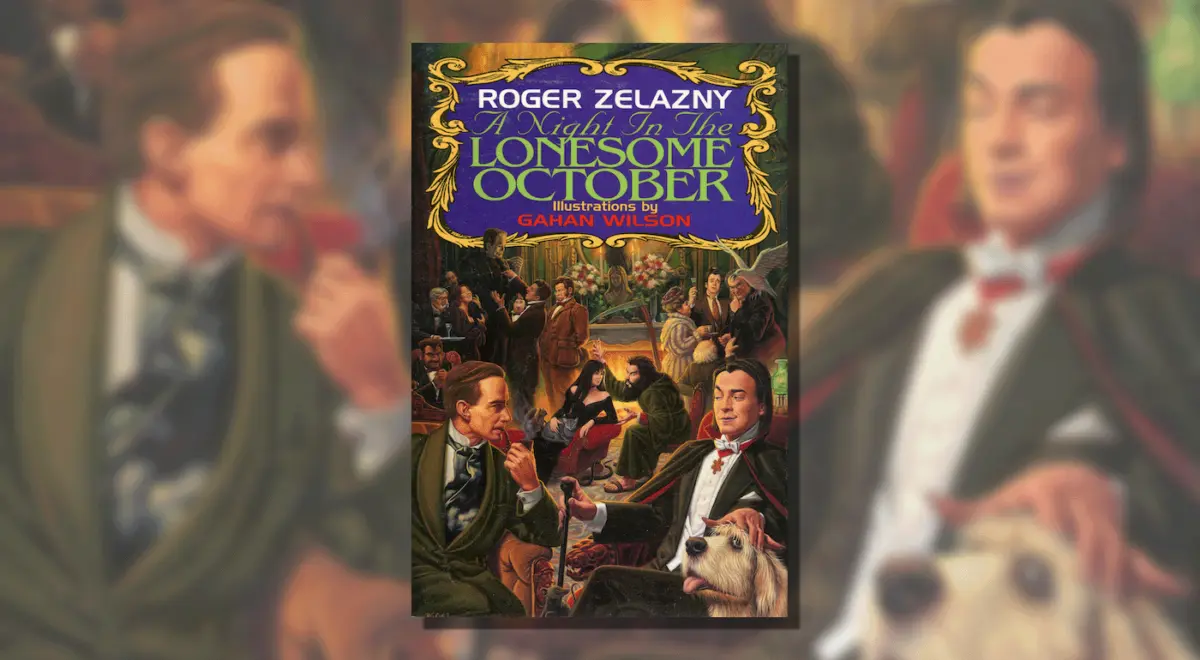
For fans of speculative fiction and atmospheric horror, the arrival of autumn marks the commencement of a revered annual tradition. Across the globe, readers and writers engage in a synchronous, chapter-by-chapter literary marathon centered on Roger Zelazny’s final masterpiece, A Night in the Lonesome October. Beginning on the first of October and culminating precisely at midnight on All Hallows’ Eve, this month-long ritual serves as both a celebration of Zelazny’s brilliant career and a deep exploration of the rich mythological tapestries from which he constructed his narrative.
Published in the twilight of Zelazny’s life, A Night in the Lonesome October is a masterclass in cross-genre pastiche. Borrowing its title from Edgar Allan Poe’s haunting ballad Ulalume, the novel weaves together elements of Lovecraftian cosmic horror, Victorian penny dreadfuls, and classic monster lore. Within its pages, historical and literary heavyweights—including Jack the Ripper, Sherlock Holmes, and Grigori Rasputin—rub shoulders with iconic cinematic entities such as Dracula, the Wolf Man, and Frankenstein’s creation. Furthermore, the novel draws heavily upon ancient folklore concerning witches, familiars, and cosmic gatekeepers.
This retrospective examines the mechanics of Zelazny’s fictional tournament known simply as "the Game," the unique perspective of its canine protagonist, Snuff, and the enduring cultural impact of a book that marries bone-chilling dread with profound emotional warmth.
Read Also
Detailed Chronology: The Anatomy of the Game
Set against the fog-draped, cobblestone labyrinth of Victorian London during a year when the full moon coincides with October’s final night, the narrative unfolds over thirty-one distinct chapters—one for each day of the month. This structural countdown establishes an immediate sense of urgency, mirroring the ticking clock of an impending cosmic catastrophe.
The Rules of Engagement
The Game is an arcane competition played in the shadows of polite society. Its participants—a curated collection of human players and their animal familiars—divide themselves into two opposing cosmic factions. Depending on their alignment, players seek either to open a dimensional portal that will loose the Elder Gods upon the earth, transforming the world into an eldritch nightmare, or to bar the gateway and preserve humanity’s fragile reality.
The month-long tournament is governed by strict temporal and tactical phases:
- The Phase of Discovery (Days 1–10): Players utilize the opening days to identify fellow competitors, deduce allegiances, and attempt to sway wavering opponents to their side of the cosmic ledger.
- The Phase of Collaboration (Days 11–25): Pragmatism often supersedes hostility during the mid-game. Competitors trade magical tools, combine rare talismans, and share vital intelligence, all while managing a shifting web of fragile truces.
- The Phase of Calculation and Climax (Days 26–31): As Halloween approaches, surviving players calculate the exact geographic convergence point where the portal will manifest. The final days devolve into high-stakes confrontations, where alliances shatter and lives—along with the fate of the cosmos—hang in the balance.
Snuff’s Chronicle: A Canine Perspective
Uniquely, the events of the Game are chronicled not through the eyes of a master detective or a dark sorcerer, but through Snuff, a loyal, hard-working hound. Far from being a simple beast of burden, Snuff is a seasoned veteran of previous iterations of the Game. His human partner is Jack, a legendary master of the knife whose shadowy past and clinical precision make him a formidable closer.
Snuff functions as the strategist of the duo. While Jack handles the physical threats, Snuff patrols their territory, maps the urban geography, marks competitor locations, and calculates the ever-shifting trajectory of the impending portal. His canine form offers distinct tactical advantages: an acute sense of smell, heightened survival instincts, and the unique ability to converse freely with any animal, bird, or reptile.
However, Snuff’s transformation is tied to a profound curse. While he understands human speech at all hours, his own voice is locked away by magic. He can only communicate verbally with humans—including Jack—during a strict, one-hour window between midnight and 1:00 a.m. This temporal restriction injects a classic comedic and tragic dynamic into the narrative: humans remain persistently, frustratingly clueless, unable to interpret the urgent warnings of their animal companions until the witching hour strikes.
Supporting Context & Metrics: Familiars, Alliances, and Literary Lore
The tapestry of A Night in the Lonesome October is enriched by an intricate ecosystem of animal familiars, each tethered to a human player representing a distinct cultural or literary archetype.
The Ecosystem of Familiars
Unlike Snuff, who embraces his canine existence with philosophical contentment, many of the other animal companions experience a profound existential toll as a result of their service. These familiars fall into distinct operational categories:
- Enslaved Intellects: Certain animals are pressed into service through arcane contracts, gaining human-level cognitive processing capacity at the cost of their natural instincts. A notable example within the text is a squirrel serving a Druid. While the squirrel can think faster and deeper, it has lost the fundamental instinct to forage and store nuts for winter, leaving it with a heightened intellect but a duller, alienated perception of the world.
- Independent Observers: Not all animal entities participate directly in the Game. Characters such as Nightwing, a wise and watchful owl, operate outside the formal conflict, serving as neutral information brokers and advisors to participants willing to listen.
- The Feline Counterpart: Graymalk, a razor-sharp cat bonded to the witch Crazy Jill, serves as Snuff’s closest confidante. Despite recognizing that Jack and Jill—and by extension Snuff and Graymalk—belong to opposing factions, the cat and dog maintain a pragmatic and genuine friendship. Graymalk’s feline agility and small stature allow her to infiltrate spaces impassable to larger mammals, making her an invaluable investigative asset.
Literary Metrics and Cross-References
Zelazny’s final novel is a triumph of literary synthesis. The following breakdown illustrates the primary literary and cinematic touchstones integrated into the narrative:
- Poe’s Influence: The title directly invokes Edgar Allan Poe’s Ulalume, establishing a melancholic, autumnal tone that permeates the London fog.
- Lovecraftian Cosmicism: The threat of the Elder Gods introduces classic themes of existential insignificance and cosmic dread, contrasting sharply with the domestic comfort of Snuff’s viewpoint.
- Victorian Pastiche: By incorporating archetypes such as Sherlockian deduction, Gothic vampirism (Dracula and his bat familiar), and Gothic science (Frankenstein’s monster and his creator), Zelazny creates a shared universe where classic horror tropes operate under a unified set of occult rules.
Official Statements & Critical Reception
In the decades following its 1993 publication, A Night in the Lonesome October has transitioned from a cult classic into an institutionalized fixture of speculative fiction culture. While Roger Zelazny passed away in 1995, the literary community has continuously championed the novel through organized, annual communal readings.
Prominent fantasy authors and critics have frequently lauded the book as a masterclass in tone control. Reviewers note that while the novel frequently brushes against the macabre, the gruesome, and the apocalyptic, it never loses its emotional anchor.
"The brilliance of A Night in the Lonesome October lies in its ability to balance absolute cosmic terror with domestic sweetness," notes one retrospective literary analysis. "When Snuff receives a pat on the head or a quiet moment by the hearth, the reader is reminded that what is truly being fought for is not just the preservation of the earth, but the preservation of simple, everyday comforts."
Furthermore, critics consistently highlight the integral contribution of illustrator Gahan Wilson. Wilson’s distinctively weird, grotesque, yet charming artwork mirrors Zelazny’s prose style precisely. The visual accompaniment grounds the fantastical London setting in a delightfully eerie aesthetic that has become inseparable from the reading experience.
Future Outlook: The Enduring Tradition of the October Read
As publishing trends shift toward digital formats and rapid-fire content consumption, the longevity of the October-long read-along for A Night in the Lonesome October stands as a testament to the power of slow, communal storytelling.
Writers, book clubs, and online literary communities continue to organize chapter-a-day schedules across social media platforms, ensuring that new generations of readers discover Zelazny’s swan song. This organic, grassroots tradition guarantees that the Game is played anew every single year, as thousands of readers open their copies on October 1st, walk the foggy streets of Victorian London alongside Snuff and Jack, and wait anxiously to see whether the world will survive until Halloween night.
In an era defined by fast-paced media consumption, Zelazny’s final gift to the literary world remains a comforting, chilling, and essential annual pilgrimage—proving that, ultimately, a good dog and a well-told story can hold back even the darkest of Elder Gods.

Comments
Facebook App ID not configured. Please add it in the Customizer.