For generations, queer individuals living in Indonesia—and across the broader Global South—have existed in a state of acute representational scarcity. When queer stories do manage to penetrate the mainstream Western media apparatus, they are frequently subjected to a homogenizing filter. Western narratives routinely position white, Western queer experiences as the universal default, while reducing non-Western identities to flat caricatures of oppression, perpetual victimhood, or exoticized spectacles. This dynamic is not merely an oversight of media diversity; it is an active flattening of rich historical, cultural, and intersectional nuances.
Nowhere is this tension more apparent than in how Western advocacy projects portray nations in the Global South. High-profile installations like the Amsterdam Rainbow Dress, while ostensibly intended as global calls for inclusivity, often perpetuate a subtle European paternalism. By grouping nations under a broad banner of human rights violations without acknowledging local historical contexts—such as the fact that modern queerphobia in Indonesia is a direct artifact of Dutch colonial administration—these projects reduce complex local resistance movements to passive subjects of Western rescue.
However, a cultural counter-offensive is underway. Through speculative fiction, graphic novels, and digital collaboration, a new generation of creators from the Global South is refusing to let their identities be dictated by either authoritarian domestic governments or patronizing Western tropes. Leading this charge are Indonesian-Australian twin creators Jes and Cin Wibowo, whose award-winning graphic novel Lunar Boy has redefined what an authentic, culturally rooted queer narrative looks like. By weaving indigenous Indonesian concepts of gender diversity, community care, and post-colonial resilience into speculative fiction, works like Lunar Boy demonstrate that queer joy and cultural heritage are not mutually exclusive—they are deeply intertwined.
Detailed Chronology: The Journey Toward Authentic Representation
The Search for Mirrors in Western Media
Growing up queer in Indonesia has historically meant surviving on scant fragments of representation. For decades, local visibility was relegated to underground networks, whispered gossip, and tightly guarded community circles where safety depended entirely on personal vouches to avoid state crackdowns or digital mobbing. When local queer Indonesians looked outward to global media, they were met with a profound disconnect. Mainstream Western stories offered characters who were overwhelmingly white, stripping intersectional identities down to a singular, tokenized trait.
This disconnect extended to corporate Hollywood’s attempts at international representation. In 2022, a coalition of Southeast Asian creators, including Jes and Cin Wibowo and the essayist, collaborated on a video series reviewing Disney’s Raya and the Last Dragon. Hosted by author Xiran Jay Zhao, the critique highlighted a recurring issue in Western media production: when non-native creators attempt to depict Southeast Asian cultures, the result is often an amalgamation of generalized motifs, stripped of historical and spiritual context. Living cultures are treated as convenient aesthetic set dressing, leaving audiences from the region unable to see themselves reflected in the art.
Finding Kinship Through Digital Infrastructure
The artistic partnership that birthed Lunar Boy began in the digital ether. Jes and Cin Wibowo first connected with fellow creatives through APIPit, a Twitter pitch event specifically designed for Asian and Pacific Islander creators to present their manuscripts to literary agents and editors. What began as a chance encounter over social media soon evolved into deep discussions regarding the state of local and international queer media.
During the development of Lunar Boy between 2021 and 2022, the Wibowo twins voiced frustrations familiar to many creators from their background: researching indigenous Indonesian queer history was an uphill battle. The legacy of state-sponsored censorship and post-colonial amnesia had successfully buried much of the archipelago’s rich history of gender diversity. Yet, rather than capitulating to these silences, the creators channeled their research into world-building.
The Release and Critical Triumph of Lunar Boy
When Lunar Boy was published, it shattered expectations. Far from being a generic science-fiction story with a superficial queer label, the graphic novel emerged as a distinctly Indonesian queer narrative.
The plot follows Indu, a transgender boy from the moon who experiences profound culture shock upon relocating to New Earth with his adoptive mother. Grappling with a language barrier and the challenge of fitting in at a new school, Indu eventually finds solace and acceptance within New Earth’s vibrant queer community.
The book’s resonance was swift and profound. In a major milestone for Southeast Asian creators, Lunar Boy was honored with a Stonewall Book Award (specifically the Mike Morgan and Larry Romans Children’s and Young Adult Literature Award) and an Ignyte Award for Outstanding Comics Team. This victory transcended commercial success; it served as a collective validation for the entire Indonesian queer community, symbolizing a vital passing of the torch from past generations of queer elders to a resilient future.
Supporting Context & Metrics: Colonialism, Erasure, and Epistemicide
To truly understand the revolutionary nature of contemporary works like Lunar Boy, one must dismantle the prevailing historical myth that queerphobia is an immutable, traditional feature of Indonesian society.
Pre-Colonial Gender Diversity in the Archipelago
Long before the arrival of European colonizers, the Indonesian archipelago featured complex, fluid systems of gender and sexuality:
The Mahabharata Adaptations: Bali-Javanese shadow puppet (wayang) traditions historically framed the warrior Srikandi as a transgender man, and the epic’s central figure, Arjuna, as a transgender woman or a third gender (kasi).
Panji Semirang: The 14th-century Eastern Javanese narrative follows the bandit king Panji Semirang, whose adventures culminate in a relationship with Raden Inu Kertapati.
Serat Centhini: Commissioned in the 19th century by the crown prince of Surakarta, this massive compendium of Javanese culture explicitly documented romantic and sexual relationships between men.
Societal Values: Historically, aggressive individualism was not a prerequisite for masculinity, and feminine qualities were not systematically equated with inferiority. Societal contribution, community harmony, and mutual aid (gotong royong) took precedence over rigid modern binaries.
The Imposition of Colonial Queerphobia and Self-Inflicted Epistemicide
The rigid stratification of class, race, and gender that characterizes modern homophobia and transphobia in Indonesia was systematically introduced by the Dutch colonial administration. Following independence, the nation underwent what scholars term "self-inflicted epistemicide"—a process wherein successive political regimes systematically erased minority histories, suppressed leftist movements, and enacted cultural genocides (such as the persecution of Chinese-Indonesians during the mid-to-late 20th century).
During the dictatorship eras spanning 1965 to 1999, queer individuals were frequently caught in the crosshairs of state purges targeting suspected communists. Despite this state violence, queer elders persevered, developing robust linguistic subcultures like Bahasa Binan (or Binan/Bencong Language). However, post-colonial amnesia runs so deep that younger generations have occasionally internalized the marginalization of terms like waria (a long-standing self-descriptor used by trans-feminine Indonesians), mistakenly viewing them through a lens of stigma rather than reclamation.
Official Statements and Cultural Impact
The broader implications of this representational shift have been articulated by creators and literary critics alike. As Charlie Jane Anders wrote in Never Say You Can’t Survive:
"Anyone who imagines a different reality is helping everyone else to see our power to act, and to make changes."
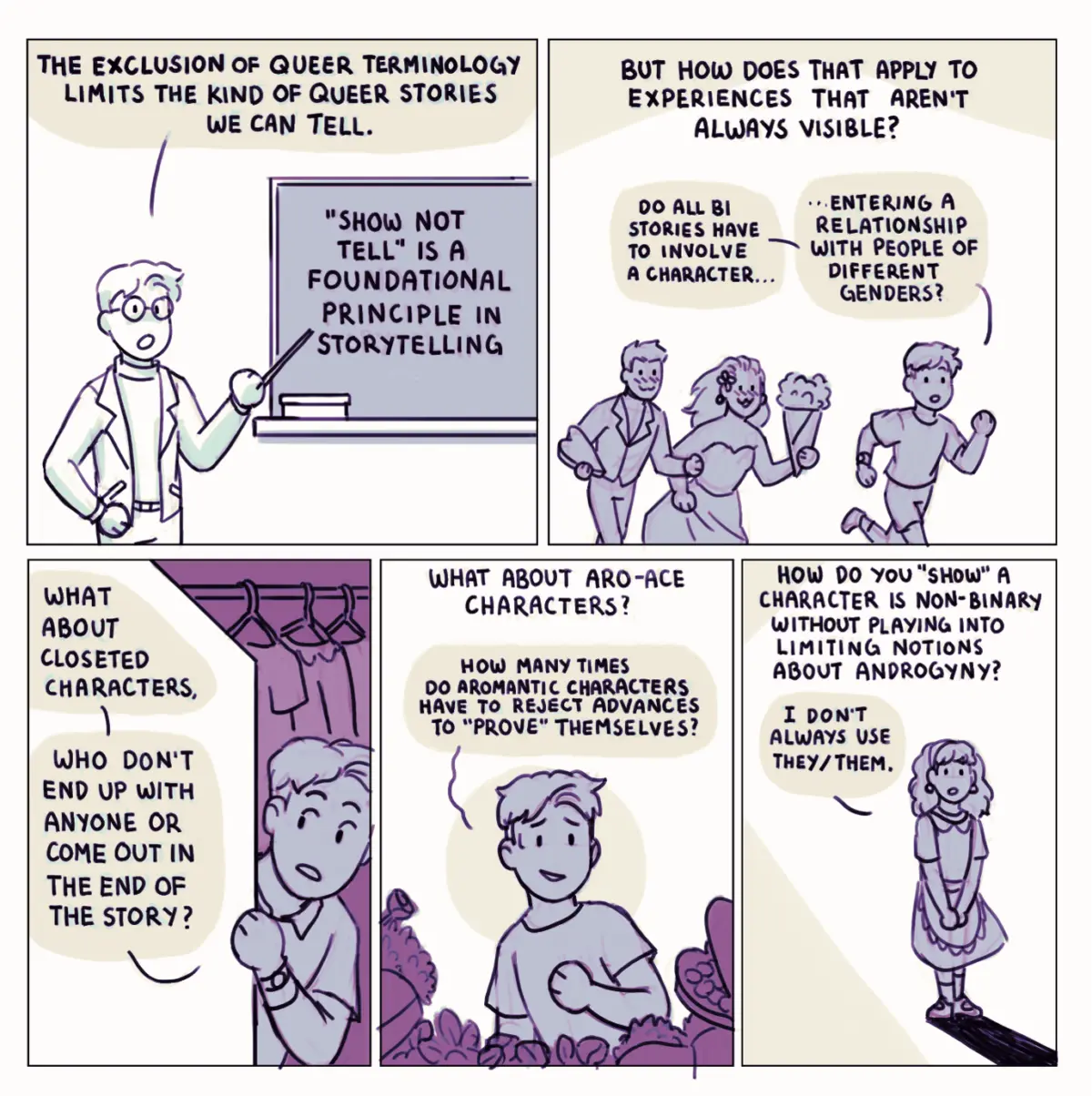
This ethos forms the core of Lunar Boy’s thematic resonance. By normalizing diverse expressions of gender—such as Aminah, a trans girl who honors the historical weight of the waria label, and Dewi, a character who embraces her femininity through Lengger lanang (a traditional Javanese dance traditionally performed by men dressed as princesses)—the graphic novel actively pushes back against white Western hegemony in queer storytelling.
Furthermore, the book translates indigenous social structures into speculative settings. The "Bhinneka Community" depicted in Lunar Boy is a direct reflection of traditional Indonesian mutual-aid networks and historical waria houses, echoing the foundational philosophy of gotong royong.
When asked about the role of language in shaping identity, creators within the network emphasize the power of reclamation. Simple editorial choices—such as incorporating terms of endearment like "sayangku" (Indonesian for "my love") into English-language fiction—assert that marginalized writers do not need to strip away their mother tongue to appeal to global markets.
Future Outlook: The Path Forward for Global South Creatives
The success of Lunar Boy and the growing chorus of voices from the Global South signal a turning point in international literature and media consumption. For too long, creators in developing nations faced a false dichotomy: either sanitize their work to match Western sensibilities and evade domestic censorship, or risk obscurity on the global stage.
The paradigm is shifting. As regional creators claim international literary accolades, they are fundamentally rewriting the terms of global representation. They are demonstrating that queer joy, intersectional struggle, and rich cultural heritage can coexist without being diluted for foreign consumption.
The message to the next generation of storytellers is clear: the history of the Global South is not merely one of trauma and persecution, but of resilience, community, and radical imagination. By anchoring stories in authentic cultural soil, creators are building spaces where queer people of color are not forced to choose between their culture and their identity. They are proving that their lives, their histories, and their futures matter.







Comments
Facebook App ID not configured. Please add it in the Customizer.