
Executive Overview
Throughout the summer months, a quiet ritual took place at the National Gallery in London, drawing art critics, theologians, and secular gallery-goers alike. Visitors found themselves inexplicably drawn week after week to a temporary exhibition dedicated to the Spanish Golden Age master Francisco de Zurbarán (1598–1664). This sustained fascination was not driven by clever marketing or sweeping retrospectives, but by the gravitational pull of the paintings themselves.
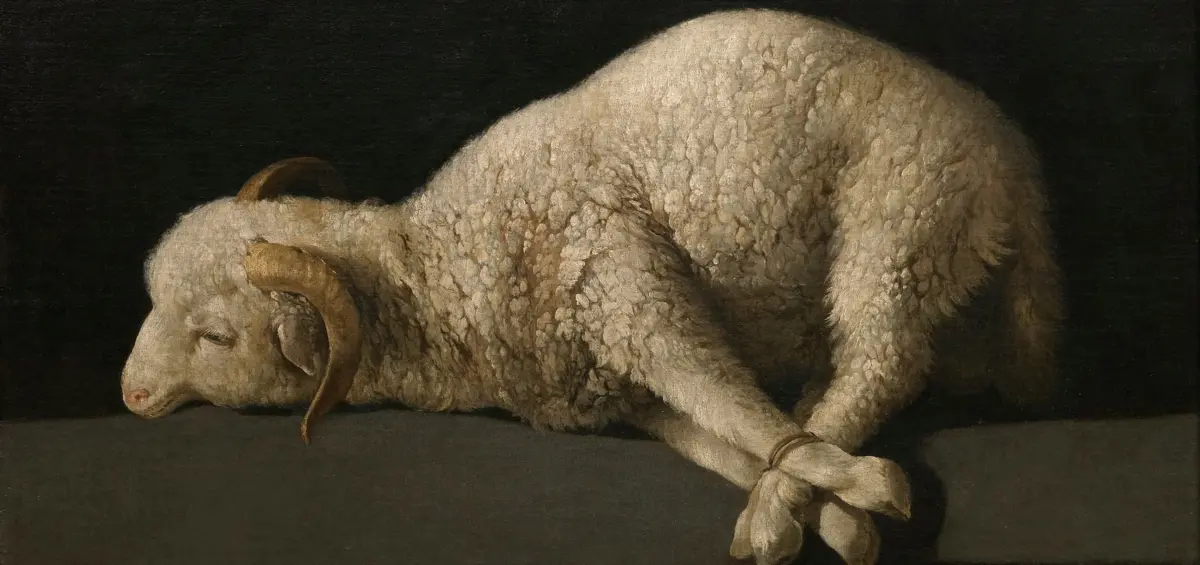
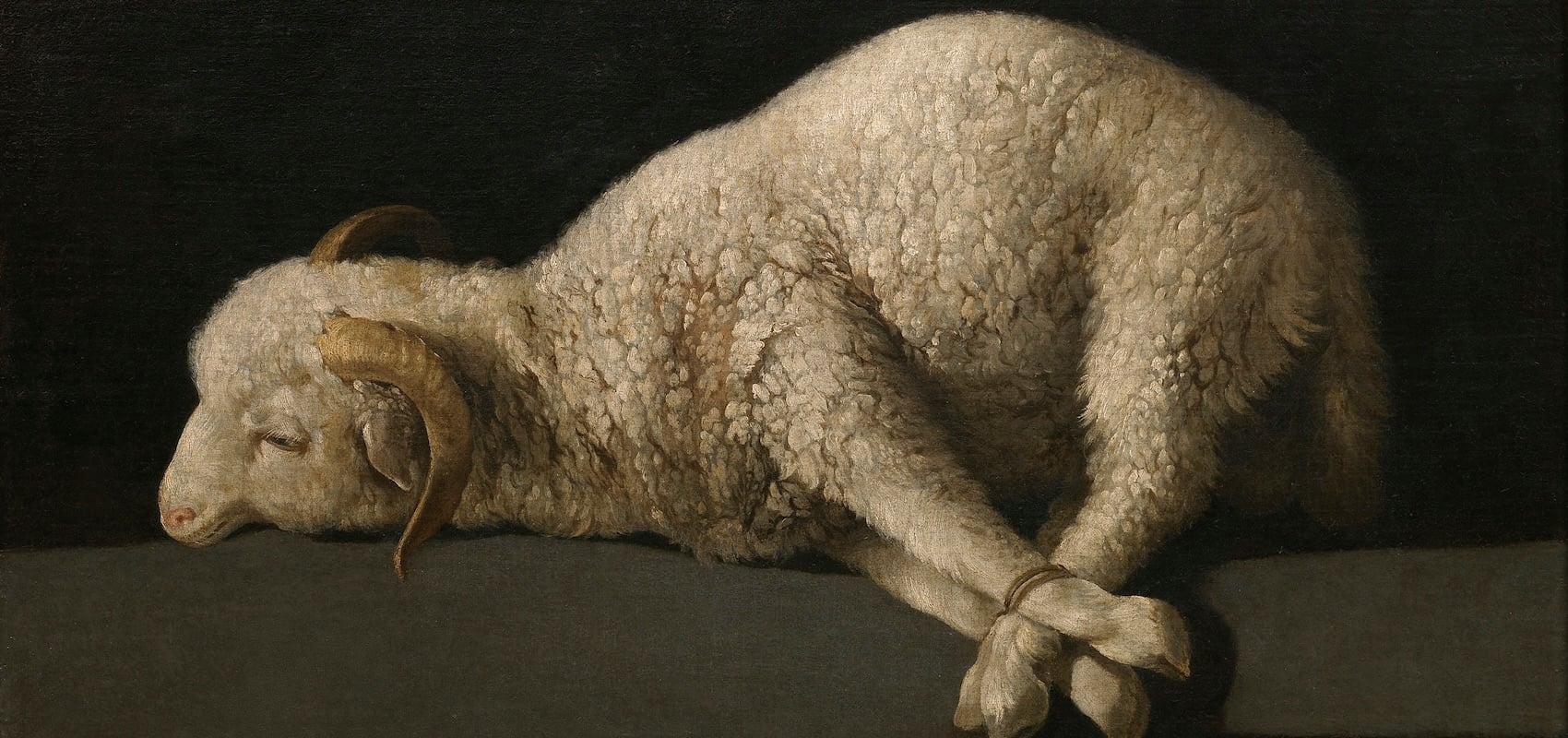
Zurbarán, widely regarded as the preeminent religious painter of the seventeenth century, occupied a unique space in European art history. While contemporaries like Caravaggio used dramatic tenebrism to heighten theatricality, and Raphael idealized human anatomy to mirror classical harmony, Zurbarán focused on spiritual conflicts and the quiet dramas of the soul. His works demand an intense, unblinking confrontation with the divine. Even as modern art historians and casual viewers catalog his anatomical shortcomings, awkward architecture, and failures of perspective, Zurbarán’s canvases retain an undeniable, haunting power. They do not merely illustrate sacred narratives; they render the invisible reality of faith palpable, transforming canvas and pigment into an act of enduring prayer.
Detailed Chronology: The Life, Art, and Trials of a Master
To understand the piercing clarity of Zurbarán’s vision, one must trace the trajectory of his life, which was increasingly marked by profound personal tragedy and professional displacement.
Read Also
Early Life and Artistic Ascent (1598–1630s)
Born in Fuente de Cantos, Estremadura, in 1598, Zurbarán grew up in a relatively prosperous merchant household. He received formal training in Seville, a bustling artistic hub where he honed his mastery over light, shadow, and the tactile qualities of heavy textiles. Early success came swiftly; his profound capability for rendering rough sackcloth, heavy embroidery, and damask silk earned him commissions from monastic orders across Spain. During this period, Zurbarán fathered at least nine children, demonstrating an engagement with earthly life that contrasted sharply with the austere, severe asceticism of his subject matter.
The Turning Point: Personal Loss and Hardship (1639–1650)
Despite his early acclaim, Zurbarán’s life was punctuated by devastating grief. His first two wives died young—in 1623 and 1639, respectively. Worse was to follow: in 1649, the bubonic plague swept through Seville, claiming the life of his beloved son Juan, a remarkably talented still-life painter in his own right. Most of Zurbarán’s children predeceased him.
Concurrently, the socio-economic and artistic landscape of Spain shifted. By the mid-1630s, Zurbarán faced mounting professional setbacks, financial distress, and artistic marginalization as younger painters like Bartolomé Esteban Murillo gained favor with the Sevillian elite. This accumulation of humiliation, grief, and financial ruin forms the backdrop of his later works—including a small, poignant self-portrait painted around 1650, at a moment when the artist appeared to have lost nearly everything. Rather than yielding to despair, Zurbarán’s brushwork achieved a new level of spiritual intensity, culminating in masterpieces that treated suffering not as a burden, but as a gateway to divine communion.
Supporting Context & Metrics: Analyzing the Paradox of Zurbarán’s Technique
Art criticism often relies on a strict accounting of formal qualities: correct anatomical proportions, precise perspective, and rigorous composition. By these metrics, Zurbarán presents a fascinating paradox. His finest works are utterly convincing despite—and perhaps occasionally through—technical flaws that would sink a lesser artist.
Technical Shortcomings and Masterful Illusion
Zurbarán’s weaknesses as a draftsman are well-documented by connoisseurs:
- Anatomy and Perspective: He frequently struggled with foreshortening forearms, rendering torsos beneath stiff garments, and positioning hands or fingers with naturalistic grace. In paintings of kneeling saints—such as the magnificent Saint Francis in Meditation at the National Gallery—shins and feet are often conspicuously missing or swallowed by heavy folds of fabric.
- Spatial Composition: His architectural rendering can appear amateurish, and his recurring motifs, such as stacked cherub heads resembling cannonballs, occasionally border on the jarring. Furthermore, he often failed to establish a consistent light source or logical shadow placement.
- The Textural Triumph: Conversely, Zurbarán was unrivaled in his depiction of how light behaves on heavy, coarse textiles. His rendering of the rough sackcloth worn by mendicant friars possesses a tactile authenticity that makes the viewer instinctively reach out to touch the weave.
Seminal Works and Critical Misreadings
This unique synthesis of technical imperfection and absolute psychological conviction is evident across several key compositions:
-
Saint Francis of Assisi in His Tomb (circa 1640s / Lyons, Boston, Barcelona):
Based on a legend where Pope Nicholas V allegedly witnessed the uncorrupted body of St. Francis standing upright in his crypt in 1449, this image has repeatedly terrified and transfixed viewers. The nineteenth-century art critic J.-K. Huysmans famously described the Lyons version in The Cathedral, misinterpreting it as an extreme visualization of the mysticism of St. John of the Cross—"the art of the torture chamber, the delirium tremens of divine intoxication." Even with the historical context corrected, the painting retains its uncanny, awful illusion of a waking vision. -
Saint Serapion (1628 / Wadsworth Atheneum, Hartford):
Depicting a Mercedarian friar martyred in 1240 while purchasing the freedom of Christian slaves, this shocking canvas shows the saint hanging by his wrists from ropes and chains. Badly beaten and unconscious, Serapion’s body hangs limply, yet the painting radiates a profound sense of transcendent endurance. -
Christ and the Virgin in the House at Nazareth (1630s / Cleveland Museum of Art):
An invention of Zurbarán’s own imagination, this domestic scene shows an eleven-year-old Jesus having pricked his finger on a crown of thorns he has been plaiting in his lap, while the Virgin Mary looks on with weary, prophetic sorrow. Despite cataloging its technical flaws, no art historian can deny its status as an emotional and spiritual masterpiece.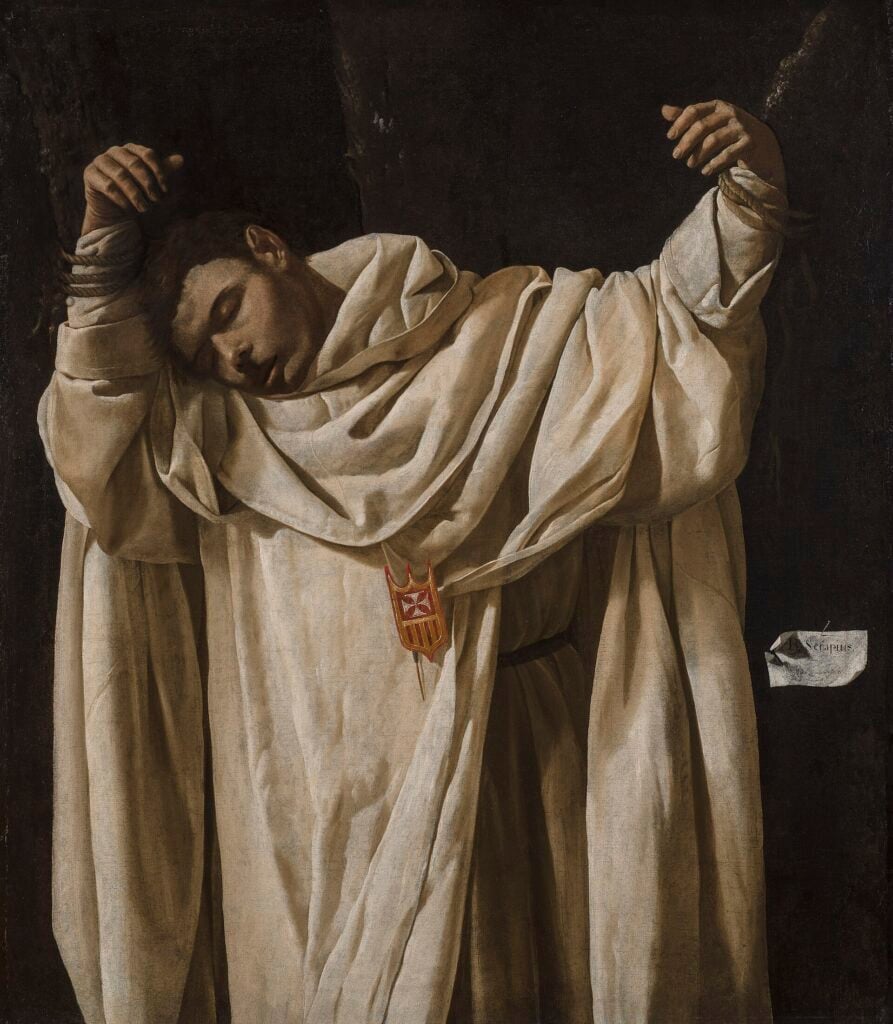
-
Saint Luke as a Painter before Christ on the Cross (Louvre / Various Collections):
Perhaps his most haunting late work, this canvas depicts St. Luke—the patron saint of artists—holding his palette and brushes while pressing his right hand to his heart. He gazes upward at Christ on the cross, who appears to bow down toward the painter, illuminated entirely by divine light.
Official Statements & Critical Perspectives
Scholarly and philosophical engagement with Zurbarán highlights how divergent worldviews interpret his unyielding devotion.
- The Secular and Philosophical View (Friedrich Nietzsche):
Many old masters invite nonbelievers to appreciate religious scenes purely through an aesthetic or cultural lens. Friedrich Nietzsche famously appropriated Raphael’s Transfiguration in The Birth of Tragedy to illustrate Apollonian cultural mechanics, treating the sacred subject as raw material for secular philosophy. Yet, art historians note that Zurbarán’s uncompromising sincerity resists such appropriation. It is nearly impossible to read his devotional imagery as anything other than an authentic expression of Catholic faith. - The Aesthetic View (J.-K. Huysmans):
Writing before and after his reconversion to Catholicism, Huysmans identified in Zurbarán an artist who bridged the gap between physical agony and spiritual ecstasy. For Huysmans, Zurbarán’s paintings proved that "a note of adoration, what a cry of love, stifled by anguish, sprang from this canvas." - The Modern Connoisseur’s Assessment:
Modern curators emphasize that Zurbarán’s raw, unpolished execution is central to his power. His art was never intended merely to decorate an aristocratic salon or serve as a passive aid to contemplation; it was, in the truest sense, a visual liturgy.
Future Outlook: The Enduring Relevance of Sacred Realism
As contemporary culture navigates an era dominated by digital acceleration, ephemeral media, and a relentless "attention economy," the appeal of Zurbarán’s work offers a stark, necessary counterweight. Exhibitions like the one hosted at the National Gallery demonstrate that modern audiences are still hungry for fixed points of reference—anchors in the permanent things.
Looking ahead, museum curators and art historians anticipate a renewed focus on the Spanish Golden Age not merely as a historical epoch of stylistic development, but as a crucible for exploring existential and spiritual resilience. Zurbarán’s legacy reminds the modern viewer that technical perfection is secondary to visionary truth. By forcing us to confront the reality of suffering redeemed by transcendent light, Francisco de Zurbarán ensures that his canvases will continue to speak across the centuries, bridging the visible world and the eternal soul.



Comments
Facebook App ID not configured. Please add it in the Customizer.