
Executive Overview
In the biting chill of a March afternoon on Wildcat Mountain, where daytime temperatures hover at twenty degrees and five-foot snowdrifts choke the landscape, a profound domestic transition was quietly underway. For seven years, a 14-by-24-foot cabin nestled deep within the trackless wilderness of the Catskills served as the solitary crucible for an unnamed author, educator, and seeker. This remote dwelling—devoid of running water, electricity, cellular service, and internet—was not merely a weekend retreat, but a deliberate hermitage born from personal collapse, family trauma, and an aching spiritual void.
Now, as the long bachelor season draws to a close with impending marriage, the cabin has undergone a rigorous, symbolic deep clean. The author prepares to bridge the gap between radical solitude and shared domesticity, leaving behind a profound era defined by silence, physical exertion, encounters with wildlife, and a long-overdue reconciliation with the ghost of an impoverished, troubled father. This report examines the psychological, ecological, and spiritual dimensions of a seven-year experiment in wilderness living, mapping the trajectory from isolation to initiation, and ultimately, to resurrection.
Detailed Chronology: From the Ashes of New York to the Catskill Ridges
The Shadows of Queens and the Genesis of Flight
The roots of the Wildcat Mountain hermitage stretch back decades, tangled in the bleak realism of 1980s New York City. Growing up in a state of severe poverty in Queens, the author endured a childhood defined by paternal dysfunction and maternal sacrifice. While the author’s mother worked double shifts as a cleaning lady and waitress—her hands permanently rubbed raw—the father sat in darkened rooms, drinking heavily and demanding his children turn cassette tapes to mimic the conducting of Siegfried’s Funeral March.
Read Also
Driven by an absolute vow to break the cycle, the young boy sold fake flower arrangements and baseball cards, harnessed strict academic discipline, and earned admission to Regis High School and subsequently Princeton University. Following a decade-long stint in the classroom—fulfilling a maternal plea not to "fall in love with money"—the author’s meticulously constructed life began to fracture. Recurrent fevers, debilitating moods, and professional burnout culminated in the painful dissolution of a marriage.
Yet, the emotional catalyst for flight was not the divorce itself, but the realization that his former wife was the last living person who had witnessed his father’s final days in the hospital. Confronted with the terrifying prospect that his father’s memory would vanish entirely from the universe, and paralyzed by the agonizing theological fear that his father was damned, conventional therapy proved useless. The author required a landscape vast enough to swallow his existential grief.
The Asccent to Wildcat Mountain
In his thirty-third year, unattached and unemployed, the author purchased six acres of rugged Catskill land and a rudimentary cabin for $67,000. On June 9, groping blindly up the mountain trail in the pitch blackness without a working flashlight, he officially crossed the threshold into a seven-year chapter of profound isolation.
CHRONOLOGY OF A TRANSFORMATION
├── Pre-2015: Childhood in Queens; paternal dysfunction; education at Princeton; 10 years of teaching.
├── June 2015: Purchase of Wildcat Mountain cabin; arrival in total darkness; onset of solitude.
├── 2016–2021: Years of silence; manual labor at maple farms and plant nurseries; deep ecological immersion.
└── March (Final Year): The spring cleaning ritual; packing for marriage; confrontation with the mountain's enduring spirit.
The daily rhythm of the cabin was dictated by raw survival and elemental labor. Without indoor plumbing, water was hauled from a spring 300 feet down a steep, treacherous slope. Heat was provided by a cast-iron wood stove salvaged from his childhood home, requiring hours of hand-sawing and chopping. Employment was strictly constrained to low-verbal, manual tasks—working on a maple syrup farm or a native plant nursery—leaving sixteen hours a day for uninterrupted solitude.
Supporting Context & Metrics: The Ecology of Silence
Living alone in the wilderness for the better part of a decade fundamentally alters human perception. The author’s experiences underscore a psychological shift away from anthropogenic concerns toward an ecological cosmology.
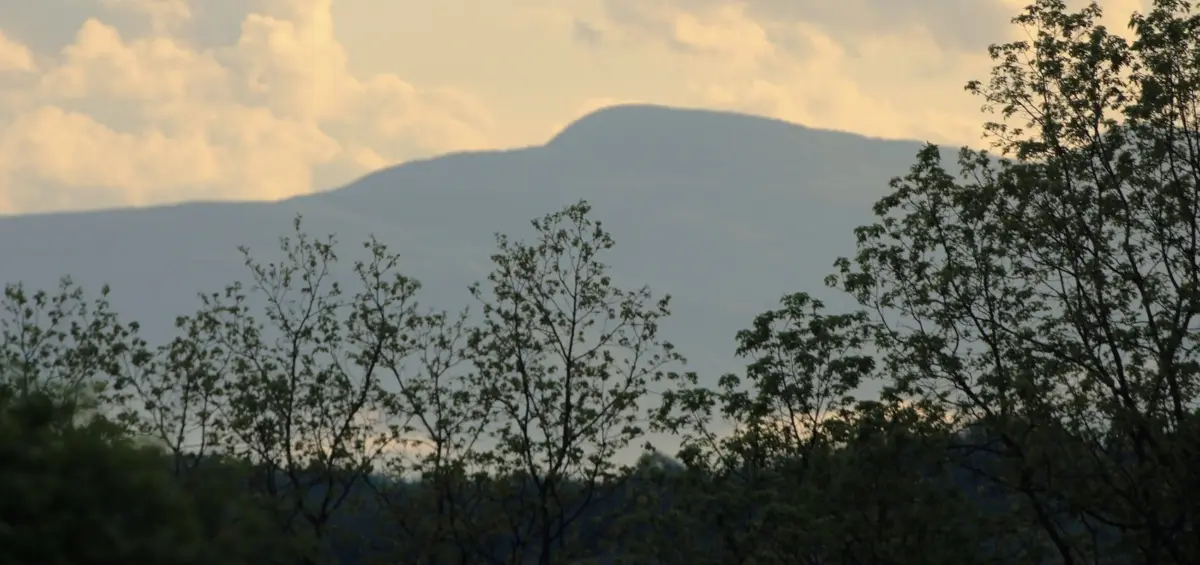
- Geographical Scale: Wildcat Mountain spans roughly 20 square miles—comparable to the footprint of Manhattan—yet its eastern half remains entirely trackless wilderness, untouched by historical settlement or commercial logging.
- Climatic Extremes: Situated at an elevation of 2,300 feet, the cabin endured deep winter temperatures plunging to five degrees Fahrenheit, accumulating up to two and a half feet of snowpack, and drawing frequent lightning strikes, including a direct hit to a salvaged television antenna functioning as an improvised lightning rod.
- Labor Metrics: Daily routines involved vertical traverses of a quarter-mile trail carrying supplies, hauling heavy water jugs up steep mountain grades, and engaging in physical labor that engaged the nervous system far beyond the reach of intellectual anxiety.
The Wilderness as Initiatory Rite
Drawing on the philosophical frameworks of Franciscan scholar Richard Rohr and ancient contemplative traditions, the author posits that true initiation is not psychological or therapeutic; it is cosmological.
"Initiation, first of all, is not a psychological paradigm at all. It’s not about therapy. It’s not about solving your problems with your father or your mother… Initiation is not a psychology: it’s a cosmology."
Through prolonged silence, words lost their inflated currency. The boundaries between human consciousness and the natural world blurred. Encounters with wildlife—from chipmunks chattering in unison on a May morning to a young, aggressive black bear ransacking the cabin—ceased to be external events and became intimate dialogues with a deeper, visceral self.
Official Statements & Reflections: The Author’s Inner Dialogue
Reflecting on the precipice of his wedding day, amidst the dust and memories swept from the cabin floor, the author articulated the complex reconciliation that defined his years on Wildcat Mountain:
"I had sworn that I would not be like him. It was an ambition calculated to inflict pain. Now I found myself emulating him. I found myself wanting, among other things, to be a husband and a father… Now I saw that I wished to be not his rival but his heir. It was the proper place of an heir not only to inherit the effects, but to put them to better use as well."
The physical act of cleaning the cabin—sweeping out pounds of accumulated wood dust, sorting unplanted seeds, and scrubbing rotted boards—served as a domestic sacrament. It was an acknowledgment that clean starts are rarely absolute; rather, the past is carried forward, integrated, and transformed by new life.
Regarding the theological weight of his journey, the author noted the realization of a forgiving, resurrecting grace embedded within the cyclical rhythms of the forest:
- The Cycle of Decomposition: Dead ferns in the compost yield rich soil for spring seeds; dead animals feed maggots that take flight.
- The Covenant of Kinship: The physical healing found in boiled witch-hazel leaves demonstrated an inexplicable, foundational kinship between human physiology and botanical chemistry.
- The Presence of the Divine: Solitude revealed a God "sundered from all twoness"—not a distant arbiter of damning standards, but an intimate presence found within the depths of the natural world and human instinct.
Future Outlook: A New Domesticity on Wildcat Mountain
The narrative concludes not with a permanent retreat from society, but with an intentional, transformed return to it. Having proved his capacity for discipline, silence, and self-reliance, the author steps off the mountain to marry.
However, the departure from Wildcat Mountain is cyclical rather than final. The future outlook envisions a life deeply rooted in the land that initiated him:
- The Return: Following the wedding, the couple plans to return to the Wildcat Mountain cabin, working locally at the plant nursery and cultivating their own food.
- The Expanding Family: The vision extends to raising children—ultimately five—on the mountain, teaching them the stars and integrating them into the rhythms of the forest.
- The Legacy of the Heir: By accepting the broken pieces of his paternal inheritance and allowing them to "fall into the earth and die," the author steps forward not as a victim of his past, but as a fully initiated husband, father, and steward of the wild.
In the final analysis, the journey on Wildcat Mountain proves that the wilderness is not merely a place to escape human sorrow, but a crucible where sorrow is transmuted into wisdom, and where the human heart, stripped of pretense, discovers its true home.





Comments
Facebook App ID not configured. Please add it in the Customizer.