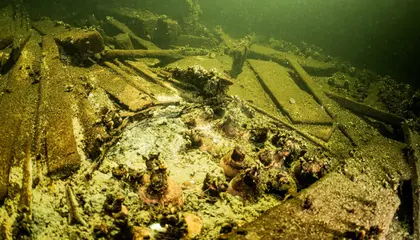
Resting silently in the chilling, absolute darkness 190 feet below the surface of the Baltic Sea lies an untouched monument to 19th-century European diplomacy, trade, and elite international relations. Discovered in the summer of 2024 by technical divers Pawel Truszynski and Marek Cacaj of the renowned exploration group Baltictech, an anonymous 160-year-old shipwreck has slowly yielded a cache of treasures that reads like a royal wishlist.
Initially misidentified as a Caribbean pirate runner due to a single stamped clay bottle bearing the word “Nassau,” the vessel has since been tracked through European archives, French Champagne houses, and English ceramics inventories. New, comprehensive research suggests that the doomed cargo ship sank in late 1856 or early 1857, traveling from the bustling German port of Hamburg to the imperial capital of St. Petersburg.
Among its remarkably preserved cargo are hundreds of bottles of vintage Louis Roederer Champagne, highly sought-after Selters luxury mineral water, English fine china from Davenport, and cutting-edge scientific measurement instruments. Most intriguingly, manifest records point toward a collection of rare meteorites and specialized mineral specimens commissioned as an extravagant diplomatic gift from Adolf, Duke of Nassau, to Czar Alexander II of Russia. The delivery was designed to bridge the geopolitical chasm left by the recently concluded Crimean War, re-establishing trade channels and cementing an alliance with the Romanov dynasty.
Detailed Chronology: From a Sonar Blip to an Imperial Manifest
The Summer 2024 Discovery
The saga began on a late evening in the summer of 2024 as Truszynski and Cacaj prepared to conclude a technical diving survey off the coast of Sweden. Scanning the silt-covered seabed one final time before heading to the surface, their sonar equipment picked up a minor anomaly.
At a depth of 190 feet, the divers illuminated a fully exposed cargo hold. Rows of upright and tilted bottles, collapsed wooden barrels, and sediment-buried crates stretched before them. Tomasz Stachura, the leader of the Baltictech expedition who boasts four decades of diving experience, noted at the time that while finding a stray bottle or two on a historic wreck is common, discovering a hold packed with intact, pristine cargo was a groundbreaking first.
Following strict legal and archaeological protocols, the team left the bulk of the site undisturbed. However, they retrieved a single clay jug, a Champagne bottle, and a scattering of ceramics to aid in identification.
Unlocking the Artifacts (2024–2025)
Without a ship’s bell, nameplate, or hull inscriptions, the vessel was entirely anonymous. The investigation’s first breakthrough arrived when pottery archaeologist Matylda Gierszewska-Noszczynska analyzed photographs of the clay bottle’s stamp. It was not Caribbean rum, as initially joked by the divers, but rather natural sparkling mineral water from the German Duchy of Nassau. Specifically, the emblem linked the bottle to Selters, a luxury brand whose distinctive stamp dated the artifact between 1836 and 1866.
Shortly thereafter, Stachura’s son noticed a faint, embossed French inscription on the cork of the recovered Champagne bottle. Closer inspection revealed it to be Louis Roederer’s Carte Blanche, a premium vintage from a Reims-based house with deep historical ties to the Russian court.
In 2025, Truszynski and diver Michał Iwicki returned to the site for a targeted excavation within the silt. Reaching deep into the deck sediment, Iwicki unearthed a ceramic plate bearing a factory mark and the number "56," matching production styles from the English pottery manufacturer Davenport in 1856. Archives in Stoke-on-Trent confirmed that Davenport exported its wares immediately after firing, establishing a tight departure window of late 1856 or early 1857 for the ship.
Archival Convergence and the Hamburg Manifest
Armed with the convergence of three distinct European manufacturing nodes—English porcelain, French Champagne, and German stoneware—Truszynski scoured international archives. Cross-referencing Amsterdam shipping logs with technical vessel specifications, mast counts, and cargo manifests, he identified a precise historical match.
The ship’s manifest included not only the recovered goods but also Villeroy & Boch ceramics, scientific instruments, and the aforementioned meteorites sent by Adolf, Duke of Nassau, to Czar Alexander II.
Supporting Context & Metrics: Diplomacy in the Wake of War
To understand the immense value and political significance of the wreck’s cargo, one must examine the geopolitical landscape of Europe in the mid-1850s.
The Aftermath of the Crimean War
The Crimean War (October 1853 – March 1856) pitted the Russian Empire against an alliance of the Ottoman Empire, France, Great Britain, and Sardinia. Sparked by disputes over religious holy sites in the Middle East and Russian expansionist pressures, the conflict devastated regional trade and isolated the Russian elite from Western European luxury goods.
When Czar Nicholas I died of pneumonia in March 1855, his son, Alexander II, inherited a struggling empire and a humiliating military defeat. Alexander signed a peace treaty in March 1856 on unfavorable terms, bringing an end to the war and prompting European powers to reassess their diplomatic chessboards.
Nassau’s Neutrality and the Imperial Gift
The Duchy of Nassau, ruled by Duke Adolf, maintained a delicate neutrality during the conflict, quietly favoring St. Petersburg. Adolf shared a deep familial bond with the Romanovs: his first wife, Grand Duchess Elizabeth Mikhailovna, was a cousin of Alexander II. Though Elizabeth had passed away in 1845, the personal and political ties remained robust.
According to Truszynski’s historical analysis, once the British naval blockade of the Baltic Sea was lifted, Duke Adolf moved swiftly to re-establish official diplomatic relations and congratulate Alexander II on his accession to the throne.
[Duchy of Nassau (Duke Adolf)]
       │
       ├─► Commercial Goods (Hides, Barrels of Wine, Davenport/Villeroy & Boch Ceramics)
       │     └─► Targeted at starving the private St. Petersburg luxury market.
       │
       └─► Official State Gift (Louis Roederer Champagne, Selters Water, Scientific Gear, Rare Meteorites)
             └─► Targeted at Czar Alexander II to cement a geopolitical alliance.
The doomed commercial vessel was commissioned to carry a dual-purpose cargo: mass-market and luxury items to supply the starved private markets of St. Petersburg, alongside an extraordinary, high-value state tribute.
The Allure of Louis Roederer and Selters Water
Louis Roederer: By the mid-19th century, Russia had become the premier export market for the champagne house. Handwritten ledgers in Roederer’s archives show annual exports to Russia reaching nearly 600,000 bottles by 1857. Laboratory testing confirmed the recovered wreck specimen was an 1857 vintage carrying a high sugar content favored by Russian aristocrats. (This enduring relationship eventually birthed Cristal in 1876, a custom flat-bottomed clear bottle commissioned by Alexander II to thwart hidden explosives or poisons—though the Czar was ultimately assassinated by a carriage bomb in 1881).
Selters Mineral Water: Sourced from the village of Niederselters, this naturally carbonated water was celebrated across 19th-century Europe for its medicinal properties. Its specialized clay bottles provided a flawless insulation barrier against light and air, enabling the water to survive long, arduous maritime expeditions across the continent without losing its effervescence or distinct flavor profile.
Official Statements and Research Insights
The discovery has generated excitement across the marine archaeology and historical research communities. Speaking on the unique nature of the site, lead historical researcher Pawel Truszynski noted:
"This cargo was intended to be a physical bridge of goodwill celebrating the return of peace to Europe, reopening blocked commercial channels and cementing Nassau’s strategic alliance with the Russian Empire. This wreck is an absolute, untouched monument to 19th-century diplomacy and elite international relations in Europe."
Reflecting on the psychological shift from physical diving to deep archival detective work, Truszynski added:
"The real adventure begins on land, when these silent objects suddenly come alive. It is a spectacular feeling when a clay jar ceases to be just a piece of debris from the seafloor and becomes a key that unlocks the cabinets of emperors and czars."
Tomasz Stachura, leader of the Baltictech diving expeditions, emphasized the unprecedented nature of the find, noting that after four decades of diving, finding an intact cargo hold of this magnitude is entirely unprecedented.
Future Outlook: The Third Expedition and Final Verification
While archival records align closely with the physical evidence recovered so far, the Baltictech team remains rigorous in their methodology. They have not yet published their findings in a peer-reviewed journal, waiting instead for absolute, definitive physical confirmation from the ship’s interior.
The team is currently awaiting formal authorization from the Swedish government to launch a third expedition to the wreck site. Upon securing clearance, the project will divide into two specialized units:
Perimeter Sweep: The first group will scour the surrounding seabed for the ship’s bell, which may have been swept away or dislodged by decades of strong Baltic currents.
Hold Excavation: The second group will conduct controlled excavations deep within the lower sediment levels of the cargo hold to uncover items listed on the manifest that have yet to be sighted.
Chief among the targeted items are the specialized, lead-lined or reinforced wooden crates housing the rare meteorites and scientific mineral specimens commissioned by Duke Adolf. Because these heavy, durable crates would have been safely tucked beneath stacked layers of Selters stoneware and champagne bottles, researchers remain hopeful they survived the vessel’s descent intact.
Recovering these rare mineralogical artifacts would provide 100% scientific certainty of the ship’s identity, opening the doors to historical insurance registers in London. This final puzzle piece will illuminate not only the exact mechanics of the tragedy—such as whether an insurance claim was ever filed for the loss of this monumental imperial cargo—but will also permanently cement the shipwreck’s legacy as one of the most significant underwater archaeological discoveries of the 21st century.

/https://tf-cmsv2-smithsonianmag-media.s3.amazonaws.com/filer_public/4f/2b/4f2b2208-f188-4e62-9e79-b57bf12e7c13/baltictech1.png)
/https://tf-cmsv2-smithsonianmag-media.s3.amazonaws.com/accounts/headshot/meilan_headshot2.png)
:focal(750x500:751x501)/https://tf-cmsv2-smithsonianmag-media.s3.amazonaws.com/filer_public/4f/2b/4f2b2208-f188-4e62-9e79-b57bf12e7c13/baltictech1.png)
/https://tf-cmsv2-smithsonianmag-media.s3.amazonaws.com/filer_public/39/2d/392d11b4-cd72-4f33-8589-a4e8d59109e7/image13.jpeg)
/https://tf-cmsv2-smithsonianmag-media.s3.amazonaws.com/filer_public/63/f7/63f7b69a-0de4-48be-8e30-50ad9e00a710/img_6584.jpeg)
/https://tf-cmsv2-smithsonianmag-media.s3.amazonaws.com/filer_public/a2/19/a2190fba-012b-4386-8f97-850ee50739b8/image3.jpeg)
/https://tf-cmsv2-smithsonianmag-media.s3.amazonaws.com/filer_public/2e/0c/2e0c9301-7985-4ec0-a628-101732cc728c/zar_alexander_ii.jpg)
/https://tf-cmsv2-smithsonianmag-media.s3.amazonaws.com/filer_public/5d/8f/5d8f61ec-3fff-4303-82b6-27cfc1b6b731/b6b72c4b-dc61-4559-8f4f-07e6061a3f7b.jpeg)




Comments
Facebook App ID not configured. Please add it in the Customizer.