
Executive Overview
In the contemporary landscape of global literature, the explosive growth of Japanese manga in the United States is often analyzed through the cold lens of market metrics, publishing trends, and shifting demographics. However, behind the multi-million-dollar sales figures and the mainstream dominance of graphic novels in American libraries lies a deeply human story of displacement, identity, and cultural exchange. At the heart of this transpacific bridge is Misako Rocks!, a prominent U.S.-based manga artist, educator, and author whose creative journey mirrors the very cultural synthesis she champions.
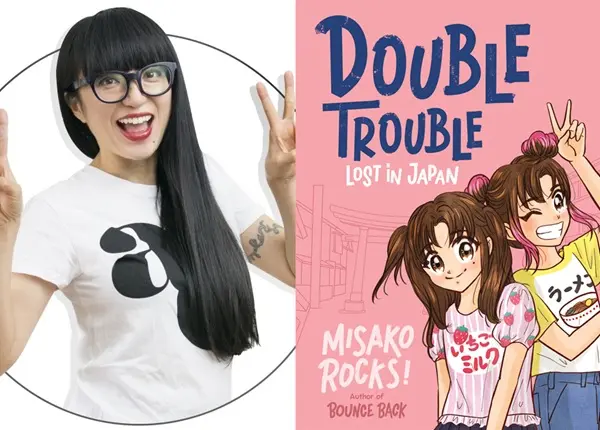
With the September publication of Double Trouble: Lost in Japan: A Kid-Friendly Manga Adventure (Feiwel and Friends)—the fourth installment in her celebrated Bounce Back series for young readers—Misako solidifies her status as a vital voice in contemporary children’s literature. Alongside her activity book series, How to Draw Kawaii Manga with Misako Rocks (Quarto), and her digital pedagogical platform, Learn Manga with Misako, her impact on the next generation of readers and creators is profound.
Yet, Misako’s professional success was hard-won. Her path from a movie-struck adolescent in Japan to a struggling expatriate in New York City, and finally to an acclaimed graphic novelist, illustrates the complex realities of cross-cultural migration. By discovering that her native heritage was not a barrier to assimilation in America, but rather her greatest artistic asset, Misako has built a career that fosters empathy, imagination, and cross-cultural understanding. This feature explores her remarkable evolution, the broader socio-cultural impact of manga as a bridge between the East and West, and the enduring power of sequential art to unite young minds across oceans.
Read Also
Detailed Chronology: From Cinematic Dreams to New York Realities
The Seventh-Grade Epiphany
Long before she was sketching panels for American schoolchildren, a young Misako was gazing at the television screen in her hometown in Japan, transfixed by the neon lights, high-stakes adventures, and boundless optimism of classic Hollywood cinema. Films like Robert Zemeckis’s Back to the Future and Richard Donner’s The Goonies did more than merely entertain her; they served as a window into a wider, seemingly limitless world.
Starting around the seventh grade, this cinematic fascination hardened into a steadfast ambition. "Dad, Mom: I’m moving to America when I grow up!" she would tell her parents almost daily. To the adolescent Misako, the United States represented an idealized frontier of freedom, individual possibility, and unbridled adventure—a place where dreams were not just conceived, but actively realized.
The Clash of Expectations and Reality
Years of diligent preparation culminated in a life-changing milestone: Misako earned a scholarship to study abroad as an exchange student in Missouri. The dream she had nurtured for half her youth was finally materializing. Yet, the transition from fantasy to lived reality proved jarringly severe.
Despite years of formal English instruction in Japan, Misako found herself entirely unequipped for the velocity and nuance of conversational American English. During her opening weeks in the Midwest, she felt chronically overwhelmed. Her interactions were paralyzed by a linguistic loop, reduced to repeating a single, exhausting phrase: "I’m sorry, could you say that one more time?"
The collision of language barriers and subtle cultural differences exerted a daily psychological toll. Simple social interactions that native speakers took for granted demanded immense reserves of courage from the young exchange student. While fatigue frequently threatened to overwhelm her, Misako anchored herself to a singular, sustaining mantra: "This is the adventure you’ve always dreamed of." It was her first rigorous lesson in resilience—a psychological fortitude that would later underwrite her survival in the cutthroat artistic ecosystem of New York City.
The Crucible of New York and the Search for Belonging
Following the completion of her college education, Misako made the definitive move to New York City, driven by a new artistic aspiration: to become a professional puppeteer. True to the classic immigrant narrative, she navigated the city’s labyrinthine economy by juggling a mosaic of odd jobs while relentlessly pursuing her theatrical ambitions.
However, the reality of the city’s artistic grind eventually forced a painful reckoning. After years of sustained effort, Misako had to confront an unpalatable truth: her career as a puppeteer was not going to materialize.
Standing in the epicenter of a metropolis teeming with millions of souls, Misako experienced a profound crisis of belonging. She had crossed an ocean to reinvent her life, yet she felt entirely untethered, floating between an abandoned past in Japan and an unfulfilled future in America. The structural displacement of migration had left her creatively and personally adrift—until a chance encounter at a children’s museum fundamentally rewired her trajectory.
Supporting Context & Metrics: The Manga Phenomenon in America
The Cultural Mirror at the Children’s Museum
While employed at a local children’s museum, Misako began interacting with young American visitors whose enthusiasm for Japanese pop culture caught her entirely off guard. Far from treating foreign media as exotic or alien, these children were deeply immersed in Japanese manga, anime, culinary arts, and even rudimentary Japanese language phrases.
Children would routinely approach her with written characters, asking her to translate or verify their brushstrokes, eagerly sitting beside her to practice the intricate scripts. When they watched her sketch, their eyes lit up with the desire to emulate her lines, drawing their own renditions of manga-style characters.
For Misako, these interactions were a revelation. Growing up in Japan, manga was as unremarkable and ubiquitous as daily newspapers or street signs; it was woven into the fabric of everyday literacy and entertainment. Consequently, she had departed her homeland completely oblivious to the burgeoning seismic shift taking place across the Pacific. She did not realize the scale of the American manga explosion until she was standing on the outside looking in.
A Beacon in the Cultural Tunnel
This grassroots enthusiasm acted as a psychological catalyst. For years, Misako had scoured the American cultural landscape searching for a sense of home, identity, and professional purpose. Seeing American children look toward Japan with the exact same wide-eyed curiosity and imaginative fervor that she had once directed toward Hollywood films provided a startling moment of clarity.
[Childhood in Japan] ---> Inspired by U.S. Cinema ('Back to the Future') ---> Moves to America
                                                                                     |
[Found in U.S.] <--- Embraces Japanese Identity & Shares Manga <--- Cultural Mirror at Museum
She recognized the reflection of her younger self in those children. More importantly, the realization crystallized: she did not need to strip away her Japanese identity to carve out a creative existence in the United States. In fact, her unique position as a cultural bridge was her greatest strength.
This epiphany transformed her artistic philosophy. She resolved to immerse herself fully in the study of manga creation, utilizing her dual heritage as a wellspring for storytelling. What began as a personal quest for belonging evolved into a mission to educate and inspire. Years later, this dedication would manifest not only in graphic novels, but in the founding of "Learn Manga with Misako," an online educational hub reaching students across the globe.
Official Statements & Reflections
Reflecting on her journey from an alienated newcomer to a celebrated cultural ambassador, Misako highlights the poetic symmetry of her career:
"American culture opened a door for me and inspired me to come to the U.S.," Misako reflects, summarizing the arc of her life’s work. "Years later, Japanese manga helped me find my place on the other side of the door. I came to America searching for an exciting future far from home. I found it by bringing home with me."
This philosophy underpins her contemporary approach to education and storytelling. By visiting schools across the nation, Misako engages directly with students—many of whom arrive as reluctant readers, intimidated by traditional text-heavy literature. Through the sequential visual pacing, emotional resonance, and accessible humor of her Bounce Back series, she witnesses firsthand how graphic novels unlock literacy for struggling learners.
"Watching reluctant—and passionate!—readers discover a love of reading through manga is something I never imagined when I first came to America," she notes.
Her interactions with these students do not merely flow outward; they serve as her primary creative crucible. By listening to contemporary American youth grapple with universal anxieties—friendships, academic pressures, identity crises, and shifting familial dynamics—she gathers the raw emotional material for her graphic novels.
"Sometimes a student tells me they dream of visiting—or even moving to—Japan because of manga and anime," Misako shares with a smile. "Every time I hear that, I remember the seventh-grade girl who dreamed about America after watching Back to the Future."
Future Outlook: The Ongoing Legacy of Transpacific Storytelling
As the global publishing market continues to embrace graphic novels and translated works, the trajectory of creators like Misako Rocks! points toward an increasingly interconnected literary future. The rigid boundaries that once separated "foreign" and "domestic" literature in Western markets are dissolving, replaced by an appetite for authentic, cross-cultural narratives that speak to the universal complexities of youth.
With the release of Double Trouble: Lost in Japan, Misako is not only expanding her successful Bounce Back universe but also deepening the dialogue between her two homes. Through her school visits, digital workshops, and continued publication schedule, she is actively cultivating a new generation of creators who view cultural differences not as walls to scale, but as bridges to cross.
Ultimately, Misako Rocks! has proven that art possesses a unique alchemy. By transforming her personal struggles with displacement into accessible, joyful, and empathetic storytelling, she has transcended the role of traditional author. She stands today as a living testament to the power of cultural exchange—proving that the longest journeys often lead us back to who we are, enriched by the worlds we dared to explore.





Comments
Facebook App ID not configured. Please add it in the Customizer.