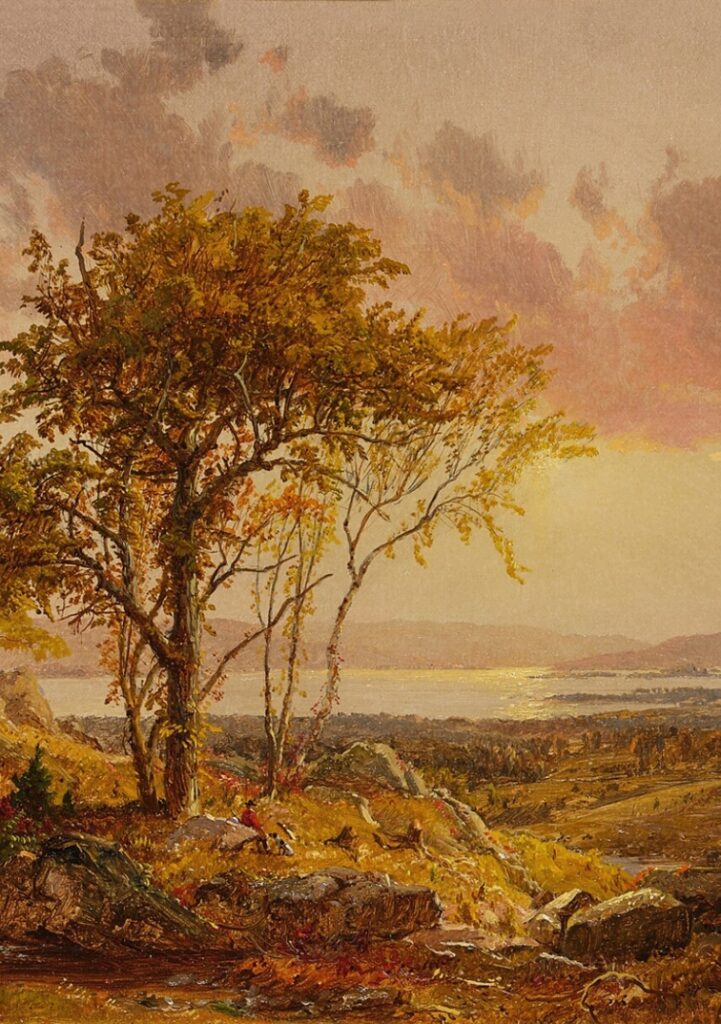
In the contemporary landscape of American poetry, few voices manage to balance devastating existential inquiry with a dry, disarming, almost conversational deadpan quite like Bob Hicok. Designated as the Missouri Review Poem of the Week for October 26, 2026, Hicok’s piece—titled “Observations meant to enlighten can also obscure”—serves as a masterclass in tonal juxtaposition. Featuring visual framing anchored by Jasper Francis Cropsey’s 1873 Hudson River School masterpiece A Distant View of the Hudson River in the Fall, the poem bridges the gap between historical romanticism and the jagged, unpredictable realities of modern psychological fracture.
Hicok, whose latest collection Breathe (Copper Canyon Press, 2026) continues to garner critical acclaim, constructs a narrative space where sharks function as natural vacuum cleaners for oceanic debris and human memory; where suicide hotlines offer impossible burdens; and where city leaf-raking becomes a tactile, therapeutic meditation on Heraclitean flux. This comprehensive review examines the architecture of Hicok’s latest work, tracing its thematic motifs from the surreal to the heartbreakingly mundane, and contextualizing its place within the broader framework of 21st-century American verse.
Detailed Chronology and Thematic Breakdown
To understand the poetic machinery of “Observations meant to enlighten can also obscure,” one must traverse its associative leaps line by line. Hicok begins not with human introspection, but with the atmospheric properties of the natural world:
No one had to teach moonlight how to whisper. And sharks are natural vacuum cleaners.
This juxtaposition immediately establishes the poem’s foundational premise: the universe operates according to innate, unprompted laws that require no human intervention or comprehension. The transition from the delicate anthropomorphism of moonlight to the grim, utilitarian nature of sharks sets the stage for the speaker’s descent into the uncanny.
The sharks are not merely predators; they are archivists of human loss. In a single oceanic specimen cut open in Santa Monica, they uncover a portfolio of modern detritus: "a wallet, license plate, / astrolabe, and loneliness." The inclusion of the astrolabe—an ancient navigational instrument—beside a driver’s license and a wallet bridges historical navigation with modern identification, culminating in the visceral weight of "loneliness" treated as physical physical flotsam.
The Santification of the Ordinary and the Crushing Weight of the Hotline
From the shores of Santa Monica, Hicok pivots toward hagiography with a characteristically secular, humorous twist:
Saint Monica sounds like someone you wouldn’t mind going to a movie with. She’d share her popcorn and not tell you if she figured out who the killer was.
This cinematic domesticity provides a brief, necessary levity before the poem plunges into its most harrowing stanza. The speaker reveals a brief, failed tenure operating a suicide hotline:
I lasted half a day on the suicide hotline. Wasn’t cut out to tell the woman who cried the whole time, whose cancer had Alzheimer’s, who was broke and alone and afraid of the dark, that she had so much to live for.
The formulation "whose cancer had Alzheimer’s" is a brilliant stroke of poetic compression, capturing physical degradation and cognitive erasure in a single, crushing breath. Refusing toxic positivity, the speaker admits a desire to offer a darker, more honest validation—"she had so much to die for"—before fleeing a system demanding simple answers to insurmountable suffering.
The Therapy of the Mundane: Raking Leaves with Heraclitus
Seeking refuge from the impossible demands of crisis intervention, the speaker takes up a municipal job: raking leaves for the city. Here, classical philosophy meets urban labor:
It’s like Heraclitus said: you never rake the same leaves twice. And the noise they make is kind of like the murmur in a bar, so I never feel alone.
The dry, rustling friction of dead foliage mimics the ambient chatter of a crowded tavern, offering a strange, communal solace to an isolated soul. This passage directly echoes the visual accompaniment of Cropsey’s A Distant View of the Hudson River in the Fall (1873)—a painting steeped in the melancholic, transience of autumn, where brilliant amber and russet hues signal both natural beauty and terminal decay.
Supporting Context & Metrics: Bob Hicok’s Literary Arc
To fully appreciate the resonance of this Poem of the Week selection, it is necessary to examine Hicok’s trajectory within contemporary American poetry. Over a prolific career spanning decades, Hicok has established himself as a poet of the working-class intellect—someone who can pivot effortlessly from automotive mechanics to abstract philosophy without losing emotional authenticity.
Metric / Detail
Description
Featured Publication
The Missouri Review (Poem of the Week, October 26, 2026)
Latest Poetry Collection
Breathe (Copper Canyon Press, 2026)
Companion Visual Art
A Distant View of the Hudson River in the Fall (1873) by Jasper Francis Cropsey
Hicok’s poetry frequently interrogates the boundaries of institutional sanity. In the poem’s concluding movements, the speaker recalls a psychiatric encounter following a release from physical restraints:
A psychiatrist once asked me if a glass was half full or half empty. This was after I was released from the restraints. Without thinking, I said the glass is thirsty and so am I.
This subversion of a tired diagnostic cliché brilliantly reframes existential despair not as a glass deficit, but as a mutual, insatiable yearning shared between the object, the self, and the environment.
Official Statements and Critical Reception
While individual poems published as weekly features typically bypass formal press releases, the editorial framing provided by The Missouri Review and the broader critical reception of Breathe offer substantial insight into Hicok’s cultural standing in late 2026.
Critics reviewing Breathe have universally lauded Hicok’s ability to confront the post-pandemic, technologically saturated modern psyche with humor and raw vulnerability. In an era dominated by hyper-polished digital discourse, Hicok’s lines—ragged, associative, and fiercely human—act as a corrective.
"Hicok writes with a stethoscope pressed against the chest of America," notes one contemporary reviewer. "He hears the erratic heartbeat of our institutions, the quiet terror of individual isolation, and the stubborn, beautiful refusal of ordinary people to stop finding music in the rake against the pavement."
The selection of “Observations meant to enlighten can also obscure” as the Missouri Review Poem of the Week highlights the publication’s continued commitment to featuring work that challenges comfort zones while maintaining deep lyrical accessibility. By pairing Hicok’s contemporary text with Cropsey’s 19th-century Hudson River School painting, the editors draw an explicit line through American history: the landscape has always been a mirror for our internal weather, shifting from romantic awe to quiet, pragmatic survival.
Future Outlook: The Enduring Legacy of Hicok’s Voice
As Breathe continues to circulate through literary workshops, university syllabi, and independent bookstores through the final quarters of 2026, poems like “Observations meant to enlighten can also obscure” signal a maturation of Hicok’s style. He has traded the sharper, more antagonistic irony of his earlier decades for a softer, more elegiac acceptance of the universe’s ambiguities.
The final lines of the poem linger in the reader’s consciousness long after the screen is closed:
Moonlight whispers as if afraid of waking the baby up. When I close my eyes and press my ear to the sky, I hear nothing, which is the mother of nothingness, calling me home.
Here, the cosmic void is neither terrifying nor hostile; it is a maternal silence, a homecoming. For readers navigating the complexities of modern life—fraught with institutional failures, personal grief, and the relentless accumulation of seasonal decay—Bob Hicok provides not a roadmap to salvation, but a companion for the dark. And in the realm of contemporary poetry, that companionship remains one of our most vital resources.




Comments
Facebook App ID not configured. Please add it in the Customizer.