
Executive Overview
For millennia, the concept of the haunted house has captured human imagination, eliciting a primal physiological response—the sudden prickle of hairs on the back of the neck, a rapid heartbeat, and an uneasy glance into the dark corners of a room. Far from being a mere passing novelty of modern horror culture, the haunted house stands as one of the most resilient, adaptable, and psychologically profound tropes in human storytelling. From the earliest recorded cuneiform tablets of ancient Mesopotamia to the contemporary Gothic thrillers dominating modern bookshelves, the architecture of terror has continuously evolved while retaining its core thematic DNA.
This comprehensive investigation explores the deep-seated cultural fascination with ghost stories, traces the historical and literary evolution of the haunted dwelling from Horace Walpole’s 18th-century experiments to the modern era, analyzes the psychological mechanisms that keep readers returning to the dark, and examines how contemporary authors—such as D.M. Pulley in her novel Stone Mad—are reinventing the genre to address modern anxieties, systemic injustices, and personal trauma.
Detailed Chronology: From Ancient Superstition to the Modern Gothic
To understand why the haunted house holds such sway over the modern psyche, one must trace its lineage backward through centuries of human history, folklore, and literary craftsmanship.
Read Also
3500 BCE: The Dawn of the Undead (Babylonia)
The written history of ghosts predates modern alphabets. According to archival research highlighted by Smithsonian Magazine, the earliest known written account of a ghost was meticulously chiseled onto a clay tablet in Babylonia around 3500 BCE. Far from being just a spooky campfire tale, this ancient artifact functioned as a practical manual—complete with step-by-step instructions on how to banish an unwanted, wandering spirit back to the underworld. This early record proves that humanity has long sought ritualistic methods to manage the psychological and spiritual unease caused by the dead lingering among the living.
1st Century CE: Classical Hauntings (Ancient Rome)
The trope of the rattling, chain-bound specter driving mortals from their homes is not a modern cinematic invention. In the letters of Pliny the Younger, written in first-century Rome, we find vivid accounts of haunted properties. Pliny describes a sprawling, notoriously cheap house in Athens plagued by the clanking of iron chains and the apparition of an old man with a long beard. These classical writings established the foundational blueprint of a haunting: a physical space corrupted by a violent or tragic past, demanding the attention of the living.
1764: The Birth of the Haunted House Novel (England)
While earlier centuries offered ghost folklore and theatrical tragedies (most notably the ghost of Hamlet’s father in Shakespearean drama), the true literary birth of the haunted house novel arrived in 1764. Horace Walpole published The Castle of Otranto initially under the pseudonym William Marshall. Clocking in at roughly 85 pages and structured much like a five-act play, Walpole’s novella deliberately fused romance, melodrama, and supernatural terror.
Operating during the hyper-analytical European Enlightenment—an era that routinely dismissed superstitions as barbaric and juvenile—Walpole feared the literary elite would reject his fantastical tale. To bypass this intellectual prejudice, the first edition was presented as a translated 15th-century Italian manuscript discovered in the library of an ancient Catholic family. The hoax worked. Castle of Otranto became a sensation, cementing the foundational elements of the Gothic genre: familial curses, the sins of the past bleeding into the present, vengeful spirits, prophetic dreams, and innocent lives hanging in the balance.
19th and 20th Centuries: The American Gothic and the Expanding Map
As the Gothic tradition crossed the Atlantic, American writers reimagined European castles to fit a New World landscape. The crumbling medieval fortresses of the Old World were transformed into rotting robber baron estates, brutal plantations, isolated religious communes, crumbling mental institutions, and desolate farmlands. Authors like Edgar Allan Poe (The Fall of the House of Usher) and later Shirley Jackson (The Haunting of Hill House) weaponized architecture, transforming physical walls, crooked hallways, and drafty chambers into active, malevolent participants in the narrative.
The Modern Era: Subverting the Genre
Today, the haunted house genre has transcended the physical boundaries of bricks and mortar. Contemporary authors deploy the framework of the haunted house to explore deeply internalized traumas, systemic violence, and modern socio-political anxieties, proving that a "haunt" can exist anywhere human pain leaves a mark.
Supporting Context & Metrics: Why Do We Love Ghost Stories?
Anthropologists, psychologists, and literary critics have long debated the underlying drivers of humanity’s obsession with ghost stories and haunted spaces.
The Universality of Grief and Mortality
At its core, our obsession with ghosts boils down to an inescapable biological reality: every human being will die, and every human being will experience the devastating loss of loved ones. Mortality is the ultimate unknown. While science offers biological finality, human psychology and culture have developed myriad theories, religious frameworks, and spiritual suspicions suggesting that the dead do not vanish completely—at least not right away.
This deeply human impulse manifests in personal rituals and cultural folklore. Many families maintain traditions of interpreting natural phenomena as signs from the departed:
- A majestic blue heron standing watch over a grieving relative.
- A vibrant northern cardinal appearing at a windowpane during a moment of distress.
- An inexplicable, split-second intervention on a dangerous highway, attributed to a deceased loved one acting as a guardian angel.
Whether viewed as wishful thinking, psychological coping mechanisms, or genuine spiritual connection, the dead are never far from our conscious—and subconscious—minds. This enduring connection explains why walking through an abandoned building, an ancient cathedral, or a dark forest triggers an uncanny, instinctual sensation: the creeping, exhilarating suspicion that we are not alone.
Architectural Symbolism: The House as a Living Archive
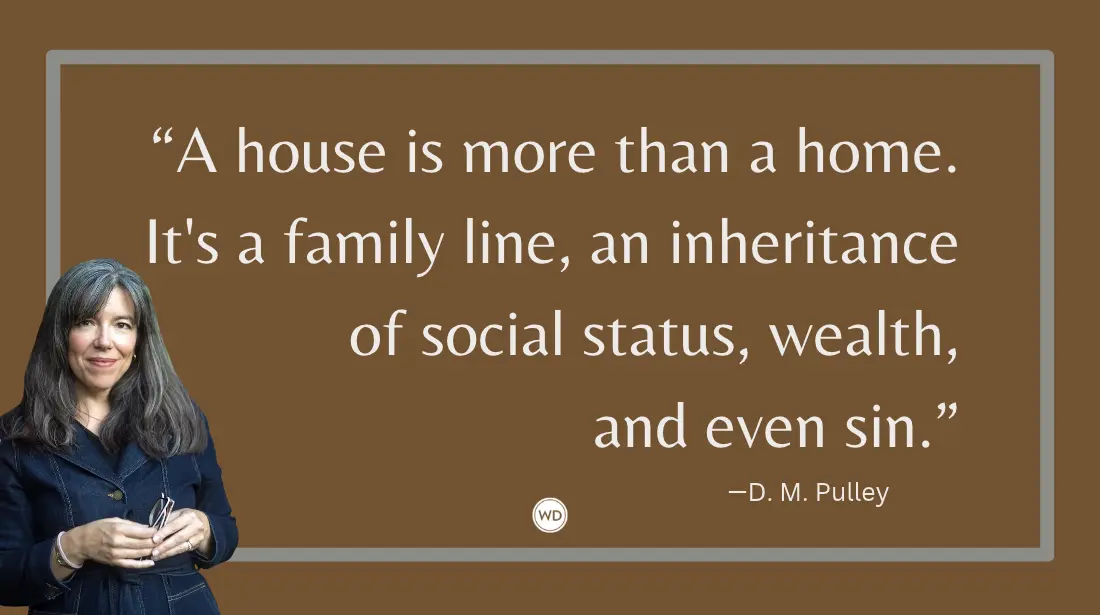
In literature, a house is rarely just a shelter; it is a physical manifestation of a family line, an inheritance of social status, accumulated wealth, and hidden sins. Architectural spaces accumulate history. Every argument, every crime, every tear, and every triumph leaves an invisible residue. When writers introduce the supernatural into a domestic space, they are literalizing the psychological truth that our environments shape us, trap us, and ultimately outlive us.
Official Perspectives: The Mechanics of the Haunt
Literary experts and authors who work within the Gothic tradition often deconstruct the anatomy of a haunting to understand why specific narrative devices consistently resonate with readers.
According to D.M. Pulley, a trained forensic engineer turned critically acclaimed Gothic thriller author, the architecture of suspense relies on establishing a delicate balance between historical realism and supernatural dread. In discussing the mechanics of her novel Stone Mad, Pulley notes that the most effective haunted houses function as pressure cookers for human secrets.
"A house is more than a home; it’s a vault for family secrets, social status, and historical sins," Pulley explains. "Whether you set your story in a medieval castle, a gothic plantation, or a rust-belt industrial manor, the underlying mechanics remain identical: the past refuses to stay buried, and the living are forced to pay the debts of the dead."
Forensic engineering—a discipline dedicated to investigating structural failures, material fatigue, and structural collapses—shares a striking conceptual parallel with the ghost story. Both fields require the investigator to look beneath the surface cosmetic layers, strip away drywall and plaster, and uncover the foundational flaws that led to catastrophe. By applying this analytical lens to fiction, writers can ground supernatural terrors in tangible, believable reality, heightening the emotional and psychological stakes for the reader.
Future Outlook: Reinventing the Haunted House for Modern Audiences
As the literary landscape continues to evolve, the haunted house genre faces the challenge of remaining relevant to a modern readership saturated with high-concept media and rapid-fire entertainment. Authors are successfully meeting this challenge by decentralizing traditional tropes and reframing the haunted space through fresh, diverse, and contemporary perspectives.
Beyond the Traditional Estate
While classic Gothic literature frequently pined for distant, romanticized historical epochs, modern haunted house narratives prove that hauntings are not restricted by time or geography. Haunted spaces can now be found:
- In the cold vacuum of outer space or dystopian futures.
- Within the broken heart of a grieving mother, as seen in Toni Morrison’s masterpiece Beloved.
- Trapped inside the guilty conscience of a young man navigating generational trauma and identity, as explored in Stephen Graham Jones’s The Only Good Indians.
Fusing Professional Expertise with Social Commentary
A prime example of this modern evolution is D.M. Pulley’s novel Stone Mad. Set inside a crumbling, cavernous Rust Belt manor in present-day Cleveland, the narrative draws directly from both real-world architectural anomalies and historical labor movements.
The protagonist, Mannie Wallace—a single working mother and forensic engineer—brings her professional tradecraft to bear on a cursed property. Unlike traditional Gothic heroines who are often passive victims of circumstance, Mannie must actively interrogate the physical structure of the building, confronting both the structural decay of the Rust Belt and the dark, hidden secrets buried within the estate’s foundations.
By anchoring supernatural horror in real-world socioeconomic struggles, modern writers ensure that the haunted house remains a vital, mirror-holding art form. As long as human beings build homes, harbor secrets, and grapple with the inevitability of mortality, the haunted house will continue to go bump in the night—inviting us to step inside, confront our deepest fears, and emerge into the light forever changed.


Comments
Facebook App ID not configured. Please add it in the Customizer.