
Executive Overview
Six decades after its release, the cinematic landscape of 1966 continues to cast a long, brilliant shadow. Looking back at the 39th Academy Awards ceremony held the following spring, the contrast with contemporary Hollywood is nothing short of dizzying. The Best Picture nominees of that year—Alfie; A Man for All Seasons; The Russians Are Coming the Russians Are Coming; The Sand Pebbles; and Who’s Afraid of Virginia Woolf?—represent a remarkably robust standard of mature, intelligent storytelling.
The 1967 Oscar gala itself feels light-years removed from the hyper-politicized, heavily commercialized spectacles that dominate modern award shows. Back then, the proceedings were defined by an understated elegance, impeccable pacing, and the effortless, white-tie charm of host Bob Hope. The night’s unforgettable crescendo arrived when Audrey Hepburn stepped up to present the final award of the evening: Best Picture. Following a gracious exchange with Hope, Hepburn read the nominees, glanced briefly toward the heavens, and smiled with the quiet satisfaction of a prayer answered as she announced the victor: Fred Zinnemann’s A Man for All Seasons.
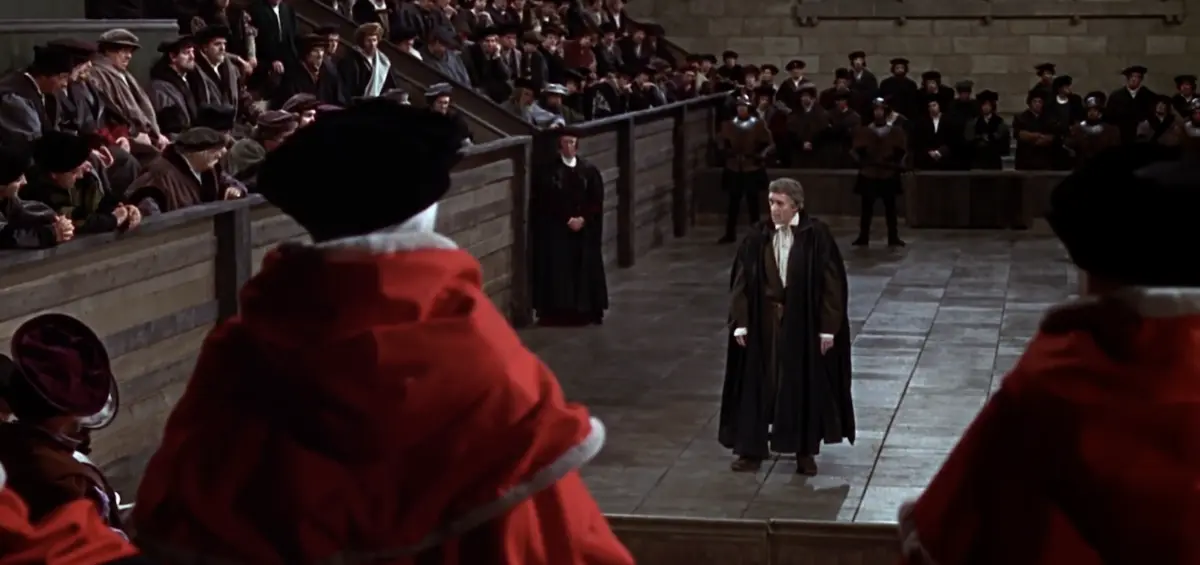
Revisiting this cinematic adaptation of Robert Bolt’s masterpiece invites a profound question: Is A Man for All Seasons quite simply the most perfect film ever made? From its airtight script and peerless performances to its historically resonant cinematography and evocative musical score, virtually every element of the production strikes an exquisite balance. As society approaches the film’s diamond jubilee, its timeless exploration of integrity, conscience, and the responsibilities of public office offers an indispensable masterclass—not just for filmmakers, but for leaders navigating the ethical complexities of the modern public sphere.
Read Also
Detailed Chronology: From Stage to Screen and the 1967 Academy Awards
To fully appreciate the triumph of A Man for All Seasons, one must trace its journey from a critically acclaimed theatrical experiment to an international cinematic juggernaut.
The Evolution of a Modern Classic
- 1960: Robert Bolt’s play A Man for All Seasons premieres in London, capturing the imagination of audiences and critics alike with its sparse yet potent examination of Sir Thomas More’s fatal confrontation with King Henry VIII.
- 1961–1962: The production successfully transitions to Broadway, cementing its status as a landmark intellectual drama. Bolt publishes the play’s paperback edition, appending a famous, revealing preface in which he attempts to reconcile his own secularist, agnostic worldview with his profound admiration for an ardent Catholic martyr.
- 1966: Director Fred Zinnemann, working in close collaboration with Bolt as screenwriter, brings the story to the silver screen. Released late in the year, the film is greeted with universal critical acclaim and massive commercial success.
- Spring 1967: At the 39th Academy Awards, the film dominates the competition, taking home six Oscars, including Best Picture, Best Director for Zinnemann, Best Actor for Paul Scofield, and Best Adapted Screenplay for Bolt.
+-----------------------------------------------------------------+
|               A MAN FOR ALL SEASONS: KEY MILESTONES             |
+-----------------------------------------------------------------+
|  1960  │ Stage Premiere in London                               |
|  1962  │ Broadway Run & Publication of Play with Author Preface |
|  1966  │ Feature Film Adaptation Directed by Fred Zinnemann     |
|  1967  │ Sweeps 39th Academy Awards (6 Wins, incl. Best Picture)|
+-----------------------------------------------------------------+
Supporting Context & Metrics: Crafting Cinematic Perfection
When analyzing the enduring brilliance of A Man for All Seasons, critics inevitably point to the seamless synergy of its moving parts. Every department—from screenwriting and acting to cinematography and scoring—operated at the absolute pinnacle of mid-century craftsmanship.
A Masterclass in Adaptation and Performance
Robert Bolt’s screenplay performs a rare cinematic magic trick: it maintains the propulsive momentum of high-stakes historical drama while preserving the intellectual depth and poetic cadence of his theatrical script.
The casting remains an embarrassment of riches:
- Paul Scofield anchors the film as Sir Thomas More, portraying a man whose quiet dignity and immovable conscience mask a deeply human vulnerability.
- Wendy Hiller delivers a heartbreaking performance as Alice More, capturing the fierce, bewildered loyalty of a wife watching her husband march toward martyrdom.
- Robert Shaw brilliantly embodies a young, dynamic, Renaissance-hero version of Henry VIII, far removed from the porcine despot of his later years.
- Orson Welles makes a commanding, memorable impression as Cardinal Wolsey, embodying a Church imperiled by its unholy alliance with temporal state power.
- Nigel Davenport brings a rough-and-tumble realism to the Duke of Norfolk, while Leo McKern portrays the cynically amoral Thomas Cromwell with chilling pragmatism.
- John Hurt brilliantly charts the corruption of Richard Rich, whose intellectual arrogance and overweening ambition lead to moral ruin.
- Vanessa Redgrave contributes a striking, lascivious 82-second cameo as Anne Boleyn, foreshadowing the tragic fate awaiting the woman who fractured Rome’s hold on England.
Visual and Musical Architecture
Ted Moore’s cinematography is as visually arresting as it is historically acute. A particularly brilliant touch occurs during More’s prolonged imprisonment in the Tower of London; looking out his cell window at the Thames embankment, viewers witness the subtle, natural changing of the seasons—a visual metaphor mirroring More’s inner constancy amidst shifting political tides. Complementing the visuals, Georges Delerue’s lush, understated score infuses the film with an authentic Renaissance flavor that propels the narrative forward without ever overwhelming it.
Official Statements and Philosophical Tensions: Bolt, Camus, and the Nature of Martyrdom
One of the most fascinating intellectual subtexts surrounding A Man for All Seasons involves the tension between the screenwriter’s personal worldview and the historical reality of his subject.
In the preface to the 1962 edition of his play, Robert Bolt—an agnostic teetering on the edge of atheism—sought to justify his deep reverence for Thomas More to a largely secularist literary establishment. To do so, Bolt framed More as a proto-existentialist hero: a man who died defending "an adamantine sense of his own self." According to Bolt’s framing, when confronted by royal pressure, this sophisticated, humorous, and adaptable man "set like metal" and was overtaken by "an absolutely primitive rigor"—becoming a cliff that simply could not be budged.
Yet, despite this secularist interpretation, Bolt’s own screenplay stubbornly refuses to erase historical reality. The film depicts the More family praying together; it highlights More’s theological acumen in assisting Henry VIII to author the book defending the seven sacraments against Martin Luther (earning the king the title Defender of the Faith); and it shows More steadfastly insisting during his trial that the papacy is a divinely mandated institution.
The definitive refutation of Bolt’s purely existentialist thesis arrives in the film’s closing moments. On the scaffold, More utters his historic, transcendent confession: he dies "the King’s good servant, but God’s first"—adding that God "will not refuse one who is so blithe to go to him."
Bolt frequently acknowledged an intellectual affinity with French existentialist writer Albert Camus. Yet it is impossible to imagine Camus’s dying words mirroring those of More under similar circumstances. By placing these specific, deeply pious lines into the mouth of his 16th-century protagonist, Bolt tacitly conceded that More went to the block because he believed in the objective truth of Christ and the Gospel—not simply because, as an existentialist bound by an "adamantine sense of self," he could do no other.
Future Outlook: A Mandate for Modern Public Service
As public office in the twenty-first century increasingly devolves into a theater of performance art and political posturing, the legacy of Sir Thomas More offers a vital corrective.
While A Man for All Seasons focuses heavily on More’s dramatic trial and martyrdom rather than the day-to-day minutiae of his tenure as Lord Chancellor of England, his historical persona remains the archetype of the conscientious, effective public servant. More approached governance not as an opportunity for self-aggrandizement or ideological brand-building, but as a solemn duty executed under the gaze of a higher moral authority.
As the cinematic milestone approaches its sixtieth anniversary in December 2026, the film deserves more than nostalgic retrospection. It stands as an urgent, enduring text that ought to be required viewing for anyone stepping into public service today. In an era marked by ethical compromise and systemic cynicism, A Man for All Seasons reminds us that true integrity cannot be bought, coerced, or legislated away—it can only be lived.
George Weigel’s column “The Catholic Difference” is syndicated by the Denver Catholic, the official publication of the Archdiocese of Denver.




Comments
Facebook App ID not configured. Please add it in the Customizer.