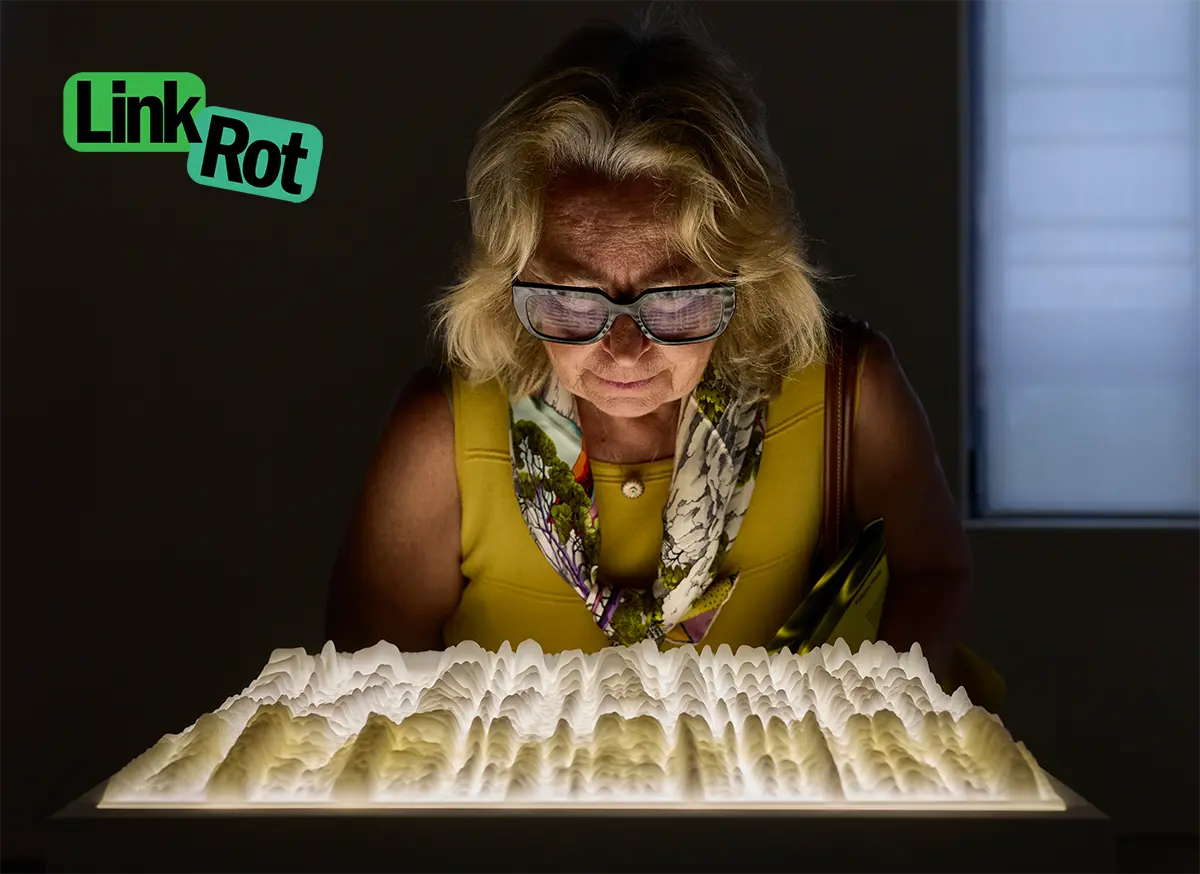
Set against the decaying grandeur of Venice’s historic Palazzo Diedo, a quiet revolution in contemporary curation is taking place. The exhibition Strange Rules—curated by Mat Dryhurst, Holly Herndon, and Hans Ulrich Obrist alongside Adriana Rispoli—presents a jarring, exhilarating juxtaposition: sleek, speculative digital technologies inhabiting spaces designed for centuries-old frescoes. The works featured in the show defy conventional artistic categorization, ranging from fortune-telling metal plants and two-headed flatworms to hyperscans of human brains communicating in pre-verbal states, and an artificial intelligence-driven film designed to unfold over a millennium.
As the mass adoption of blockchain, generative AI, and decentralized systems continues to disrupt traditional creative industries, Strange Rules seeks to answer an ancient, fatigued question: Is it art?
Rather than shying away from this cliché, the exhibition’s curators provide a sophisticated framework to legitimize and contextualize these complex digital practices: Protocol Art.
Defined as creative practices that engage directly with the underlying rules determining how culture is produced, distributed, and perceived in the digital age, Protocol Art shifts the locus of authorship. It argues that the art is not the final visual or auditory output, but the overarching protocol, algorithm, or infrastructure designed by the creator. In doing so, this movement draws a hard line between thoughtful technological intervention and passive, algorithmic consumerism—offering both a defense against institutional skepticism and a new taxonomy for twenty-first-century creation.
Detailed Chronology: The Evolution of Protocol-Driven Creation
To understand how Protocol Art emerged as a necessary vocabulary for contemporary creators, one must trace the convergence of computational logic, participatory media, and institutional resistance over the past two decades.
2008–2010 (The Genesis of Participatory AI): AI researcher Ken Stanley develops Picbreeder, an online platform where users navigate and select preferred genetic variations of imagery, collectively "breeding" complex digital forms over time. This early experiment laid the conceptual groundwork for how human participation trains generative models.
2014 (The Autonomy of Systems): Primavera De Filippi introduces Plantoid, exploring blockchain-based autonomous art entities that can own themselves, reproduce, and compensate human contributors, blending smart contracts with kinetic sculpture.
September 2025 (The French Institutional Battle): Following the French National Center for Cinema and the Moving Image’s (CNC) policy against funding AI-generated films, digital artists Grégory Chatonsky and Ida Soulard publish a fiery op-ed in Libération. They challenge the blanket rejection of AI, arguing that passive "slop" must be distinguished from rigorous authorship operating across the entire technical chain.
2025–203025 (A Millennial Experiment): The launch of Feral (Epoch 1)—a massive cinematic undertaking shot and edited by AI, intended to evolve continuously over one thousand years across 32 successive generations of artists, beginning with Fabien Giraud and Pierre Huyghe.
2026 (The Institutionalization of Protocol Art): The Berggruen Arts & Culture-run Palazzo Diedo opens Strange Rules, establishing Venice as a primary institutional temple for Protocol Art through expansive exhibitions and ongoing theoretical research.
Supporting Context & Metrics: Navigating the Boundaries of Authorship
The urgency behind the Protocol Art framework stems from an ongoing crisis of distinction. In an era where anyone can prompt a text-to-video model to generate soap operas starring humanoid fruit, or flood social media platforms with algorithmically optimized content, the cultural definition of an "author" has fractured.
What Protocol Art Includes vs. Excludes
The curators of Strange Rules deploy the protocol framework to clarify what constitutes genuine artistic engagement with technology versus mere consumer-grade utilization:
Category
Description
Locus of Authorship
Examples
Protocol Art
Rigorous investigation, manipulation, and intervention in infrastructural, algorithmic, and social logics.
The operational chain (training corpora, model selection, process configuration).
Ken Stanley’s Picbreeder, Michael Levin’s Double-Headed Planaria, Mat Dryhurst & Holly Herndon’s Attention Guild.
Content Creation / "Slop"
Passive generation of visual or auditory output using commercial off-the-shelf tools without infrastructural critique.
Absent or dictated by external corporate/algorithmic parameters.
Social media prompt-art, commercial concept illustration via surface-level Wacom tablet integration.
This distinction addresses a significant legal and financial paradox. Currently, the U.S. Copyright Office refuses to recognize AI-generated works as having a human author. While this policy protects commercial illustrators and traditional artists from corporate displacement, it creates an ontological vacuum: if a work has no author, where does its cultural value originate?
Protocol Art resolves this tension by insisting that authorship has not vanished; rather, it has migrated upstream. As Chatonsky and Soulard note, true computational authorship occurs when an artist chooses their models, configures their processing loops, curates their training corpus, and accepts the material consequences of these technical choices.
Official Statements and Theoretical Perspectives
The theoretical underpinnings of Strange Rules draw heavily on philosophy, cybernetics, and fierce debates regarding the socio-political implications of machine intelligence.
In their exhibition text, the curators articulate the core philosophy of the movement:
"Protocol Art operates at the level of the rule: not only analyzing these systems but seeding new ones. The protocol is not the subject of art: it is the art. When the protocol is the art, the scientists and researchers authoring such rules become artists."
This sentiment is echoed by Grégory Chatonsky and Ida Soulard in their advocacy for a renewed politics of the author in the digital age. Writing against blanket institutional rejections of artificial intelligence in cinema, they draw a sharp boundary against the commodified influx of automated media:
"What a machine without an author produces has a name: slop… The author chooses their models, trains their corpus, configures their processes, works locally with open-source software, and accepts the material consequences of their choices. Authorship no longer resides solely in the final image; it now permeates the entire operational chain."
Yet, critics and observers note that Protocol Art also functions as an intellectual shield. By elevating technical labor to the status of avant-garde practice, artists utilizing blockchain and AI can successfully reframe their work against institutional gatekeeping and legal skepticism, trading the mischievous, prankster irreverence of early NFT subcultures for an air of intense, nerdy academic rigor.
Future Outlook: The Question of Value in an Automated World
In his foundational essay What is an Author?, French philosopher Michel Foucault predicted a future where the "author function" would dissolve into structural indifference, leaving audiences to wonder simply, "What difference does it make who is speaking?"
As we navigate an era where generative models churn out synthetic averages at scale, and internet discourse is increasingly saturated by PR bots and automated language generators, Foucault’s vision feels closer than ever. However, the cultural anxiety has shifted. The central question is no longer merely who or what is speaking, but whether the utterance is worth listening to.
Ultimately, the framework established by Protocol Art suggests that the value of digital creation cannot be measured by inspecting the mechanical output or policing the tools employed. Instead, true artistic merit lies within the rigorous, intentional framework engineered by the human mind manipulating the machine. As institutions continue to adapt to technological disruption, spaces like Palazzo Diedo prove that the future of art will not be defined by avoiding technology, but by mastering its foundational rules.




Comments
Facebook App ID not configured. Please add it in the Customizer.