
Executive Overview
In the lexicon of classical music, an étude—derived from the French word for "study"—is a notoriously demanding instrumental composition designed to push a musician past their physical and technical limits, transforming mechanical difficulty into sublime mastery. By applying this logic to the realm of contemporary performance art, avant-garde visionary Florentina Holzinger has framed her final Venice Biennale presentation, CLOSING ÉTUDE, not as an end, but as a grueling threshold. Following a tumultuous, propriety-imploding seven-month run of her waste-wonderland installation SEAWORLD VENICE at the Austrian Pavilion, this grand finale suggests that there are yet greater feats of physical and psychological endurance ahead.
Since its sensational opening in May, SEAWORLD VENICE has operated as a grotesque, magnetic altar dedicated to the ongoing ecological and cultural apocalypse of Venice. Part performance art, part immersive installation, the project immediately challenged the boundaries of audience comfort, institutional decorum, and bodily autonomy. Anchored by Holzinger’s uncompromising "body-first" philosophy, the installation transformed the prestigious Austrian Pavilion into a surreal wasteland of human refuse and lagoon debris. Visitors were not merely passive spectators; they were active participants in a closed-loop ecosystem fueled by their own biological waste, jet skis, and the melancholic, deafening toll of a salvaged maritime bell.
As the 2024 Venice Biennale draws to its official close, Holzinger is preparing for a monumental transition. CLOSING ÉTUDE will see the project’s iconic bell embark on a ceremonial procession across the floating city, culminating in a secular-sacred "final dinner" at the historic Scuola Grande della Misericordia. This concluding chapter will crystallize seven months of accumulated human byproduct into a single, permanent monument—a literal distillation of visitor waste transformed into a relic for an uncertain future.
Read Also
Yet, the closure in Venice marks merely the first movement in a much broader international symphony. SEAWORLD VENICE is slated for a multi-year, transcontinental reincarnation, with major institutional stops already locked in at Berlin’s Gropius Bau, Vienna’s Kunsthalle Wien, and Brooklyn’s Amant foundation. This comprehensive report explores the genesis, execution, philosophical underpinnings, and future trajectory of one of the most provocative and culturally disruptive art installations of the twenty-first century.
Detailed Chronology: From the Lagoon’s Depths to the Scuola Grande
The Genesis and Opening: May 2024
When SEAWORLD VENICE opened its doors at the Austrian Pavilion in May, it signaled a radical departure from the typically pristine, contemplative curation associated with national pavilions at the Biennale. The exhibition’s overture was sounded by the piercing, concussive peal of a colossal bell salvaged directly from the murky depths of the Venice Lagoon.
In a gesture that immediately established the tone of the entire installation, Florentina Holzinger eschewed traditional mechanical clappers. Instead, adhering strictly to her body-first philosophy, a completely nude Holzinger served as the human clapper herself, swinging against the bronze interior in a display of raw, unfiltered physical vulnerability. While the artist’s direct physical intervention in this capacity was temporary, the bell itself remained operational, continuing to mark the relentless, uncaring passage of time. Throughout the seven-month Biennale run, the bell has tolled hourly across the pavilion and its surrounding gardens—a haunting, industrial knell echoing over the fading grandeur of a sinking city.
The Ecosystem of Excess: Summer and Autumn
Within the pavilion, Holzinger constructed an ecosystem that deliberately blurred the lines between high art, industrial squalor, and carnival absurdity. The raw materials of the installation were twofold: freshly sourced human refuse and tangible waste hauled in from the Venice Lagoon by the persistent high tides.
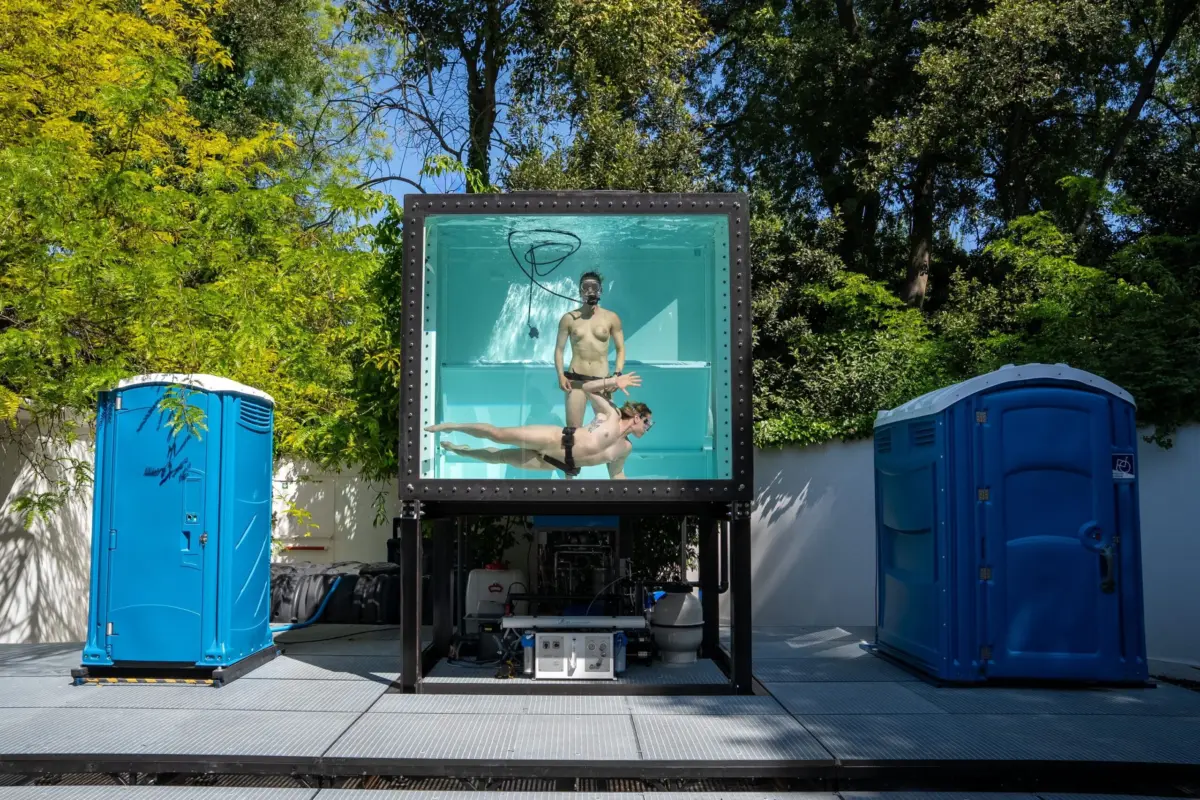
To sustain this living monument to societal decay, participatory engagement was mandatory. Visitors to the Austrian Pavilion were actively encouraged—and practically necessitated—to utilize the on-site port-a-potties. In a stroke of engineering that horrified purists and fascinated theorists alike, the human urine collected from these facilities was systematically filtered, channeled, and repurposed into a central dunk tank, where performers and participants enacted theatrical, athletic, and often jarring vignettes. Jet skis roared within enclosed architectural spaces, juxtaposing the petroleum-soaked reality of modern Venetian tourism with the ancient, slow-motion sinking of the lagoon.
This calculated assault on the senses transformed the pavilion into a living, breathing, and frequently foul-smelling organism. It forced audiences to confront the invisible supply chains of their own bodily existence and the literal shit—both biological and industrial—left in the wake of mass tourism.
CLOSING ÉTUDE: The Final Act
As the Venice Biennale reaches its statutory conclusion, Holzinger is orchestrating the climax of the Venetian chapter. Titled CLOSING ÉTUDE, the final performance migrates the symbolic heart of the installation away from the Austrian Pavilion and into the historic heart of Venice’s Cannaregio district.
The venue is the Scuola Grande della Misericordia, a monumental architectural landmark founded in the Middle Ages as a religious and charitable guild. Following an extensive, decades-long architectural restoration, the cavernous building reopened as a cultural exhibition space in 2015. With its soaring ceilings, massive structural belly, and faded frescoes attributed to the school of Paolo Veronese, the Misericordia provides a suitably grand, ecclesiastical backdrop for the sacred and profane tones Holzinger has struck throughout the Biennale.
Conjuring heavy shades of Christian iconography—specifically the solemnity of the Last Supper—CLOSING ÉTUDE is explicitly framed by the artist and her team as "a final dinner." According to official announcements released ahead of the event, this concluding rite traces a profound material transformation: from solid to liquid, ultimately forging a tangible, permanent relic.
The centerpiece of this final event is the cumulative yield of the past seven months: all the bodily waste collected from pavilion visitors, systematically filtered, processed, and distilled. This residual matter will be presented as a monument for the future on November 22, positioned dramatically in front of the now-closed Austrian Pavilion. The Venetian iteration of SEAWORLD VENICE will officially conclude not with a curtain call, but with a quiet, entropic fade—the exact moment the ceremonial bell "falls silent" and the contaminated water "stops circulating."
Supporting Context & Metrics: The Anatomy of a Spectacle
To understand the cultural resonance of SEAWORLD VENICE, one must examine the metrics of its production and the lineage of Florentina Holzinger’s career. Holzinger, an Austrian-born choreographer and performance artist, has steadily built an international reputation for staging spectacles that investigate the limits of physical endurance, the history of dance, feminist bodily autonomy, and the tropes of pop culture and extreme sports.
Previous works, such as ANAPNOE, TANZ, and Apollyon, routinely featured elements of stunt work, martial arts, classical ballet, and bodily modification, frequently crossing the line into performance art that elicits visceral, physical reactions from audiences. fainting spells, sensory overload, and profound moral debates are standard byproducts of a Holzinger production.
| Project Metric / Feature | Description |
|---|---|
| Duration in Venice | 7 Months (May 2024 – November 2024) |
| Primary Venue | Austrian Pavilion, Giardini della Biennale |
| Closing Venue | Scuola Grande della Misericordia, Cannaregio |
| Key Materials | Salvaged lagoon bell, municipal waste, visitor urine, jet skis, industrial filtration systems |
| Upcoming International Stops | Gropius Bau (Berlin), Kunsthalle Wien (Vienna), Amant (Brooklyn) |
| Curatorial Oversight | Nora-Swantje Almes (Gropius Bau / Venice Pavilion coordination) |
The integration of bodily waste and municipal refuse within a state-sponsored national pavilion represents a high-water mark for institutional bravery—or institutional masochism. The Austrian Federal Ministry for Arts, Culture, the Civil Service and Sport, by backing Holzinger’s proposal, effectively underwrote a project that aggressively subverted the traditional nationalist diplomacy of the Biennale. Rather than presenting a sanitized, highly polished portrait of Austrian artistic achievement, the pavilion functioned as an open-air sewage treatment plant and a nihilistic commentary on European ecological collapse.
Furthermore, the logistical footprint of the installation cannot be overstated. Maintaining a closed-loop waste system within a historic pavilion in a fragile lagoon city required unprecedented engineering feats, regulatory navigation, and continuous maintenance by a dedicated team of performers, technicians, and sanitary workers.
Official Statements and Institutional Perspectives
The transience of the physical installation in Venice stands in sharp contrast to the permanence of its institutional afterlife. While the literal waters of the Austrian Pavilion will cease their circulation on November 22, the machinery of the art world is already hard at work preparing for the project’s migration.
Nora-Swantje Almes, the curator for live programs and outreach at Berlin’s prestigious Gropius Bau, has played a pivotal role in shaping the project’s trajectory. Having organized the logistical realization of the Venice presentation, Almes is uniquely positioned to shepherd the work through its upcoming German iteration.
In a joint statement regarding the transition, institutional representatives have emphasized that SEAWORLD VENICE cannot—and will not—be simply packed into crates and reassembled in a white cube gallery. The work’s radical site-responsiveness is its defining characteristic.
Speaking to ARTnews earlier this year, a spokesperson for Amant, the Brooklyn-based art foundation slated to host the exhibition’s final leg in March 2028, highlighted the complex curatorial challenges ahead:
"If you saw the show in Venice, you know it’s very site-responsive, so [Almes] needs to figure out how to adapt it for Berlin after the Biennale closes in Venice this fall. After that, we’ll have a better idea of how our own team can further adapt it for Brooklyn."
This sentiment underscores the adaptive, parasitic nature of Holzinger’s art. The installation acts as a living organism that feeds on the specific architectural, political, and cultural nutrients of its host institution. In Venice, it devoured the history of the lagoon and the nationalist architecture of the Giardini. In Berlin, it will confront the institutional gravity of the Gropius Bau—a nineteenth-century exhibition hall deeply tied to Germany’s complex sociopolitical history. In Vienna, it will occupy the Kunsthalle Wien, engaging with an urban audience intimately familiar with Central European performance traditions. Finally, in Brooklyn, it will test the limits of American contemporary art infrastructure, forcing a dialogue between European waste politics and New York’s hyper-gentrified, post-industrial landscape.
Future Outlook: The Global Tour and the Legacy of CLOSING ÉTUDE
As the bell at the Scuola Grande della Misericordia tolls for the final time in Venice, bringing CLOSING ÉTUDE to its theatrical and theological conclusion, the art world is forced to reckon with the legacy Florentina Holzinger has carved out during the 2024 Biennale.
By weaponizing bodily waste, extreme physical endurance, and institutional space, Holzinger has fundamentally redefined what a national pavilion can achieve. She has bypassed the polite diplomacy of cultural exchange in favor of a visceral, uncompromising confrontation with the material realities of human existence on a dying planet.
The roadmap for the next four years is as demanding as the étapes that defined its creation:
- Spring 2025: Adaptation and restaging at the Gropius Bau in Berlin, curated by Nora-Swantje Almes. This iteration will test how the visceral sewage-and-industrial apparatus translates from the water-locked ruins of Venice to the monumental neoclassical architecture of a Berlin museum.
- Autumn 2025: A subsequent presentation at Kunsthalle Wien in Vienna, bringing the monstrous home-grown spectacle back to the artist’s German-speaking roots.
- March 2028: The final, definitive international leg at Amant in Brooklyn, New York, where the project will complete its trans-Atlantic migration.
Whether the jet skis, the filtration tanks, and the porta-potties will survive this international journey remains an open question. Yet, regardless of the physical props that make the trip, the true legacy of SEAWORLD VENICE and CLOSING ÉTUDE has already been cemented. Florentina Holzinger has proven that contemporary performance art can still shock, provoke, and demand absolute physical and moral reckoning from its audience. As the distilled relics of seven thousand visitors are sealed into monuments for the future, the art world is left waiting for the next movement in her relentless, punishing composition.

Comments
Facebook App ID not configured. Please add it in the Customizer.