
Executive Overview
The French capital has once again transformed into the epicenter of the global contemporary art market as Art Basel Paris officially opened its doors for its 2026 edition. Running through October 25 at the magnificently restored Grand Palais, this year’s iteration of the Swiss organization’s premier French venture marks a critical milestone in the fair’s maturation. Hosting roughly 200 meticulously curated booths, the fair has firmly transitioned from an ambitious regional newcomer into a heavyweight marketplace dominated by blue-chip inventories, major international galleries, and staggering transactions reaching well into the six-, seven-, and even eight-figure domains.
As collectors, curators, and institutional directors converged on the French metropolis during the exclusive Avant-Première VVIP preview on Tuesday afternoon, the mood was one of calculated optimism and aggressive acquisition. Galleries representing the upper echelons of the international art trade reported brisk, high-value sales that continued unabated through the close of business on Wednesday. Heavyweights like Gerhard Richter and Georg Baselitz commanded immediate attention, while museum-quality presentations across the ground floor underscored the fair’s growing status as a primary destination for premier market assets.

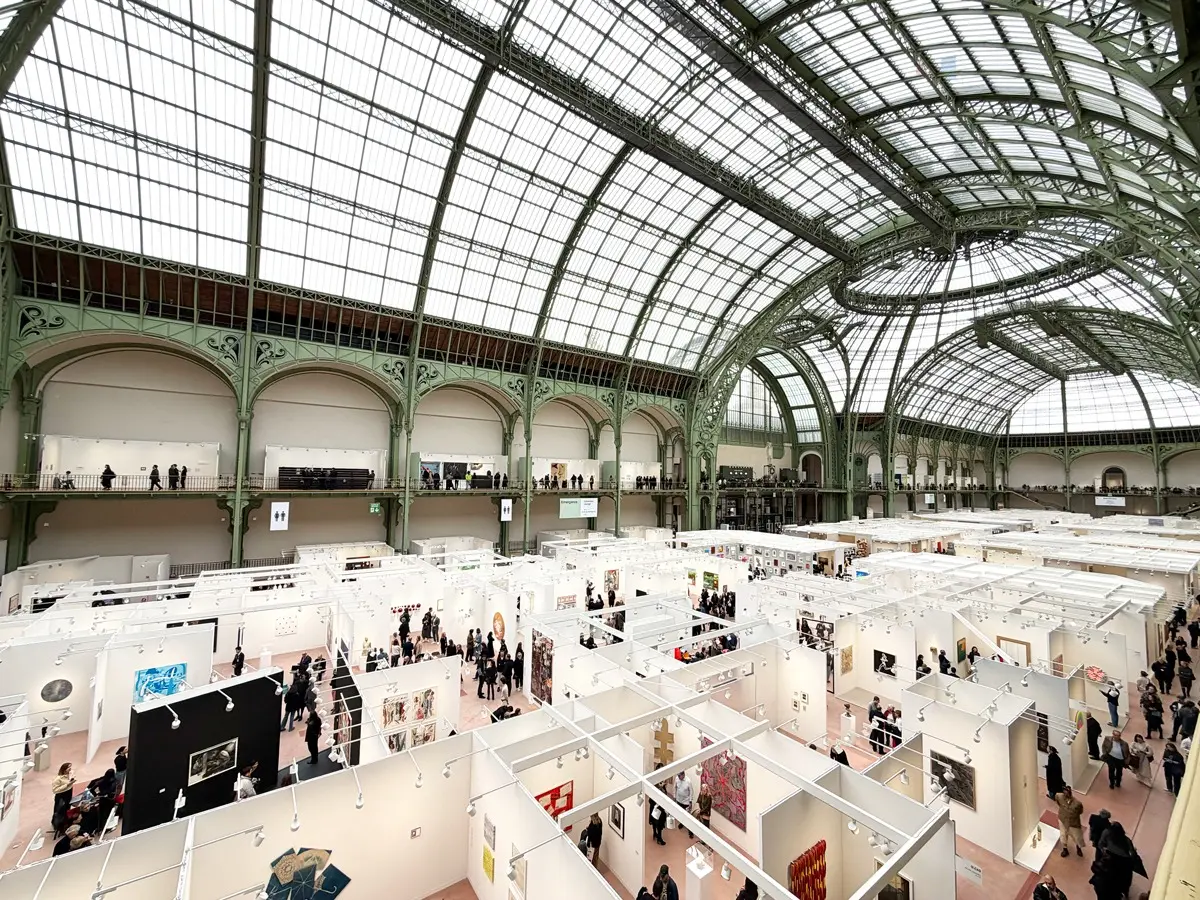
Yet, despite the overwhelming presence of market-darling blue-chip inventory on the main floor, Art Basel Paris 2026 continues to reward the discerning explorer. Those who venture to the upper levels of the Grand Palais find themselves rewarded with radical, risk-taking curatorial projects, historical retrospectives, and conceptual presentations that balance out the commercial gravity of the lower level. Overhead, visitors are continually reminded of the venue’s architectural majesty—a breathtaking expanse of green-painted steel and glass that frames the artistic dialogue unfolding below. This extensive report examines the commercial pulse, spatial dynamics, standout presentations, and broader macroeconomic context defining Art Basel Paris 2026.
Read Also
Detailed Chronology: From VVIP Preview to Market Momentum
Tuesday, October 20: The Avant-Première Kickoff
The atmospheric pressure within the Grand Palais reached its zenith on Tuesday afternoon as the Avant-Première VVIP preview commenced. For elite collectors arriving from New York, London, Zurich, and beyond, the stakes were immediately apparent. Unlike the sprawling, exploratory atmospheres of earlier iterations, the 2026 fair greeted attendees with an aura of established permanence. Galleries came prepared for serious business, installing museum-grade works that commanded immediate reverence and rapid-fire acquisitions.

Within the first two hours of the preview, several major galleries reported significant placements. The institutional-grade offerings—ranging from post-war European masterpieces to contemporary heavy hitters—found ready buyers among private foundations and prominent collectors seeking to secure blue-chip assets before public doors opened. Sales sheets filled up swiftly, proving that despite macroeconomic headwinds and cautious global financial climates, capital for top-tier art remains robust and agile.
Wednesday, October 21: Sustained Velocity and Mid-Week Momentum
Building upon the intense kinetic energy of Tuesday’s preview, Wednesday’s trading session maintained a steady, high-volume rhythm. Exhibitors noted that the initial rush of impulse buying by ultra-high-net-worth individuals during the VVIP hours gave way to more deliberate, highly vetted acquisitions by international museum trustees and advisory boards.

Major sales were publicly confirmed throughout the day, cementing the fair’s reputation as a transactional powerhouse. Works by master painters such as Gerhard Richter and neo-expressionist pioneer Georg Baselitz shifted hands rapidly, drawing crowds of onlookers and underscoring the enduring market appetite for canonical European modernism and contemporary stalwarts. By the time the exhibition halls closed on Wednesday evening, participating dealers expressed widespread satisfaction, noting that Art Basel Paris had successfully captured liquidity that might have otherwise remained sidelined until later in the autumn auction season.
Supporting Context & Metrics: The Evolution of Art Basel Paris
The Maturation of a Marketplace
To understand the current iteration of Art Basel Paris, one must trace its rapid evolution since its inception under the Paris+ par Art Basel moniker. Born out of the void left by the shifting landscape of European art fairs and leveraging the deep historical and cultural prestige of the French capital, the fair has systematically elevated its standards of admission.

With approximately 200 galleries occupying the cavernous halls of the Grand Palais this year, the curatorial filter has tightened considerably. The emphasis has decisively shifted from regional discovery to international validation. While emerging galleries and younger spaces still find vital platforms within specialized sectors, the overarching narrative of the 2026 fair is its consolidation as a marketplace for premier works. This maturation has altered the psychology of the buying floor: visitors are no longer merely browsing for emerging talent; they are engaging in high-stakes asset acquisition.
Architectural Splendor Meets Commercial Scale
The choice of venue plays an indispensable role in shaping the identity of Art Basel Paris. The Grand Palais—recently reopened following a massive, multi-year restoration project—provides a breathtaking neoclassical and Beaux-Arts backdrop that few other venues in the world can rival.

The interplay between the historic, light-flooded glass nave and the sleek, contemporary architecture of the temporary gallery booths creates a distinct visual rhythm. However, this spatial layout also dictates visitor behavior. The ground floor acts as the primary commercial thoroughfare, dense with the heavy footprints of mega-galleries showcasing their most expensive, museum-caliber inventory.
Conversely, the upper level serves as a vital counterweight. Navigating the stairs reveals a distinct shift in curatorial ambition. Upstairs, galleries often take greater risks, presenting cohesive solo projects, historical rediscoveries, and conceptual installations that might prove too challenging for the bustling, high-traffic corridors of the ground floor. This vertical dichotomy ensures that Art Basel Paris retains a multifaceted intellectual appeal, preventing it from becoming a purely transactional exercise.

Official Statements and Market Perspectives
Gallery Reactions and Sales Sentiment
Exhibiting dealers have been vocal about the unique commercial viability of the Paris autumn window. Speaking on the condition of anonymity regarding specific client lists, several prominent international gallerists emphasized that Paris has effectively cemented its position alongside Basel and Miami as an unmissable fixture on the global art calendar.
"The concentration of serious collectors here during the Avant-Première is comparable to anything we see in Basel or New York in May," noted the director of a major transatlantic gallery. "There is a distinct sophistication to the European buying base in Paris. They are deeply informed, highly decisive, and willing to commit significant capital to works that anchor a collection."

Another dealer specializing in post-war European art highlighted the seamless synergy between the city’s rich cultural infrastructure and the fair itself. "When you have world-class museum exhibitions happening concurrently across the city—from the Centre Pompidou to the Palais de Tokyo—it creates an immersive cultural ecosystem. Collectors don’t just come to buy; they come to immerse themselves. That intellectual engagement directly fuels their confidence on the sales floor."
Curatorial Observations
Independent curators and institutional directors roaming the aisles have similarly praised the rigorous presentation standards maintained by participating galleries. The push toward six-, seven-, and eight-figure pricing has raised expectations regarding provenance, conservation condition, and art-historical significance.

"You can sense that galleries brought their absolute ‘A-game’ to the Grand Palais this year," observed a visiting European museum curator. "The sheer density of museum-quality material is staggering. It makes the fair less of a traditional trade show and more of a transient, hyper-exclusive museum experience—albeit one where everything on the wall has a red dot or a pending red dot next to it."
Future Outlook: The Strategic Significance of Paris in the Global Art Economy
As Art Basel Paris 2026 heads toward its weekend conclusion on October 25, its broader implications for the international art market are becoming increasingly clear. The fair’s undeniable success serves as a powerful validation of Paris’s post-Brexit ascent as the undisputed capital of the European art market.

By successfully marrying the historic prestige of French cultural institutions with the unrivaled commercial engine of the Art Basel brand, the fair has permanently reconfigured the global art calendar. The October window in Paris is no longer viewed as a regional prelude to the winter auctions in New York and London; it is recognized as a primary liquidity event in its own right.
Looking ahead, the challenge for the organizers will be maintaining this delicate balance between high-end commercial viability and grassroots artistic discovery. As booth costs rise and blue-chip inventories dominate the floor plan, ensuring that younger galleries and experimental practices continue to find oxygen within the ecosystem will be vital for the fair’s long-term health.

For now, however, the mood inside the Grand Palais remains triumphant. Beneath the magnificent green-painted steel and glass ceiling, masterpieces are changing hands, institutional collections are being fortified, and the global art market has received a resounding vote of confidence from the heart of France.


Comments
Facebook App ID not configured. Please add it in the Customizer.