
Executive Overview
As the sprawling Star Trek franchise marked its historic 60th anniversary, the fourth season of Star Trek: Strange New Worlds (SNW) arrived as a microcosm of the property’s entire history. It encapsulated both the transcendent heights and the frustrating pitfalls that have defined the iconic science fiction institution across decades of television production.
Over the past ten years, the television landscape has undergone a seismic shift toward shorter, more concentrated seasons. While this structural evolution has largely benefited writers’ rooms by mitigating burnout, enhancing actor flexibility, and allowing for tighter serialization—lessons painfully learned during the protracted 22-to-26-episode eras of Deep Space Nine and Enterprise—it presents a unique set of hazards for standalone storytelling. Without the buffer of volume, short-season formats demand immaculate narrative economy to prevent redundancy.
Following a third season visibly fractured by the industry-wide writers’ and actors’ strikes, Strange New Worlds rebounded in its fourth outing with an undeniable injection of creative adrenaline. Yet, this ambition came at a cost. The season frequently fell into a trap historically mastered by Star Trek: Voyager: prioritizing high-concept, headline-grabbing gimmicks over substantive narrative execution.
Read Also
Balancing genuine emotional breakthroughs for its legacy characters against an exhausting parade of stylistic detours—ranging from noir pastiches and time-travel paradoxes to a startling mid-season puppet episode—SNW Season 4 leaves critics and fans alike grappling with a paradoxical legacy. As the series approaches an abbreviated six-episode final run, this retrospective examines how the show’s boldest swings both anchored and undermined its penultimate chapter.
Detailed Chronology: Analyzing the Season’s Narrative Trajectory
High Concepts and High Stakes: The Opening and Closing Bookends
Season 4 began with a firm commitment to philosophical weight, leaning into the moral labyrinths of temporal mechanics. "Valles Marineris," featuring a dignified guest turn by Saffron Burrows as Commander Cassell of Mars, established an early standard for atmospheric tension. However, it was the season-ending "Tomorrow’s Enterprise" that truly crystallized the show’s capability for poignant, high-stakes drama.
While both bookend episodes were occasionally bogged down by classic Trek scientific hand-waving, they excelled in exploring the psychological debris left in the wake of historical alterations.
Similarly, "The Griffin Incident" offered a masterclass in atmospheric horror. Despite lacking a rigorous scientific breakdown of its titular phenomenon, the episode functioned as a harrowing psychological thriller.
Concurrently, "A Case of Chiaroscuro" utilized an explicit stylistic gambit—complete with a striking black-and-white aesthetic, a doppelgänger plot, and a legacy character cameo—to deliver a powerful anti-fascist parable. Most importantly, it served as a long-overdue spotlight vehicle for Una Chin-Riley (Number One), proving that stylistic window dressing can occasionally elevate underutilized ensemble members when anchored by genuine thematic urgency.

The Middle Stretches: Triumphs and Missteps in Gimmickry
Between these high-water marks, the season’s structural reliance on ambitious conceptual gambits began to strain viewer goodwill. "Off-Hour" stood out as a taut, self-contained bottle episode that functioned flawlessly as both an action sequence and a character development crucible for Scotty, Dr. M’Benga, and Nurse Chapel.
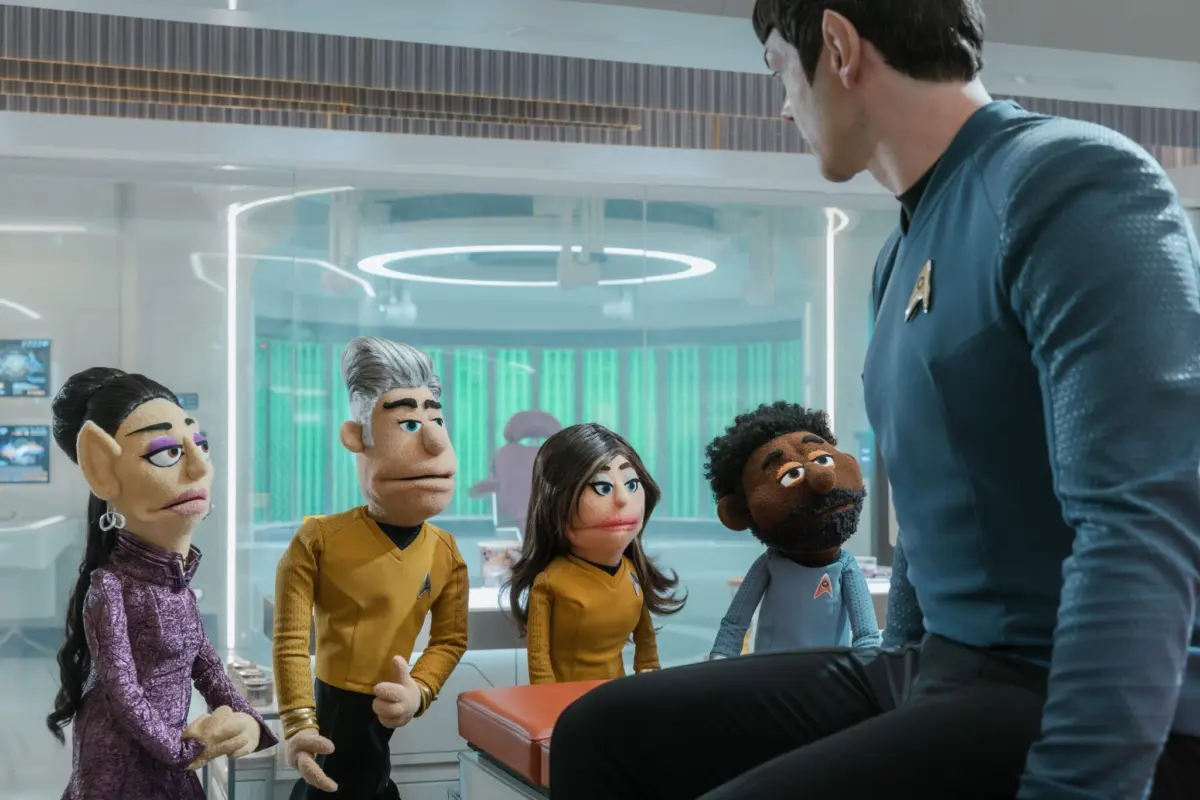
Conversely, other experiments were less successful. "Level-Five Transporter Accident"—which transformed the entire USS Enterprise crew (minus Spock) into Muppet-style Jim Henson Company puppets—provoked sharp division among the fandom. While defense can be made for reading the entire scenario as a manifestation of Spock’s acute anxiety dream, the sheer whiplash of the premise alienated a vocal segment of the audience.
Other entries stumbled more definitively. "Human Best Friend" struggled to balance lighthearted comedy with character work, failing to land its comedic beats. Meanwhile, "Like Chronitons Through the Hourglass" flirted with narrative exhaustion before pulling off a miraculous recovery in its final act, driven by a devastating meditation on grief anchored by Anson Mount’s exceptional performance as Captain Christopher Pike.
"Once La’an a Time," conceived as a spiritual successor to Season 1’s "The Elysian Kingdom," ultimately suffered from the sensation of an unpolished first draft. Despite charming nods to The Princess Bride and the delightful presence of Carol Kane, the episode lacked structural cohesion.
The Masterclass: "Orders of Magnitude"
Amidst the stylistic fluctuations, "Orders of Magnitude" emerged as an undisputed masterpiece of the season, entering the pantheon alongside Season 2’s "Ad Astra per Aspera" as one of the finest hours in SNW history. The episode benefited immensely from a powerhouse guest performance by Joe Morton, who brought profound nuance and psychological complexity to a role that lesser scripts could easily have reduced to a tired archetype. Morton’s contribution highlighted the season’s broader success in attracting top-tier guest talent, including Rachael Harris, Deidre Barnes, Demore Barnes, Brian Markinson, and Dave Foley.
Supporting Context & Metrics: Character Evolution and the 1966 Baseline
The foundational mandate of Strange New Worlds has always been bridge-building: charting the formative years of legacy characters to explain how they ultimately assumed their iconic positions aboard the USS Enterprise in the 1966 Original Series. Season 4 achieved its most consistent successes in fulfilling this charter, particularly regarding Spock, Uhura, and the Kirk brothers.
| Character | Season 4 Arc Trajectory | Alignment with 1966 Baseline |
|---|---|---|
| Spock (Ethan Peck) | Rejection of human emotional experiments; retreat into rigid Vulcan logic. | High: Directly establishes the stoic, logic-driven First Officer of TOS. |
| Nyota Uhura (Celia Rose Gooding) | Transition from self-doubt and professional drift to assertive competence. | Moderate-High: Bridges the gap toward Nichelle Nichols’ poised communications officer. |
| James T. Kirk (Paul Wesley) | Integration into the ship’s ecosystem; exploration of paternal family dynamics. | High: Adds generational depth missing from the Kelvin timeline films. |
Spock’s Retreat to Logic
For the first three seasons, Spock’s narrative arc heavily featured explorations of his human heritage—often yielding painful or destabilizing results. Season 4 marked a definitive psychological shift. Faced with the emotional turbulence of his hybrid nature, Spock actively sought to purge his human vulnerabilities, deliberately hardening himself into the rigid, emotionally disciplined officer audiences first met under Captain Kirk.
Uhura’s Maturation
Celia Rose Gooding’s interpretation of Nyota Uhura spent the early seasons establishing a character navigating professional uncertainty. Through pivotal developments in "A Case of Chiaroscuro," "Orders of Magnitude," and "Tomorrow’s Enterprise," Gooding steered the character closer to the poised, authoritative confidence embodied by Nichelle Nichols in the original series.

The Kirk Family Dynamic
Paul Wesley’s portrayal of James T. Kirk faced occasional logistical hurdles within the ship’s current timeline, but the writers successfully utilized the season to enrich the Kirk family tapestry. Alongside Dean Jeannotte as Sam Kirk, the series introduced vital backstory regarding their father. This narrative approach provided a psychological foundation for Jim Kirk that bypassed the reductive tropes of the 2009 franchise reboot films, grounding his eventual promotion to the captain’s chair in earned familial complexity.
Official Statements and Production Insights
The creative challenges of balancing episodic experimentation with serialized character progression have been a persistent talking point among the show’s leadership. Showrunners Akiva Goldsman and Henry Alonso Myers have repeatedly emphasized the unique tightrope walk required to maintain Star Trek’s traditional anthology spirit while satisfying contemporary streaming demands for character serialization.
Reflecting on the production constraints imposed by the post-strike schedule, production insiders noted that the writers’ room faced immense pressure to deliver high-impact moments within a compressed timeline. Speaking on the integration of high-concept premises, executive producers have historically maintained that Star Trek possesses a proud, foundational tradition of genre-bending satire and theatricality—tracing a direct lineage from The Original Series’ "A Piece of the Action" to Strange New Worlds’ musical and comedic excursions.
However, industry analysts have pointed out that the frequent deployment of high-concept gimmicks—such as the noir framing of "A Case of Chiaroscuro" or the soap-opera mechanics of Pike’s grief storylines—frequently served as unnecessary narrative crutches. As the series heads into its final stretch, creative retrospectives suggest a growing internal consensus on the need for narrative restraint, ensuring that stylistic flair serves character development rather than overshadowing it.
Future Outlook: The Road to the Series Finale
As Strange New Worlds prepares for its fifth and final season, the parameters of production have shifted dramatically. Paramount has confirmed that the series conclusion will be restricted to an abbreviated six-episode order.
This structural constraint presents an unprecedented test for the writing staff. Condensing the series’ remaining narrative threads, character arcs, and institutional world-building into half a dozen episodes leaves zero room for redundant concepts or self-indulgent stylistic detours. The production must execute a masterclass in narrative efficiency to deliver a satisfying conclusion for Captain Pike, Number One, Spock, and the rest of the Enterprise crew before they hand the ship over to James T. Kirk.
Furthermore, the broader ecosystem of the Star Trek franchise continues to evolve. Housekeeping notes regarding adjacent properties, such as Starfleet Academy, underscore the volatile nature of contemporary franchise discourse. With Starfleet Academy slated for an abbreviated multi-season trajectory, the overarching television strategy appears to be pivoting away from open-ended expansion toward tightly managed, finite event television.
Ultimately, Strange New Worlds Season 4 serves as a cautionary yet triumphant example of modern franchise television. It proved that the creative team retains the capacity to produce transcendent science fiction, even as it occasionally lost its way in a maze of high-concept novelties. If the writers’ room can harness the emotional depth of "Orders of Magnitude" and the focus of "Off-Hour" while shedding the unnecessary gimmickry that plagued its misfires, the forthcoming six-episode final season has all the raw material necessary to secure the series’ legacy in the pantheon of great Star Trek iterations.



Comments
Facebook App ID not configured. Please add it in the Customizer.