
Executive Overview
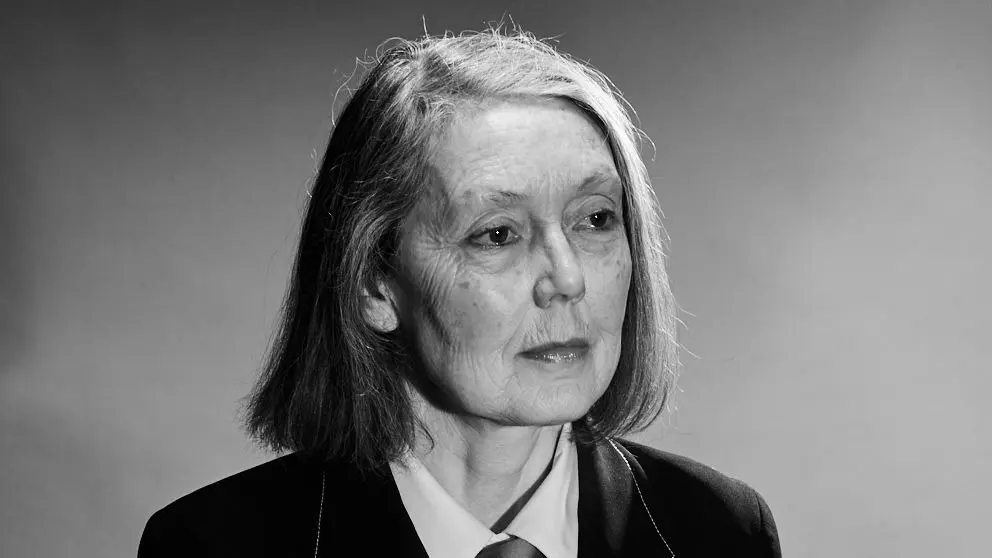
In recent years, the Nobel Prize in Literature has increasingly gravitated toward writers who confront the raw, ungovernable forces of human emotion through rigorous formal discipline. The recognition of Canadian poet, essayist, and translator Anne Carson—alongside recent laureates such as Annie Ernaux (2022)—reflects a pivotal institutional acknowledgment of literature that treats eros not as a casual motif, but as a severe, volatile, and central metaphysical reality.
Where contemporary culture often deflates passion into hyper-civilized irony or transactional intimacy, Carson’s body of work operates at the intersection of classical scholarship and radical formal experimentation. A scholar of Ancient Greek, Carson has spent decades building literary containment vessels—verse novels, hybrid essays, comic books, opera librettos, and translations—capable of holding what she characterizes as a "terrible excess of feeling." By placing the violent, unmanageable language of antiquity alongside the surreal fragments of modern life, Carson has established translation itself as a primary art form: an ongoing exercise in productive error, metaphor, and spiritual surrender.
This report examines the intellectual trajectory of Anne Carson, analyzing her key texts, her formal innovations, her philosophical framing of desire and grief, and her place within a broader literary continuum alongside writers like Annie Ernaux, Jon Fosse, and László Krasznahorkai.
Read Also
Detailed Chronology of Carson’s Major Works and Intellectual Evolution
Carson’s career is defined by a unique dual identity as a rigorous academic classicist and an avant-garde innovator. Over four decades, her published output has continually expanded the boundary of what literary criticism and poetry can achieve.
       [1986] "Eros the Bittersweet"
          │   (Foundational scholarship on ancient Greek desire)
          ▼
       [1992] "Short Talks"
          │   (Micro-essay collection defying genre boundaries)
          ▼
       [1995] "Plainwater"
          │   (Explorations of feral romance, pilgrimage, and loss)
          ▼
       [1998] "Autobiography of Red"
          │   (Breakthrough verse novel re-imagining the mythic monster Geryon)
          ▼
       [1999] "Economy of the Unlost"
          │   (Comparative analysis of Simonides of Keos and Paul Celan)
          ▼
       [2000] "Men in the Off Hours"
          │   (Metaphor, error, and surreal historical dialogues)
          ▼
       [2001] "The Beauty of the Husband: A Fictional Essay in 29 Tangos"
          │   (Anatomy of marital collapse and divine deception)
          ▼
       [2002] "If Not, Winter: Fragments of Sappho"
          │   (Definitive translation restoring the physical spaces of antiquity)
1986: Eros the Bittersweet
Carson’s primary critical treatise originated from her academic research into ancient Greek lyric poetry. Examining how Sappho and her contemporaries conceptualized longing, Carson identified eros as an external, invasive force that overruns the individual’s rational defenses. She famously observed:
"Foreign to her will, it forces itself irresistibly upon her from without. Eros is an enemy."
1992–1995: Short Talks and Plainwater
Transitioning into hybrid creative prose, Carson published Short Talks, a series of dense, surreal micro-essays ranging from artistic reflections to everyday observations, such as "Short Talk on the Sensation of Airplane Takeoff," where she describes commercial flight as a sudden confrontation with love: "Well you know I wonder, it could be love running towards my life with its arms up yelling ‘let’s buy it what a bargain!’"
In Plainwater (1995), her prose turned darker, framing romantic attachment as a destructive, predatory instinct:
"Humans in love are terrible. You see them come hungering at one another like prehistoric wolves, you see something struggling for life in between them like a root or a soul and it flares for a moment, then they smash it."
1998–2001: The Verse Novels and Men in the Off Hours
With Autobiography of Red (1998), Carson achieved widespread literary acclaim. The verse novel recasts the ancient Greek myth of Geryon—a red winged monster slain by Herakles—into a tender, tragic coming-of-age story set in contemporary times.
She followed this with Men in the Off Hours (2000) and The Beauty of the Husband: A Fictional Essay in 29 Tangos (2001). The latter dissects the infidelity and dissolution of a marriage, comparing the husband’s manipulative linguistic detachment to the way Homeric gods use human words with total indifference to their earthly meanings:
"What really connects words and things? / Not much, decided my husband / and proceeded to use language / in the way that Homer says the gods do… They flip the switch at will. / My husband lied about everything."
2002: If Not, Winter: Fragments of Sappho
Carson’s translation of Sappho’s surviving verses served as a landmark event in classical translation. By utilizing brackets and white space to represent the physical gaps in the surviving papyri, Carson invited readers into the exact texture of antiquity, presenting Sappho’s verse with unvarnished precision.
Supporting Context & Metrics: Deconstructing Form, Metaphor, and Translation
Carson’s work is distinguished by its meticulous linguistic precision and radical formal variance. Rather than adhering to conventional poetic structures, Carson builds bespoke forms designed to constrain intense emotional chaos.
1. Translation as Sustained Metaphor
For Carson, translation is not a passive transfer of meaning from one tongue to another, but an active, inherently flawed art form. Because no two words across different languages possess identical semantic signatures, translation requires a commitment to imperfection.
Carson articulates this mechanism in Men in the Off Hours:
"Aristotle says that metaphor causes the mind to experience itself / in the act of making a mistake. / Not only that things are other than they seem, / and so we mistake them, / but that such mistakenness is valuable."
This reliance on "valuable mistakenness" enables Carson to bring wildly disparate concepts into juxtaposition. In Economy of the Unlost (1999), she reads the ancient Greek poet Simonides of Keos alongside the 20th-century Holocaust survivor and poet Paul Celan, describing Celan as "a poet who uses language as if he were always translating."
2. Precision in Lexicography: Lusimeles and Glukupikron
Carson’s critical interventions often hinge on subtle choices in translation that restore the original physical weight of ancient Greek terms:
| Greek Term | Standard / Conventional Translation | Carson’s Translation | Conceptual Impact |
|---|---|---|---|
| λύσιμελής (lusimeles) | "Loosener of limbs" | "Melter of limbs" | Replaces a passive, almost athletic description with a visceral image of physical dissolution under passion. |
| γλυκύπικρον (glukupikron) | "Bittersweet" | "Sweetbitter" | Restores Sappho’s original word order, emphasizing the immediate shock of pleasure rapidly shadowed by pain. |
3. Formal Diversity Across the Oeuvre
Carson’s refusal to remain within standard genre bounds has yielded a remarkably varied output:
- Verse Novels: Narrative poetry re-imagining classical texts (Autobiography of Red, Red Doc>)
- Physical Artifacts: Nox (2010), an epitaph for her deceased brother presented as an accordion-fold scroll contained in a physical wooden box.
- Anachronistic Dialogues: Screenplays featuring historical and mythic figures in unexpected settings (e.g., Thucydides in Conversation with Virginia Woolf).
- Translations of Drama: Performing editions of Euripides, Aeschylus, and Sophocles (Grief Lessons, Bakkhai).
Official Statements & Critical Commentary: The Theology of Eros and the "Holy Fool"
Critical analysis of Carson’s work frequently centers on her engagement with "decreation"—a concept borrowed from philosopher Simone Weil detailing the undoing of the self in the presence of the divine or the beloved.
The Triad of Ecstatics
In her seminal essay "Decreation: How Women Like Sappho, Marguerite Porete and Simone Weil Tell God," Carson maps the extreme trajectory of absolute devotion. She examines how three distinct historical figures surrendered their identities to love, reaching a state of near-annihilation:
- Sappho: The ancient lyric poet whose physical reaction to desire mimics the sensation of dying:
"no: tongue breaks and thin / fire is racing under skin / and in eyes no sight and drumming / fills ears / and cold sweat holds me and shaking / grips me all, greener than grass / I am and dead—or almost / I seem to me"
- Marguerite Porete: The 13th-century French Christian mystic who authored The Mirror of Simple Souls and was burned at the stake for heresy after refusing to recant her radical vision of divine love.
- Simone Weil: The 20th-century philosopher who starved herself during World War II in solidarity with occupied France, treating affliction as a portal to spiritual truth.
Reflecting on these women, Carson writes:
"What I like best about the three women we’ve been studying is that they know what love is. They know love is the touchstone of a true or a false spirituality."
Carson and the Lineage of "Holy Fools"
Literary scholars place Carson alongside other recent Nobel-caliber figures whose works center on spiritual extremity and radical devotion. Like Norwegian novelist Jon Fosse and Hungarian author László Krasznahorkai, Carson constructs characters who function as "holy fools"—individuals who pursue an absolute, uncompromised vision despite social ruin, madness, or death.
                   THE CONTINUUM OF ABSOLUTE DEVOTION
                                   │

┌─────────────────────────┼─────────────────────────┐
         ▼                         ▼                         ▼
   ANNE CARSON                 JON FOSSE            LÁSZLÓ KRASZNAHORKAI
 (Eros as Destruction /    (Quietist Mysticism /     (Apocalyptic Zeal /
   Spiritual Test)           Radical Silence)         Absolute Obsession)
Future Outlook: Carson’s Legacy in Contemporary Letters
The sustained acclaim surrounding Anne Carson signals a broader recalibration within contemporary literature. For decades, postmodern literary trends favored detachment, self-referential irony, and emotional minimization. Carson’s work offers an alternative route: combining rigorous scholarly intellect with unvarnished, high-stakes emotional intensity.
Key Takeaways for Literature and Translation Studies:
- Rehabilitation of Passion: Carson demonstrates that ancient concepts of grief, anger, pride, and erotic desire remain deeply relevant when removed from ironized contemporary filters.
- Redefining the Translator’s Role: By highlighting the white spaces, fragments, and inherent errors of translation, Carson has elevated the translator from an invisible medium to an active creative artist.
- The Endurance of the Minimalist Impulse: Carson proves that the most effective way to convey "a terrible excess of feeling" is through tight, austere formal constraint.
Ultimately, Carson’s work offers a testament to resilience in the face of emotional turmoil. As illustrated in Glass, Irony & God, her poetry framing a conversation between a grieving woman and her skeptical mother captures the quiet triumph of enduring through despair:
"Dr. Haw says grief is a long process.
She frowns. What does it accomplishall that raking up the past?
Oh—I spread my hands—
I prevail! I look her in the eye.
She grins. Yes you do."
As global institutions like the Swedish Academy continue to honor writers who engage with fundamental human experiences, Anne Carson’s corpus stands as a vital monument to the enduring, sweetbitter power of love, language, and art.



Comments
Facebook App ID not configured. Please add it in the Customizer.