
Executive Overview
In a landmark international repatriation effort, New York law enforcement officials announced on Wednesday the return of thirty-six high-value antiquities—collectively valued at upwards of $5 million—to the people of Syria. Spearheaded by the Manhattan District Attorney’s Antiquities Trafficking Unit (ATU), the operation underscores the ongoing, high-stakes battle against illicit art trafficking, cultural heritage destruction, and the global black market networks that profit from war-torn regions.
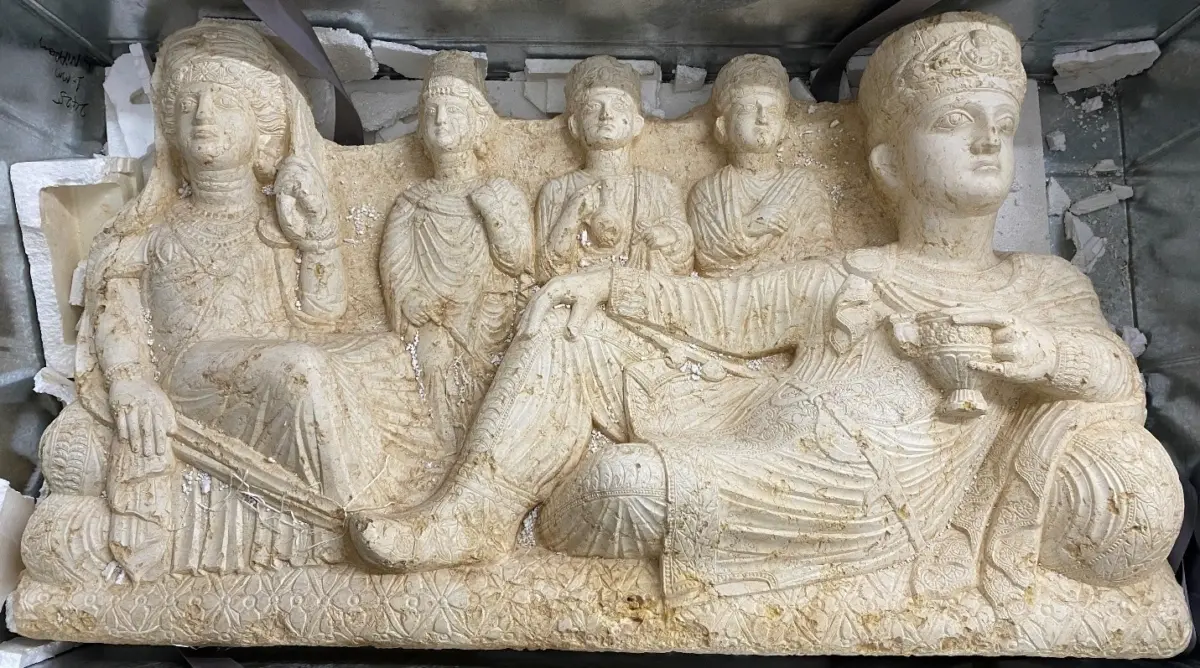
Among the repatriated artifacts is an exceptionally rare, monumental 3rd-century BCE mosaic floor depicting mythological deities, alongside a towering 1,000-pound limestone relief looted from the ancient desert city of Palmyra before its devastation by ISIS. Many of the returned items trace their provenance back to Georges Lotfi, an international antiquities dealer who underwent a stunning transition from a confidential informant for Manhattan prosecutors to an internationally wanted fugitive charged with trafficking stolen cultural property.
Simultaneously, Manhattan District Attorney Alvin L. Bragg, Jr., disclosed that his office had seized an additional 13 artifacts from the Metropolitan Museum of Art. This latest acquisition brings the staggering total of antiquities seized from the Met by investigators since 2017 to more than 402 items, with a combined estimated value exceeding $98.7 million. While these successive seizures highlight institutional vulnerabilities in provenance research among world-class museums, they also reflect an evolving, collaborative paradigm between cultural titans and law enforcement agencies to purge illicit items from public view.
Read Also
Detailed Chronology: From Syrian Sanctuaries to New York Storage
The journey of these thirty-six artifacts from the ancient Near East to clandestine storage units in New York City reads like a geopolitical thriller, marked by civil conflict, transnational smuggling syndicates, and a high-profile betrayal of trust within the art-dealing community.
The Palmyra Relief and the Shadow of ISIS
The centerpiece of the repatriated collection is a soaring limestone sculpture weighing more than 1,000 pounds. Crafted in the late 2nd century CE for an elaborate subterranean burial chamber in Palmyra, the relief depicts a reclining man flanked by women and children, sculpted in the rich, expressive funerary style unique to the Greco-Roman desert oasis.
Investigators believe the sculpture was violently hacked from its architectural setting by looters well before the ancient site fell under the control of ISIS, which notoriously dynamited and pulverized many of Palmyra’s monumental structures between 2015 and 2017. Once detached from its tomb, the heavy relief was smuggled out of Syria, routed through transit hubs, and eventually warehoused in Dubai before slipping past customs checks to enter the Western art market.
Georges Lotfi and the Mosaic Masterpieces
Also featured in the Wednesday restitution are 14 "extraordinary" mosaics stolen from a sprawling Roman-era villa in Syria. These treasures are directly linked to Georges Lotfi, an antiquities dealer whose career encapsulates the shadowy nexus between legitimate collections and illicit pillaging.
For years, Lotfi operated as a trusted source and informant for the Manhattan District Attorney’s Antiquities Trafficking Unit, dangling access to regional networks to curry favor with American law enforcement. However, a dramatic investigative turn in 2022 revealed that Lotfi was simultaneously serving as a central node in an international smuggling ring trafficking stolen antiquities from both Syria and Lebanon. When authorities closed in, Lotfi fled jurisdiction. He is currently an international fugitive, wanted by both New York authorities and Interpol.
The crown jewel of the Lotfi seizure—which was raided from a New York storage unit in 2021—is a massive section of flooring dating to the 3rd century BCE. The mosaic is an artistic tour de force, depicting the sacred wedding of the god Telete and Eros, accompanied by Aphrodite and the Three Graces. Preserved with astonishing clarity, the floor represents an irreplaceable fragment of ancient Levantine heritage.
Supporting Context & Metrics: The Met Museum and the Scale of Illicit Trade
While the return of Syrian artifacts marks a diplomatic and cultural victory, the simultaneous announcement regarding the Metropolitan Museum of Art places the broader structural crisis of museum collections under intense public scrutiny.
Escalating Seizures at the Met
By seizing 13 additional objects from the Met, the Manhattan District Attorney’s office pushed the running tally of interventions at the institution to historic proportions. Since 2017, investigators have removed over 402 looted or illegally exported antiquities from the museum’s galleries and storage vaults. The cumulative market value of these retrieved items stands at a staggering $98.7 million.
These enforcement actions are not isolated incidents; rather, they represent a systemic re-evaluation of museum acquisitions over the past half-century. Many of these pieces entered the Met’s collection during an era when provenance verification was lax, documentation was easily falsified, and museums routinely prioritized acquisition over rigorous ethical vetting.
The Mechanics of Provenance Research
To combat these historical oversight errors, the Met maintains a dedicated team of provenance experts tasked with auditing the museum’s vast holdings. Lucian Simmons heads a specialized squad of 12 researchers within the institution whose sole responsibility is to trace the ownership history of every object, identifying gaps, suspicious dealer names, and red flags associated with known traffickers.
Despite these internal efforts, museum officials readily admit that they often lack the jurisdictional reach, subpoena power, and intelligence-gathering apparatus necessary to uncover deep-seated fraud. This is where the Manhattan D.A.’s Antiquities Trafficking Unit has emerged as an indispensable ally, leveraging grand juries, wiretaps, and international police cooperation to pierce the veils of shell companies and offshore accounts used by modern antiquities cartels.
Official Statements and Institutional Collaboration
The dual announcements from District Attorney Bragg’s office reflect a changing philosophy within the cultural heritage sector. Rather than treating law enforcement as an adversarial force, major collecting institutions are increasingly choosing collaboration over litigation.
In statements released earlier this year, representatives for the Metropolitan Museum of Art emphasized their proactive stance on purging tainted items.
"The Met doesn’t want any stolen art in our collection," Lucian Simmons, head of the museum’s provenance research team, stated during a joint briefing. "The District Attorney’s office has been an invaluable partner to us in this work—particularly their ability to unlock information that would otherwise be inaccessible to private institutions."
This sentiment was echoed by Manhattan District Attorney Alvin L. Bragg, Jr., whose office has spearheaded the repatriation of hundreds of stolen cultural artifacts to nations across the globe, including Italy, Greece, Egypt, Cambodia, India, and now Syria.
"While we must remain vigilant against those who seek to profit from the destruction of human history, today’s return of thirty-six antiquities to the people of Syria proves that justice has no expiration date," Bragg noted. "Whether these items are hidden away in private storage units by fugitive dealers or displayed on the pristine white walls of world-class museums, our office remains committed to restoring cultural patrimony to its rightful home."
Future Outlook: The Road Ahead for Cultural Heritage Protection
The successful repatriation of the Palmyra relief and the Lotfi mosaics, paired with the ongoing house-cleaning at the Metropolitan Museum of Art, signals a critical turning point in the global fight against cultural property crimes. However, experts warn that significant challenges remain.
Geopolitical Instability and Ongoing Looting
As long as regions across the Middle East, North Africa, and parts of Asia remain destabilized by conflict and economic turmoil, the threat of systematic looting will persist. Desperate local populations, armed militias, and sophisticated international crime syndicates continue to view ancient sites as cash cows, hastily unearthing irreplaceable historical data for pennies on the dollar before shipping them to lucrative markets in the West and East Asia.
The Evolution of Smuggling Networks
Law enforcement agencies must also adapt to the digitalization of the art market. While traditional smugglers relied on physical shipping containers and forged paperwork, contemporary traffickers increasingly utilize encrypted messaging apps, dark web marketplaces, and decentralized cryptocurrency networks to broker illicit deals anonymously.
A New Standard for Due Diligence
The ongoing cooperation between prosecutors and museums like the Met may serve as a blueprint for other cultural institutions worldwide. As transparency becomes the baseline expectation for museum boards and donors, institutions that fail to rigorously audit their collections risk not only catastrophic financial and reputational damage, but also legal liability under international antiquities laws.
For the people of Syria, the return of these thirty-six artifacts offers a vital thread of connection to an ancient heritage fractured by modern war. While the physical rebuilding of archaeological sites like Palmyra will take generations, the recovery of these scattered stones and mosaics ensures that the narrative of human history cannot be permanently erased by the ravages of conflict.




Comments
Facebook App ID not configured. Please add it in the Customizer.