
Executive Overview
QUANTICO, Va. — In an act of senseless vandalism that has sent shockwaves through military and historical preservation communities nationwide, a Virginia man was arrested late Wednesday night after allegedly wielding a sledgehammer against the iconic Iwo Jima monument located near the United States Marine Corps Base Quantico. The suspect, identified as 27-year-old Miguel Alonso Maldonado Soriano of Stafford, Virginia, was apprehended on-site by local law enforcement officers who caught him in the act of bludgeoning the bronze-and-stone tribute.
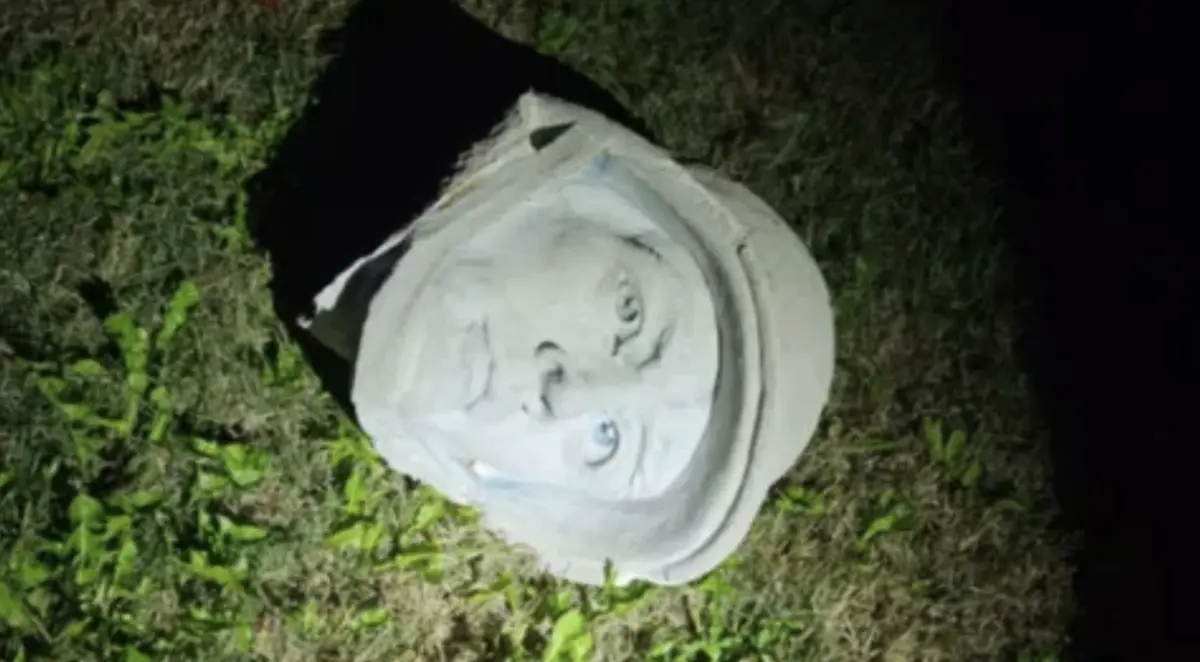
According to preliminary estimates provided by law enforcement and cultural preservation specialists, the structural and aesthetic damage inflicted upon the monument amounts to hundreds of thousands of dollars. The assault resulted in the complete decapitation of one of the six heroic figures immortalized in the sculpture, extensive gouging and structural fracturing on a second marine, and the complete disappearance of a carved stone bayonet from a third.
The targeted installation is not merely a piece of public art; it is a scaled version of the legendary Marine Corps War Memorial situated in Arlington, Virginia. It serves as a solemn tribute to one of the most defining and ferocious amphibious assaults of the Pacific Theater during World War II: the capture of Mount Suribachi on the Japanese island of Iwo Jima.
Read Also
Maldonado Soriano now faces multiple felony charges, including the willful injury of a monument and malicious destruction of private or public property, alongside a misdemeanor charge of trespassing with the intent to damage property. As the legal proceedings unfold, the incident has reignited national conversations regarding the urgent necessity of bolstering security measures around historic public installations, veterans’ memorials, and national heritage sites.
Detailed Chronology of the Incident
The sequence of events that led to the desecration of the Quantico-area landmark began unfolding on Wednesday evening, as routine patrols and local security protocols intersected with the suspect’s alleged rampage.
The Response and Apprehension
According to the official incident report filed by the Prince William County Police Department, emergency dispatchers received urgent calls concerning suspicious activity and loud metallic impacts echoing from the monument site near the Quantico Marine base. Responding officers arrived at the location late Wednesday night to find the suspect actively engaged in the destruction.
Police observed Maldonado Soriano—armed with a heavy-duty construction sledgehammer—landing repeated, forceful blows against the primary bronze-and-stone figures of the monument. Officers intervened immediately, securing the perimeter, neutralizing any potential threat, and taking the 27-year-old Stafford resident into custody without further incident.
Extent of the Physical Damage
Forensic damage assessments conducted in the immediate aftermath of the arrest revealed the methodical and devastating nature of the attack:
- The First Figure: One of the six immortalized Marines suffered a catastrophic structural failure after being struck multiple times in the upper torso and head, resulting in the complete severance and removal of the statue’s head.
- The Second Figure: A nearby soldier’s helmet and facial features were subjected to intense concussive force, leaving them deeply "chipped and gouged," requiring specialized metallurgical and stonework restoration.
- The Third Figure: The detailed rifle hoisted across the back of an adjacent statue was severely compromised, with its carved stone bayonet completely broken off and missing from the scene, prompting a secondary search for the fragmented artifact.
Maldonado Soriano was subsequently transported to a local detention facility. He is currently being held without bond as he awaits his initial formal arraignment and subsequent court appearances. Representatives for the public defender’s office or private counsel assigned to his defense have thus far declined to issue public comments regarding the ongoing investigation.
Supporting Context & Metrics: The Weight of History
To fully grasp the gravity of the vandalism at Quantico, one must understand the profound historical weight carried by the imagery of the Iwo Jima monument. The targeted structure is a meticulously crafted replica of the iconic Marine Corps War Memorial in Arlington, Virginia, which stands as a towering tribute to the United States Marine Corps and the ultimate sacrifices made during World War II.
The Photograph and the Sculptor
The monument immortalizes the historic second flag-raising atop Mount Suribachi on February 23, 1945, a scene captured forever by Associated Press photographer Joe Rosenthal. His shutter click yielded a Pulitzer Prize-winning photograph that instantly transcended journalism to become an enduring symbol of American resolve, perseverance, and unity.
For decades following the publication of the photograph, Rosenthal faced persistent, unfounded accusations that the momentous event had been staged for the camera—allegations that the esteemed photojournalist vehemently denied until the end of his life. Felix de Weldon, the sculptor who brought the 2D photograph into three-dimensional bronze reality, spent years ensuring that every fold of clothing, every strain of muscle, and every angle of the flagpole captured the raw intensity of the original moment.
The Crucible of Iwo Jima
The battle for Iwo Jima was not merely a strategic skirmish; it was a grueling, blood-soaked campaign for a barren volcanic island measuring just eight square miles. Situated roughly halfway between the Mariana Islands and Tokyo, the island held immense tactical value for the United States Army Air Forces, who required its airfields to launch escort-fighter planes in support of long-range B-29 bomber raids against the Japanese mainland.
The combat operations, spanning from February 19 to March 26, 1945, marked the first time American forces breached the threshold of the Japanese homeland’s inner defenses. The Japanese Imperial Army, under the command of General Tadamichi Kuribayashi, had spent months constructing an impenetrable network of underground tunnels, fortified pillboxes, and deeply embedded artillery positions.
The human cost was staggering:
- The Photograph’s Subjects: Of the six brave individuals captured by Rosenthal hoisting the Stars and Stripes on Mount Suribachi—Hanks Hansen, John Bradley, Charles Lindberg, Rene Gagnon, Ira Hayes, and Michael Strank—only three (Bradley, Hayes, and Lindberg) survived the entirety of World War II. The remaining three (Hansen, Strank, and a replacement later identified as Harold Schultz) were killed in action within weeks of the photograph being snapped, long before the fierce battle for the island’s mountaintop had officially ceased.
- Total Casualties: The United States suffered nearly 27,000 casualties, including over 6,800 Marines killed in action. On the opposing side, out of a defending garrison of roughly 21,000 Japanese soldiers, only 216 were taken prisoner at the conclusion of the battle, with the rest fighting to the death.
Official Statements and Community Reaction
The deliberate defacement of a monument dedicated to such profound sacrifice has drawn swift condemnation from military officials, local government representatives, and veterans’ advocacy organizations across the Commonwealth of Virginia and the broader United States.
Law Enforcement and Legal Standpoint
Prince William County police officials emphasized the severity of the charges levied against Maldonado Soriano, underscoring that crimes targeting cultural heritage and war memorials carry profound societal ramifications.
"When an individual targets a monument honoring those who paid the ultimate price in service to their country, it transcends ordinary vandalism; it strikes at the shared memory and collective gratitude of a nation," noted a law enforcement spokesperson familiar with the ongoing probe. The inclusion of felony counts for injury to a monument reflects both the exorbitant financial cost of repair and the statutory protections afforded to historic and commemorative properties.
Veteran and Community Outcry
Local veterans’ groups have expressed deep sorrow and palpable anger over the incident. Chapters of the Veterans of Foreign Wars (VFW) and the Marine Corps League have mobilized online networks to demand absolute accountability and heightened vigilance around military-affiliated landmarks.
"Monuments like the one outside Quantico are silent sentinels of our history," said a representative for a regional veterans coalition. "They remind new generations of the high price of freedom. To see one of these hallowed figures disfigured by a sledgehammer is an insult to every man and woman who has ever worn the uniform."
Art conservationists have likewise voiced their distress, pointing out that repairing cast bronze and intricately carved stonework requires specialized artisans whose time and materials will easily account for the six-figure financial estimates cited by investigators.
Future Outlook: Restoration, Security, and Legal Proceedings
As the legal system processes Miguel Alonso Maldonado Soriano, structural engineers and historical preservationists are already looking ahead to the complex, delicate task of healing the scarred monument.
Legal and Judicial Horizon
Maldonado Soriano remains incarcerated without bond at a Prince William County detention facility. His upcoming court appearances will determine whether his defense counsel will pursue psychological evaluations or enter formal pleas regarding the felony destruction of property and trespass charges. Given the federal and state interest in the protection of veterans’ memorials, prosecutors are widely expected to push for strict sentencing guidelines if a conviction is secured.
Restoration Challenges
Restoring the Quantico-area monument presents a unique set of technical challenges:
- Metallurgical Re-casting: Reattaching or re-casting the severed head of the Marine figure requires matching the precise alloy composition, patina, and welding techniques utilized in the original sculpture to ensure seamless integration.
- Stone Masonry Precision: Re-sculpting the missing stone bayonet and repairing the gouged helmet and facial features demands master-level stonemasons who can carve exact replicas without compromising the structural integrity of adjacent components.
- Timeline and Funding: While initial estimates place the financial toll in the hundreds of thousands of dollars, the actual timeline for complete restoration remains uncertain. Specialized fabrication shops must be contracted, and historic preservation boards must approve all remediation plans.
Enhanced Security Measures
In the wake of this destructive episode, local authorities and military base liaisons are re-evaluating the physical security posture of monuments situated outside active-duty installation boundaries. Discussions are underway regarding the potential implementation of enhanced closed-circuit television (CCTV) surveillance, motion-activated lighting, and increased frequency of law enforcement drive-bys to deter opportunistic vandals.
Ultimately, the attack on the Iwo Jima monument near Quantico serves as a stark, painful reminder of the vulnerability of public art and historical heritage. Yet, just as the monument itself stands as a testament to perseverance in the face of insurmountable odds, the community and preservationists alike remain resolute in their commitment to restoring the memorial to its original, unbroken glory—ensuring that the legacy of those who raised the flag on Mount Suribachi continues to stand tall for generations to come.




Comments
Facebook App ID not configured. Please add it in the Customizer.