
Executive Overview
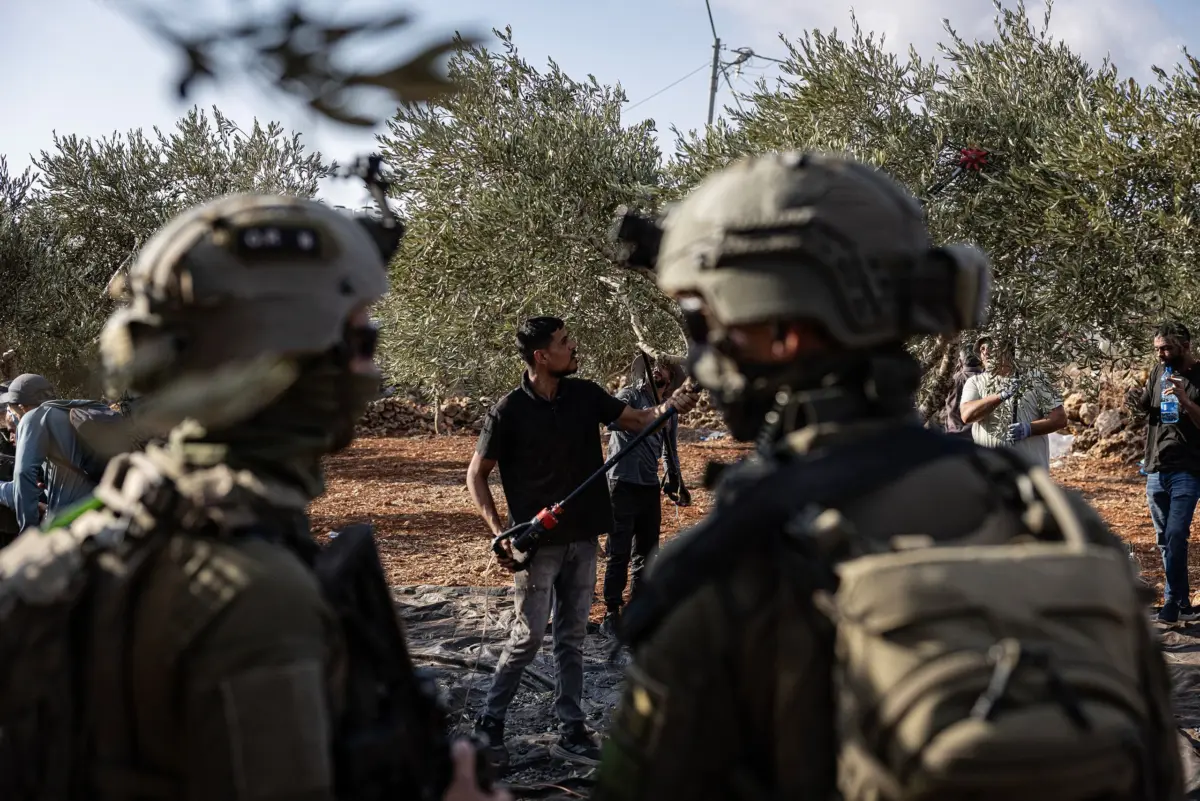
A brutal attack on Palestinian olive harvesters and an American photojournalist in the West Bank village of Khirbet Abu Falah has exposed an escalating pattern of state-facilitated settler violence. On a recent Friday, dozens of masked, armed Israeli settlers descended from an unauthorized hilltop outpost, launching a coordinated assault on local farmers attempting to gather their annual olive harvest. Among those targeted was Heidi Levine, an acclaimed 63-year-old American photojournalist on assignment for the Washington Post, who was beaten, stripped of her equipment, and robbed.
While foreign media attention centered on the assault of an American journalist, eyewitness accounts and field reports indicate that the incident was not an isolated outburst of extremist rage. Rather, it represents the operational reality of a systematic, highly organized campaign to alter the demographic and geographic landscape of the West Bank. Eyewitness testimony from independent journalist Jasper Nathaniel, who was present during the attack, highlights how settler violence has transitioned from sporadic, localized clashes into structured, paramilitary maneuvers designed to clear Palestinian land.
This systemic shift is supported directly by institutional changes within the Israeli government. Under the direction of Finance Minister Bezalel Smotrich—who also oversees civilian administration within the Ministry of Defense—the Israeli government has systematically stripped away administrative barriers to illegal outposts. Settlers have been increasingly integrated into territorial defense forces, provided military equipment, and empowered to create physical "facts on the ground."
Read Also
As Israel approaches a critical election in late October, the dynamic in the West Bank has reached a flashpoint: settlers are accelerating their land-grab operations to permanently lock in territorial gains, operating under the assumption of absolute immunity from domestic law enforcement.
Detailed Chronology of the Khirbet Abu Falah Attack
[Morning: Harvest Begins]
Palestinian farmers gather at Khirbet Abu Falah to harvest olives under group protection.
       │
       ▼
[Pre-Attack Mobilization]
Settlers assemble at hilltop outpost, donning masks, arming with clubs, slings, and firearms.
       │
       ▼
[Phase 1: Initial Assault]
40-50 settlers charge downhill; stone-throwing and tree-burning begin; local 'shabab' counter-defend.
       │
       ▼
[Phase 2: Military Escalation]
IDF units deploy tear gas against Palestinians; armed settlers in white pickup open machine-gun fire.
       │
       ▼
[Phase 3: Attack on Press]
Heidi Levine overrun and beaten by 5-6 settlers; Palestinian youths charge settlers to rescue her.
       │
       ▼
[Phase 4: Village Raid & Shooting]
IDF storms village core; fires live rounds, shattering a Palestinian man's femur; delays medical care.
1. Preparation and Early Warnings
The olive harvest in Khirbet Abu Falah—a traditional community event crucial to the local economy—began under intense security concerns. Overlooking the village’s agricultural perimeter sits an illegal Israeli outpost strategically positioned on a high ridge. Because the surrounding fields have been repeatedly targeted by settlers, Palestinian farmers organized a collective harvest, seeking safety in numbers.
Observational reports from the field confirm that from the moment harvesters arrived, settlers at the hilltop outpost began preparing for an assault. Masked men dressed in black were observed assembling, picking up wooden clubs, preparing stone slings, and readying weapons. Recognizing the impending danger, only Palestinian men participated in the harvest, working at high speed to clear trees before the inevitable clash.
2. The Assault and Counter-Defense
Approximately one hour into the harvest, a mob of 40 to 50 settlers charged down the hillside. The initial wave involved coordinated rock-throwing using heavy slings capable of delivering lethal force at long distances.
As settlers advanced toward the edge of the residential core, local Palestinian youths—known as the shabab—masked their faces and positioned themselves between the attackers and their village. For roughly 15 minutes, local residents managed to hold off the advance through counter-throwing of stones, preventing the settlers from entering residential homes.
The situation deteriorated rapidly when settlers set fire to several olive groves, filling the area with thick smoke. Shortly thereafter, Israeli Defense Forces (IDF) personnel arrived on the scene. Rather than dispersing the attacking settlers, military forces deployed tear gas directly at the Palestinian harvesters, forcing them into a retreat.
3. Escalation to Live Fire and the Assault on Heidi Levine
As tear gas rendered the fields impassable, an unmarked white pickup truck emerged from the haze. Two to three settlers in black hoodies carrying assault rifles began firing live automatic rounds into the air and toward the retreating crowds, triggering mass panic.
During the chaotic retreat, 63-year-old photojournalist Heidi Levine was separated from the group. Five to six settlers knocked her to the ground, repeatedly striking her with wooden clubs and kicking her. The attackers forcibly seized her professional equipment—including multiple camera bodies, lenses, mobile devices, cash, and personal identification—before being forcibly driven back by a group of young Palestinian men who charged the attackers with stones to rescue her.
Journalist Jasper Nathaniel, who assisted Levine following the beating, noted that Levine was severely traumatized and sustained significant physical injuries before being evacuated by local Palestinian paramedics.
4. Post-Attack Military Operations
Following the retreat of the main settler mob, IDF soldiers stormed the residential core of Khirbet Abu Falah. During the subsequent operation, military personnel fired live ammunition, striking a Palestinian bystander in the leg. The high-velocity round shattered the man’s femur, leaving unremovable bullet fragments throughout the limb.
According to eye-witness accounts and subsequent reporting by The New York Times, IDF soldiers delayed emergency medical transportation, pointing weapons at paramedics and demanding identification from the severely wounded victim before allowing the ambulance to transport him to a regional hospital.
Supporting Context & Metrics
The Organizational Evolution of Settler Militias
The incident at Khirbet Abu Falah highlights a broader structural transformation within the West Bank settler movement. Historically characterized by opportunistic or localized vigilante action, settler groups have increasingly evolved into organized, highly disciplined paramilitary structures.
       HISTORICAL VIGILANTISM                  MODERN PARAMILITARY STRUCTURE
┌───────────────────────────────────┐      ┌───────────────────────────────────┐
│ • Reactive, localized disputes    │      │ • Structured leadership & gangs   │
│ • Uncoordinated village raids     │ ───► │ • Direct IDF guard allocation     │
│ • Minimal state infrastructure    │      │ • Deputized units (Hagmar)        │
│ • Limited long-term planning      │      │ • Strategic territorial clearance │
└───────────────────────────────────┘ └───────────────────────────────────┘- Gang Structures and Gang-Style Leadership: In regions such as Masafer Yatta in the South Hebron Hills, organized settler factions operate under designated leaders like Shimon Atiya. These groups deploy teenagers and young men to conduct systematic harassment—grazing livestock on Palestinian farmland to destroy crops, vandalizing infrastructure, and physically assaulting residents to force abandonment.
- Deputization via Hagmar Units: Following the events of October 7, 2023, large numbers of settlers were formally integrated into regional defense units known as Hagmar (Regional Defense Forces). Outfitted with standard-issue IDF uniforms, military-grade assault rifles, and tactical gear, the boundary between official military authority and extremist settler action has effectively collapsed.
- Institutionalized Logistics: Key figures within outposts often maintain direct contact with regional IDF commanders. While the IDF officially denies providing dedicated personal security details to illegal outpost leaders, field reports demonstrate routine military intervention that serves to cover, support, or protect settler operations while suppressing Palestinian self-defense.
Institutional Alignment: The Smotrich Sovereignty Plan
The rapid expansion of violent outposts corresponds directly with policy initiatives executed at the highest levels of the Israeli government.
| Metric / Dimension | Policy Mechanism & Implementation |
|---|---|
| Administrative Control | Creation of the Settlement Administration within the Ministry of Defense, led directly by Finance Minister Bezalel Smotrich. |
| Bureaucratic Streamlining | Systematic removal of legal "red tape" to retroactively legalize unauthorized outposts and expedite bypass road construction. |
| Territorial Strategy | Implementation of Smotrich’s "Sovereignty Plan," aimed at corralling Palestinian populations into six isolated urban hubs (e.g., Ramallah, Nablus, Hebron). |
| Resource Allocation | Allocation of state subsidies for pastoral farming outposts, directly funding livestock and shepherd labor used to clear farmland. |
Erosion of Press Security and Foreign Diplomatic Immunity
A critical detail from the Khirbet Abu Falah assault is the absolute disregard shown by settlers toward international press markers and foreign passports.
- Loss of the "Passport Buffer": Historically, international observers, foreign correspondents, and Palestinian-Americans possessed a degree of protection due to foreign citizenship. Over recent years, this insulation has largely eroded.
- Escalation Against Journalists: Foreign journalists routinely report being targeted despite wearing high-visibility press vests, carrying media credentials, and identifying themselves in English. Press credentials are no longer perceived by extremist groups as a deterrent, but frequently as a target.
Official Statements and Institutional Responses
The international outrage generated by the assault on an American journalist forced official responses across diplomatic and government channels, though responses highlighted deep political divisions:
United States Embassy in Jerusalem
"The United States Embassy in Jerusalem condemns the recent violent attacks on civilians and journalists in the West Bank. We have explicitly requested a thorough, rapid, and transparent investigation by Israeli authorities into the assault on American citizen and photojournalist Heidi Levine, as well as broader attacks targeting agricultural workers."
Office of the Prime Minister of Israel (Benjamin Netanyahu)
"The Prime Minister’s Office maintains that an official investigation into the events in Khirbet Abu Falah is warranted. However, public accounts must be vetted against operational facts to prevent inaccurate depictions of defense forces. We caution against what appears to be a coordinated political campaign aimed at smearing the State of Israel internationally."
Israel Defense Forces (IDF) Official Spokesperson
"Claims that the IDF provides official personal security guards to the leadership of unauthorized outposts are entirely unfounded. The IDF operates in the Judea and Samaria region to maintain security for all residents and responds to violent disturbances in accordance with standard operational rules of engagement."
Future Outlook: Legislative Deadlines and Post-Election Scenarios
As Israel approaches its national election in late October, dynamics in the West Bank are expected to intensify. Observers and field researchers outline two primary factors shaping the immediate future:
1. The "Race Against the Clock"
Settler leadership views the current political alignment as an unprecedented window of opportunity. Fearing potential policy shifts or foreign diplomatic pressure should the political composition of the Israeli government change, outposts are aggressively expanding their physical footprints. By seizing key ridges, establishing bypass access points, and forcibly driving Palestinian farmers off agricultural buffer zones, the movement aims to establish irreversible "facts on the ground."
2. Post-Election Volatility
Regardless of the electoral outcome between Prime Minister Benjamin Netanyahu and opposition figures such as Gadi Eisenkot, rights groups anticipate severe volatility:
- In the Event of a Coalition Victory: Settler groups will likely interpret electoral success as a mandate to accelerate the total clearance of rural Palestinian communities and push for formal annexation.
- In the Event of an Opposition Victory: Anticipating potential policy friction or renewed enforcement against unauthorized outposts, extremist groups may launch "revenge pogroms" or "price-tag" operations designed to lock down territorial positions before any structural changes can be implemented.
For Palestinian communities in Khirbet Abu Falah, Masafer Yatta, and across the West Bank, the daily reality remains defined by an existential struggle for land, where traditional agricultural seasons—such as the annual olive harvest—have transformed into active conflict zones.





Comments
Facebook App ID not configured. Please add it in the Customizer.