
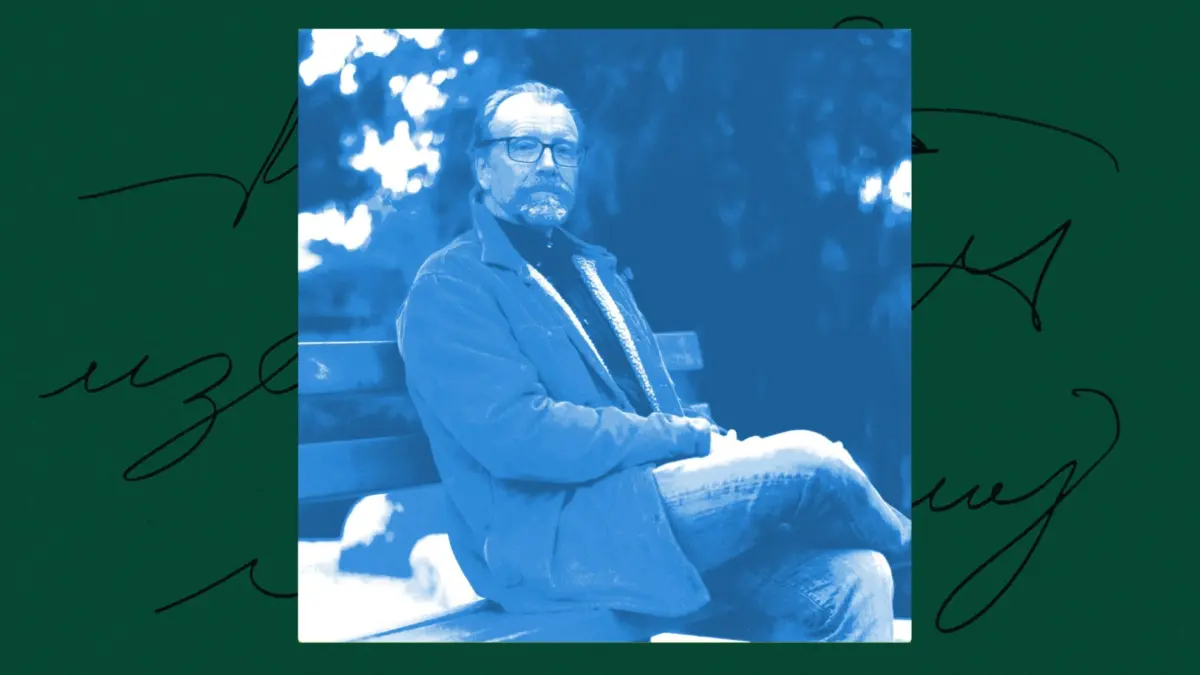
Executive Overview
In an era defined by hyper-partisanship, algorithmic echo chambers, and the fragmentation of objective truth, Booker Prize-winning author George Saunders has released his latest work of short fiction, "Appeasement, Ohio" (published in The New Yorker). The story serves as both a sharp comic satire and a haunting tragedy regarding the state of modern civic life. Centered on a protagonist named Leo who travels to rural Ohio to secure a corneal tissue donation from his estranged nephew, the narrative exposes the deep-seated epistemic and socio-economic fractures splitting American families apart.
Upon arrival, Leo anticipates meeting the sweet boy he once helped raise, only to encounter Kip—a physically imposing adult man who, alongside his radicalized friend Mick, has embraced the absurd yet dangerous fringe belief that the American Civil War never occurred. What begins as a desperate bid for personal health transforms into a masterclass on moral cowardice, class resentment, and the insidious nature of social appeasement.
Through "Appeasement, Ohio," Saunders diagnoses a unique contemporary pathology: the transformation of historical denialism into a tool of personal power and white-supremacist revisionism. Furthermore, the story critically interrogates the middle-class instinct to remain silent in the face of blatant falsehoods for the sake of politeness or transactional gain. The result is a profound cultural text that asks a chilling question: What happens to a society when those who know the truth systematically pander to those who reject it?
Read Also
Detailed Chronology
The gestation and thematic architecture of "Appeasement, Ohio" span over six years of writing, editorial refinement, and acute observation of the American political landscape.
[2018–2019: Conceptual Spark]
   └── Discovers online "Helen Keller deniers"
   └── Conceptualizes epistemic isolation and personal information domains

[2019–2022: Narrative Drafting & Structural Evolution]
   └── Drafts initial versions featuring ghosts, overt political mockery, and "both-sides" symmetry
   └── Recovers core focus: Leo's complicity, family dynamics, and social class tensions

[2023–2025: Moral Calibration & Revisions]
   └── Eliminates unnecessary supernatural elements
   └── Refines Leo from a passive observer into an active agent making explicit moral choices
   └── Abandons false equivalencies regarding Kip and Mick's extremism

[2026: Publication & Critical Reception]
   └── Published in 'The New Yorker'
   └── Establishes a major literary critique of modern social appeasement and post-truth dynamics
Phase 1: Conceptual Origins and Epistemic Inception (2018–2019)
The initial spark for the story occurred several years prior to publication, when Saunders encountered the online subculture of "Helen Keller deniers"—individuals who argue that because they personally cannot conceive how a deaf and blind woman could author books, Keller’s achievements must be a hoax. Saunders recognized this phenomenon not merely as an isolated conspiracy theory, but as a symptom of modern hubris: an environment where individuals designate themselves as the ultimate arbitrators of reality within self-curated digital domains.
Phase 2: Narrative Drafting and Structural Evolution (2019–2022)
Over a six-to-seven-year period, Saunders developed the narrative around the protagonist, Leo, and his attempt to obtain eye tissue from his nephew, Kip. Early iterations of the story struggled with tone and focus. Initial drafts featured supernatural elements—including ghosts—and took an overtly mocking stance toward the conspiracy theorists. Other drafts overcorrected by attempting to enforce a false symmetry, seeking to legitimize the perspective of Civil War deniers under the guise of narrative fairness.
Phase 3: Moral Calibration and Editorial Refinement (2023–2025)
Through extensive revisions—and crucial feedback from editors at The New Yorker—Saunders overhauled the story’s conclusion and character architecture. He realized that the narrative’s emotional core lay not in caricaturing conspiracy theorists, but in exploring Leo’s moral hesitation. Saunders elevated Leo’s agency, forcing him to choose twice between legal/ethical duty and familial loyalty. Crucially, Saunders abandoned the attempt to validate Kip and Mick’s views, explicitly identifying their denialism as an absurd, dangerous manifestation of latent white supremacy that required moral correction rather than empathetic coddling.
Phase 4: Publication and Cultural Arrival (2026)
Upon its publication in late 2026, "Appeasement, Ohio" arrived as an urgent mirror to a nation struggling with political polarization, state-sponsored doubt, and the erosion of shared truth. The story culminates in a dark, cautionary ending where the characters’ refusal to confront bad-faith extremism leaves them entirely stripped of agency and power.
Supporting Context & Metrics
To fully grasp the psychological and sociological terrain of "Appeasement, Ohio," it is necessary to examine the broader cultural conditions Saunders critiques. The story intersects three primary domains: cognitive information overload, socio-economic alienation, and the rhetoric of false equivalence.
       [MODERN DISINFORMATION ENGINE]
                     │
    ┌────────────────┴────────────────┐
    ▼                                 ▼
[Cognitive Overload]         [Class & Isolation]
 • 100s of daily voices       • Rust Belt decay
 • Addiction-driven media     • Class resentment
 • Information hyper-curation • Sunk-cost compliance
    │                                 │
    └────────────────┬────────────────┘
                     ▼
          [Moral Appeasement]
          • Refusal to call out absurdity
          • Destruction of shared reality
          • Eventual loss of agency
1. The Metric of Cognitive Saturation
Saunders contrasts the cognitive landscape of pre-modern humans with that of contemporary digital citizens. Historical and psychological models highlight the dramatic shift in how human consciousness processes external input:
| Historical Era | Average Daily External "Voices" | Primary Source of Information | Cognitive Stress Level | Epistemic Framework |
|---|---|---|---|---|
| Pre-Industrial / Medieval | 8 to 12 trusted sources | Family, local clergy, immediate community | Low to Moderate | Communal / Traditional |
| 20th-Century Mass Media | Dozens of curated sources | Newspapers, broadcast radio/TV | Moderate | Institutional Consensus |
| Modern Algorithmic Age | Hundreds to Thousands | Social platforms, targeted ads, algorithmic feeds | High (Hyper-vigilance) | Hyper-fragmented / Self-curated |
Saunders argues that just as the human biological digestive system—evolved for fruits and nuts—fails when subjected to a high-calorie diet of fast food, the human mind suffers severe damage when exposed to constant, addictive, agenda-driven media streams. This cognitive saturation breeds fatigue, aggression, cruelty, and an urge to withdraw into personal reality bubbles.
2. Class Resentment and Epistemic Power
The estrangement between Leo and his cousin Maribeth is rooted as much in class dynamics as in ideology. Leo, though far from wealthy, represents the professional class that "escaped" their modest upbringing. Maribeth and Kip remain financially insecure in a region marked by shrinking economic opportunities.
In this context, adopting fringe conspiracy theories (such as Civil War denial) functions as a mechanism of social power. For Kip and Mick, rejecting established history is not an intellectual error; it is an act of rebellion against perceived cultural elites. Epistemic denial becomes an equalizer: If I refuse to acknowledge your reality, I deprive you of your authority.
3. The Trap of "Both-Sidesism"
A primary theme of the text is the modern impulse toward false equivalence. In literary and political discourse, "both-sidesism" demands that every claim—regardless of how factually baseline or absurd—be granted equal validity. Saunders addresses this directly: while empathy is essential to fiction, certain ideas are demonstrably wrong, harmful, and rooted in malice. Tolerate or appease such ideas under the banner of politeness or open-mindedness does not demonstrate compassion; it enables harm.
Official Statements & Authorial Commentary
Throughout discussions surrounding the story’s release, George Saunders provided detailed analysis of his creative choices, the societal mechanics of political division, and the psychological burden of modern digital culture.
On the Origin of Civil War Denialism and "Helen Keller Deniers"
"The story started with something I read a few years ago about Helen Keller deniers… I was fascinated by the hubris of this and by the idea of a country in which every person, no matter how poorly informed, gets to be king or queen of their own self-curated information domain. From inside such a system, regarding something as true (because it is, in fact, true) can look like naïveté. A person might feel that doubting everything is a form of power."
— George Saunders
On Digital Overload and the Degradation of Public Discourse
"I think of a guy in the Middle Ages, whose head was full of maybe eight or nine voices that were not his own… and compare him to any one of us, who hears hundreds of outside voices every day, most of them the voices of strangers—strangers with agendas, who have access to appealing, highly addictive message-delivery systems. In the same way that a stomach built for fruits and nuts will not thrive on three Big Macs a day, I doubt that our dear little minds are built to accommodate so many agenda-laden voices. Has this contributed to our current level of stupidity and aggression and cruelty… ? Well, I think, maybe?"
— George Saunders
On the Failure of Moral Appeasement and False Equivalence
"The title came to me very early, along with a feeling that part of our problem here in the good old U.S. might be that those of us who, say, are pretty sure the Civil War actually happened, might, if confronted with the contrary view, be hesitant to just say, outright, ‘That is a truly stupid idea. Shame on you. Stop it at once.’ We are maybe a little in the throes of the ‘two sides to every story’ vibe… but sometimes one of them is demonstrably wrong. And it doesn’t serve compassion or fairness… to tolerate that wrong idea, especially when the idea might inspire its holder to harm other people."
— George Saunders
On the Dark Realism of the Story’s Ending
"It is a dark ending (or maybe a cautionary ending?)… On the other hand, I think it’s an honest ending. If we pander to a willfully ignorant force that is revealing itself to be also a violent force, we’ll find that, like the adults in the story, we’re left sitting on the floor with no phones, all our power to do good taken away from us."
— George Saunders
Future Outlook
The publication of "Appeasement, Ohio" comes at a critical juncture for contemporary fiction and democratic discourse. As short story literature increasingly wrestles with the erosion of social cohesion, Saunders’s work offers important takeaways for cultural critics, writers, and citizens alike.
                  [FUTURE CIVIC DISCOURSE]
                             │
     ┌───────────────────────┼───────────────────────┐
     ▼                       ▼                       ▼
[Literary Shift]     [Epistemic Courage]    [Systemic Realism]
 Moving away from     Rejecting false        Recognizing that
 toothless satire    equivalence; naming    unconfronted hostility
 toward clear moral   absurdity outright     leads to loss of agency
 accountability
1. Re-evaluating Political Satire
For years, political satire relied on exaggerating reality to highlight its absurdities. However, in an era where fringe conspiracy theories routinely enter mainstream discourse, satire can no longer rely on hyperbole alone. "Appeasement, Ohio" demonstrates a path forward for literary satire: shifting focus from the absurdity itself to society’s reaction to the absurdity. The core drama lies in how ordinary people compromise their integrity when confronted with outrageous bad-faith behavior.
2. The Direct Rejection of Epistemic Cowardice
Saunders’s candid reflection on his revision process provides a framework for public discourse. The impulse to appease bad-faith actors—driven by a desire to avoid confrontation, protect personal interests, or maintain social harmony—acts as an engine for radicalization. Moving forward, maintaining a healthy democratic culture requires "epistemic courage": the willingness to firmly reject demonstrably false and dangerous narratives rather than accommodating them under the banner of polite consensus.
3. A Cautionary Vision for Civic Society
The conclusion of "Appeasement, Ohio" offers no easy comforting resolution. By depicting characters who end up disarmed, isolated, and powerless after repeatedly accommodating bad-faith demands, Saunders issues a stark warning. When reasonable people abdicate their responsibility to defend truth and establish firm moral boundaries, they do not preserve peace—they merely ensure their own eventual powerlessness.





Comments
Facebook App ID not configured. Please add it in the Customizer.