
Executive Overview
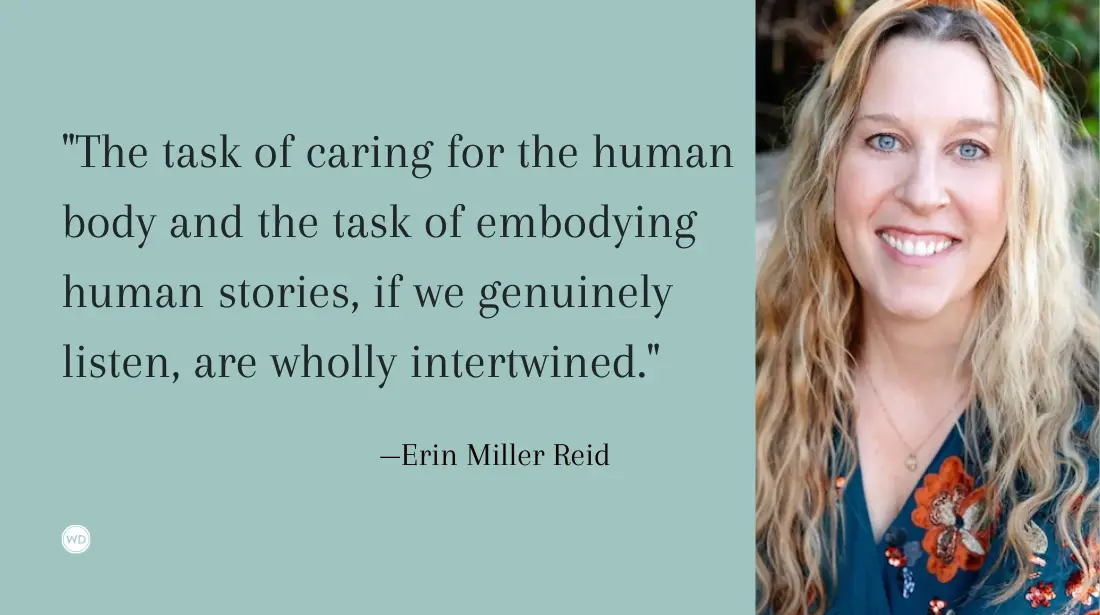
In the modern medical landscape, the intersection of clinical science and human empathy has become a critical frontier. For Dr. Erin Miller Reid—a practicing Mohs micrographic surgeon, novelist, and author of But For Fortune—this intersection is not merely an academic theory, but a lifelong inheritance. Raised within the rich oral storytelling traditions of Southern Appalachia, Reid’s early life was defined by long conversations, detailed recollections, and a cultural affinity for verbal exchange.
However, the transition from an inherently loquacious childhood to a rigorous medical career required a profound evolution. In the fall of 2025, Reid completed a certificate in Narrative Medicine, a discipline pioneered by Dr. Rita Charon. This framework emphasizes "radical listening"—the deliberate practice of attending to patient narratives without interruption or judgment.
This article explores the profound synergy between narrative medicine, clinical practice, and creative writing. By examining the roots of Appalachian storytelling, the structural demands of Mohs surgery, and the transformative power of patient narratives, this piece investigates how true listening serves as the foundational bedrock for both exceptional healing and enduring literature.
Read Also
Detailed Chronology: From Porch-Sworpin’ to the Operating Room
To understand Dr. Reid’s approach to modern medicine, one must first retrace a personal and cultural chronology rooted in the mountains of Southern Appalachia.
The Heritage of Talk
- Early Childhood: Reid’s formative years were spent waiting—in the aisles of Butch’s convenient store, outside mechanic shops where her father analyzed Kentucky basketball games, and in stuffy cars parked outside churches while Sunday pot roasts waited at home. These environments fostered an early appreciation for dialogue, observation, and the cultural adage that her father "had never met a stranger."
- Generational Continuity: This linguistic predisposition proved hereditary. Reid’s daughter demonstrated an advanced conversational aptitude by age three, engaging effortlessly with both peers and adults. Reid herself embraced loquacity, a trait that manifested everywhere from spontaneous chats in Ireland to lighthearted warnings from her husband during legal appointments.
Cultural Foundations
- Appalachian Storytelling: Beyond genetics, Reid’s communication style was heavily influenced by the cultural confluence of Scots-Irish, African, and Cherokee heritages in Southern Appalachia. While taciturn mountain residents certainly exist, local gatherings routinely feature long, highly detailed stories blending fact and fiction, culminating in emotional highs of laughter, fear, or scandal.
- The Appalachian Writers’ Workshop: Annually, Reid attends this nearly 50-year-old gathering, where writers engage in late-night storytelling sessions known colloquially as porch-sworpin’.
The Turn Toward Narrative Medicine
- Fall 2025: Seeking to augment her career as a physician and dermatologic surgeon, Reid completed a formal certificate in Narrative Medicine.
- Integration into Clinical Practice: Under the guidance of Dr. Rita Charon—an internal medicine physician with a PhD in English—Reid learned to apply humanities-based interpretive skills to clinical environments. This training transformed her approach from merely gathering a medical history to practicing "radical listening," allowing patients to articulate the full human experience of their illnesses.
Supporting Context & Metrics: The Mechanics of Narrative Medicine
The Genesis of Narrative Medicine
Narrative medicine was established to address a persistent gap in modern healthcare: the separation of a disease’s physiologic effects from the patient’s lived experience. Dr. Rita Charon recognized that physicians trained exclusively in biological sciences often struggled to comprehend the existential weight of chronic or terminal illness.
To bridge this gap, narrative medicine curricula incorporate non-medical textual analysis:
- Literary Discernment: Reading and analyzing complex poetry to recognize nuance, subtext, and emotional resonance.
- Visual Literacy: Studying the granular details of paintings to train the clinical eye for subtle physical and behavioral cues.
- Aural Attentiveness: Listening deeply to music to cultivate a heightened sensitivity to rhythm, tone, and unspoken emotion.
The Mohs Surgery Environment
Reid’s subspecialty—Mohs micrographic surgery for skin cancer—provides a unique structural setting for narrative exchange. Unlike rapid-fire primary care appointments or unconscious surgical procedures under general anesthesia:
- Extended Duration: Mohs procedures often span several hours, involving multiple stages of tissue excision and microscopic analysis.
- Conscious Patients: Patients remain awake throughout the procedure, including the final surgical repairs.
- Intimate Encounter: This extended timeline creates a rare clinical container where physician and patient can engage in sustained, meaningful dialogue, transforming an otherwise clinical procedure into an exercise in human connection.
Official Statements and Theoretical Frameworks
The philosophical underpinnings of narrative medicine rest on the assertion that storytelling and healing are fundamentally indivisible.
"When asked, how I have for so many years continued an equal interest in medicine and the poem, I reply that they amount for me to nearly the same thing."
— Dr. William Carlos Williams, Poet and Physician
This sentiment is echoed in the principles of narrative medicine, which reject the notion that clinical detachment is a prerequisite for professional competence. Instead, proponents argue that emotional engagement and narrative competence directly improve diagnostic accuracy, patient compliance, and psychological well-being.
Dr. Charon’s concept of "radical listening" requires practitioners to temporarily suspend their own internal monologues and conversational reflexes. For physicians accustomed to interrupting patients within seconds to narrow down a differential diagnosis, radical listening is a radical act. It demands patience, humility, and an absolute commitment to bearing witness.
In her creative work, Reid explores similar themes. In her novel But For Fortune, the protagonist Corinth reflects on the function of narrative within families:
"That’s why stories are called yarns. They are what holds everything together, what links the past to present."
Future Outlook: The Intertwined Future of Medicine and Art
As healthcare systems face increasing administrative burdens, electronic health record pressures, and diminishing face-to-face time between doctors and patients, the principles of narrative medicine offer a vital counter-movement.
Implications for Clinical Training
Medical schools and residency programs are increasingly incorporating humanities courses into their core curricula. By teaching future physicians how to read literature, analyze art, and listen without bias, medical educators aim to mitigate burnout, foster empathy, and combat depersonalization in clinical care.
The Writer’s Web and Universal Empathy
For Reid, the disciplines of writing and medicine remain mutually reinforcing. Writers operate from a "web of interconnected observations," weaving together personal history and the lived experiences of others. When a patient shares a profound trauma—such as an elderly mother recounting decades of grief over a deceased child—that story becomes part of the physician’s internal landscape.
As Reid notes regarding her unforgettable encounter in the operating chair:
"It’s not my own story… but it’s become part of my web. It’s a story that I hold as part of my experience… a story that works on me, a story that I will carry with equal measure of honor and empathy."
Looking forward, the integration of narrative practices into high-tech specialties like dermatology and surgery signals a promising evolution. It reminds the medical community that behind every pathological slide, surgical excision, and diagnostic code is a human being carrying a complex, fragile, and enduring story waiting to be heard.



Comments
Facebook App ID not configured. Please add it in the Customizer.