
Executive Overview
The landscape of contemporary creative non-fiction has added a profound new landmark to its terrain with the announcement of the 95th Annual Writer’s Digest Writing Competition results. Securing the first-place prize in the Memoir/Personal Essay category is Diane Birnbaumer, a writer whose professional background as an emergency physician uniquely positions her to examine the anatomy of mortality, loss, and familial legacy. Her winning essay, "Dad’s Desk," transforms the universally daunting task of sorting through a deceased parent’s personal effects into a surgical exploration of emotional archeology.
Structured around four utilitarian actions—Toss, Donate, Shred, and For Me—Birnbaumer’s narrative rejects traditional linear storytelling in favor of an inventory-style architecture. This methodological approach mirrors the clinical triage a physician performs daily, yet it is saturated with the raw, unfiltered vulnerability of a grieving daughter. By categorizing her father’s remaining physical footprint into what should be discarded, given away, destroyed, or preserved, Birnbaumer crafts a poignant commentary on the items we leave behind and the invisible threads that tether us to the departed.
This review and feature article examines the structural brilliance of Birnbaumer’s work, contextualizes it within the broader literary landscape of memoir writing, explores the intersections of medicine and grief, and evaluates the enduring impact of personal essay competitions on elevating authentic human narratives.
Read Also
Detailed Chronology: The Anatomy of an Inventory
To understand the emotional trajectory of "Dad’s Desk," one must examine the chronology of the sorting process itself. The essay operates as a step-by-step psychological unburdening, moving from the superficial layers of a lifetime’s accumulation down to the core artifacts of paternal love and professional identity.
Phase One: Toss
The essay opens with the initial confrontation with the desk’s contents, organized under the pragmatic header of "Toss." Here, Birnbaumer encounters artifacts of her childhood that challenge her preexisting assumptions about her father’s emotional interiority.
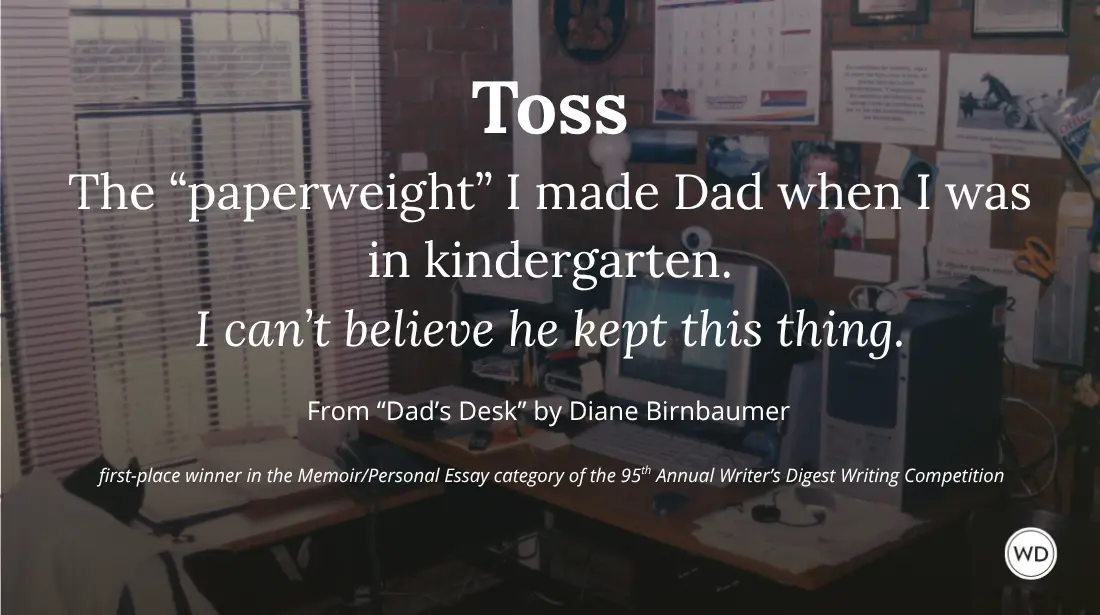
- The Kindergarten Paperweight: A child’s craft project—a first-grade photo pressed into the bottom of a glass ashtray and filled with Plaster of Paris—survives decades of shifting offices and changing lives. The discovery prompts a moment of deep introspection for the adult physician, who wonders if her childhood self already sensed the necessity of building internal fortresses.
- Handmade Ephemera: The bottom drawer yields an archive of childhood drawings, greeting cards, and a mock prescription for "rest and relaxation" written during Birnbaumer’s medical school years. The sheer volume of saved memorabilia forces a revelation: “Why didn’t I know Dad was so sentimental?”
- The Contradiction of Addictions: Interspersed among the mementos are the inescapable markers of her father’s lifelong struggle with smoking—matches and lighters. The juxtaposition of paternal tenderness with the destructive corporate legacy of tobacco invokes a flash of righteous anger from the author.
Phase Two: Donate
Transitioning to items intended for others, Birnbaumer’s gaze shifts from paper to textiles and furniture.
- The Oak Desk: Bearing the physical scars of a life fully lived—cigarette burns and water rings etched into the wood—the desk becomes an extension of the man himself. Birnbaumer notes her half-hearted attempts to clean the stains, realizing that these blemishes “seem to belong there, wisps of him.”
- The Gray Cardigan: Initially slated for donation, her father’s favorite gray cardigan undergoes a re-evaluation. Reeking of the cigarettes that ultimately consumed his health, the sweater acts as a portal to his final days. Birnbaumer recalls a quiet, devastating afternoon sitting side-by-side with her wheelchair-bound father, who asked his physician-daughter to light a cigarette for him, conceding with the bittersweet words, “Guess that horse is out of the barn.”
Phase Three: Shred
The third category tackles the bureaucratic and medical paper trail of a life concluding, revealing the complex emotional topography of an aging parent and an achieving child.
- Decades of Tax Returns: Spanning back to the 1960s, these financial records highlight a generational shift in socioeconomic mobility. Birnbaumer reflects on the quiet humility of her father, realizing that her starting salary out of medical residency surpassed his peak retirement earnings, and wonders how that disparity resonated within him despite his outward pride.
- The Medical Files: Meticulously organized by her father using neat, all-caps printing ("MEDICARE," "MEDICAL BILLS—TO BE PAID," "TEST RESULTS"), these folders hold CT scans and margin notes marked "ask Diane." Here, the author grapples with the duality of her roles: the daughter who wanted to offer hope, and the physician who recognized the terminal horizon.
- Imaging CDs: The discovery of medical imaging discs in the top drawer brings the essay to its most visceral medical confrontation. Birnbaumer retraces the progression of her father’s lung cancer, femoral metastasis, and ultimate brain tumors ("cannonball tumors"), wrestling with the professional guilt of not recognizing the warning signs sooner.
Phase Four: For Me
The final movement of the essay focuses on preservation, curating the items that will anchor Birnbaumer’s memory of her father moving forward.
- The Hospital ID: A vintage identification card from her father’s first job—obtained after he fabricated his age by six years—establishes a generational continuity. Forty years later, Birnbaumer walks the halls of the same hospital as an emergency physician, wondering if her footsteps align with his.
- The Fishing Flies: Unearthing a small aluminum box of hand-tied fishing flies prompts reflections on gender dynamics, paternal acceptance, and shared hobbies. Whether playing tea party on the living room floor or inhaling the intoxicating glue fumes while building model cars, Birnbaumer paints a picture of a father who effortlessly bridged traditional gender roles to connect with his daughters.
- The Cardigan’s Reprieve: Ultimately rescued from the donation pile, the gray cardigan is reclaimed as a sensory relic, smelling “just like him.”
Supporting Context & Metrics: The Writer’s Digest Legacy
To appreciate the significance of Birnbaumer’s victory, one must look at the institutional weight of the competition that recognized her work.
| Competition Metric / Detail | Overview |
|---|---|
| Competition Name | Annual Writer’s Digest Writing Competition (95th Iteration) |
| Category | Memoir / Personal Essay |
| Award Level | First-Place Winner |
| Primary Theme | Grief, familial legacy, medical ethics, and material culture |
| Literary Style | Cataloged vignette format, blending clinical precision with lyrical vulnerability |
Entering its 95th year, the Writer’s Digest Writing Competition stands as one of the longest-running, most prestigious international forums for unpublished writers and self-published authors. Receiving thousands of entries across multiple genres—including mainstream/literary fiction, genre fiction, poetry, and personal essay—the competition serves as a bellwether for emerging literary talent.
Birnbaumer’s win in the Memoir/Personal Essay category underscores a growing appetite among readers and judges for narrative non-fiction that tackles universal human struggles through specialized, authentic lenses. By leveraging her unique perspective as an emergency physician confronting familial terminal illness, Birnbaumer elevates the personal essay from a mere cathartic exercise to an authoritative, masterclass examination of life, loss, and professional limitation.
Official Statements and Literary Analysis
While formal press releases from literary competitions often rely on generalized praise, the resonance of "Dad’s Desk" lies in its mastery of craft—specifically, its use of material culture as a vehicle for emotional truth.
Literary critics and essayists frequently note that objects possess an uncanny ability to outlive their creators, functioning as emotional lightning rods for those left behind. In "Dad’s Desk," Birnbaumer executes this concept with surgical precision. By organizing the essay around operational verbs (Toss, Donate, Shred, For Me), she imposes a sense of order on an inherently chaotic and emotionally overwhelming experience.
"The structure of the essay is its genius," notes a contemporary essay review. "By treating her father’s belongings as a chart to be triaged, Birnbaumer acknowledges her training as a physician while subverting it. In the emergency room, triage is designed to save lives; here, triage is weaponized to process death, allowing the author to safely navigate the minefield of her own grief one category at a time."
Furthermore, the essay confronts the complex emotional ecosystem of parent-child dynamics in adulthood. The realization that a parent is a complete human being with private vulnerabilities, financial insecurities, and quiet sacrifices often arrives too late—only after they have passed. Birnbaumer captures this universal epiphany without sliding into sentimentality or melodrama, maintaining an observant, clear-eyed prose style that honors both the doctor she is and the daughter she will always be.
Future Outlook: The Evolution of Medical Memoir
Diane Birnbaumer’s triumph in the 95th Annual Writer’s Digest Writing Competition signals an exciting trajectory for her burgeoning literary career. As medical professionals increasingly turn to creative writing to process the emotional toll of healthcare—a movement championed by literary journals, narrative medicine programs, and essay anthologies—voices like Birnbaumer’s are vital.
The intersection of clinical expertise and profound emotional literacy offers readers a rare perspective: an author who can simultaneously read the radiographic evidence of a terminal diagnosis and articulate the crushing weight of heartbreak experienced by the family standing in the exam room.
As "Dad’s Desk" reaches a broader audience through its award-winning status, it establishes Birnbaumer as a compelling new voice in personal narrative non-fiction. Whether she expands this essay into a full-length memoir or continues to explore the intersections of emergency medicine, human vulnerability, and family history in future essays, the literary community will undoubtedly be watching.
For now, readers can celebrate the publication of "Dad’s Desk" as a masterclass in modern memoir—a reminder that while we must eventually clear away the physical debris of those we love, the echoes of their lives remain forever etched into the desks they worked at, the sweaters they wore, and the hearts of the children they left behind.




Comments
Facebook App ID not configured. Please add it in the Customizer.